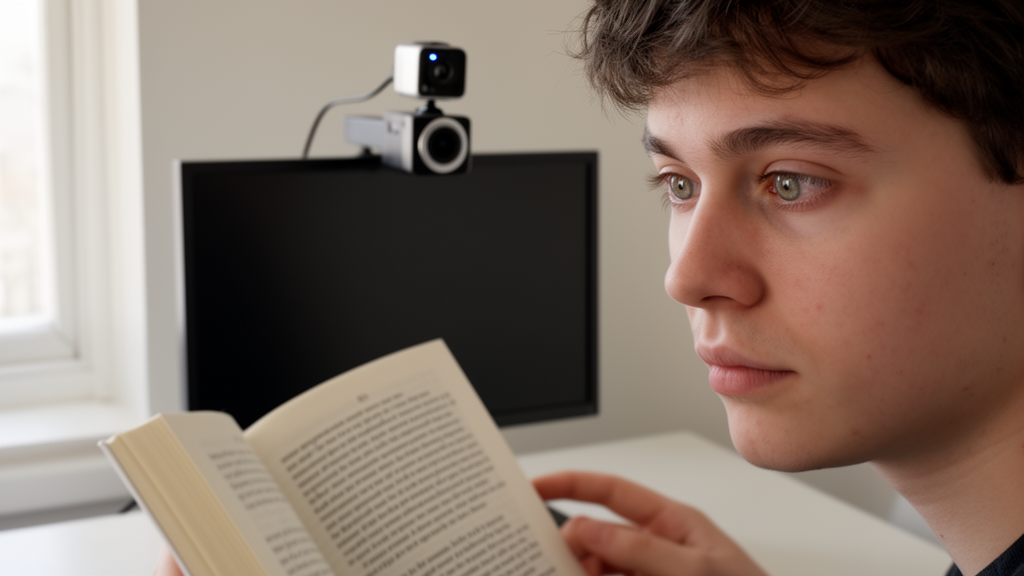
Webcams can reveal cognitively meaningful patterns in eye movement while people read, including the classic tendency to look longer at less familiar words, according to three experiments that paired webcam tracking with a laboratory eye tracker or recruited readers online. The results show that consumer-style cameras can support research on language processing, but the signals are noisier than those from high-precision eye trackers: they merge some short eye movements, produce longer detected fixations and measure word skipping less reliably. The study therefore positions webcam tracking as a scalable complement to laboratory equipment rather than a full replacement.
Researchers used the Labvanced platform to estimate gaze direction from video recorded by a Logitech StreamCam. In two controlled laboratory experiments, an EyeLink Portable Duo sampled eye position at 1,000 Hz while the webcam operated at an effective rate of about 57 Hz. Experiment 1 presented English sentences in multi-line and single-line formats; Experiment 2 replicated the approach in Spanish, using two-line sentences displayed on a laptop. The third experiment recruited 66 English-speaking participants through Prolific for completion at home with their own webcams, whose effective sampling rate averaged 25.66 Hz and ranged from 9.66 to 35.46 Hz.
The camera and EyeLink signals were strongly associated in the laboratory, confirming that the two systems generally followed the same gross movements. In Experiment 1, correlations between their raw gaze samples were r = 0.78 horizontally and r = 0.76 vertically for the multi-line corpus. For the single-line corpus, the corresponding values were r = 0.86 and r = 0.23, consistent with the limited vertical eye movement required by that task. The Spanish replication produced correlations of r = 0.83 horizontally and r = 0.92 vertically. These associations resemble earlier results from Kaduk et al., who obtained correlations of about 0.83 during free viewing.
Strong correlation did not mean that the devices agreed equally well in every respect. Bland–Altman analyses found little systematic horizontal bias, important because horizontal position helps determine which word receives a fixation, but the uncertainty around estimates remained substantial. Vertical coordinates were systematically distorted in the first experiment, and the webcam merged nearby samples more often than the EyeLink. The two-line laptop setup in Experiment 2 reduced average vertical error to 0.35 degrees of visual angle, compared with 3.50 degrees in Experiment 1, although error still varied widely. Horizontal error averaged 0.25 degrees in Experiment 1 and 0.10 degrees in Experiment 2.
Eye-movement algorithms also divided the signals differently. Webcam data contained fewer but longer detected fixations because small saccades could not reliably be distinguished from positional noise. In Experiment 2, the fixation-detection algorithm identified 15,192 fixations from webcam data but 20,265 from the EyeLink. At a 60 Hz sampling rate, a new position is recorded every 16.7 milliseconds, while reading saccades commonly last roughly 20–70 milliseconds and may be represented by only one to four samples. A short movement whose displacement resembles measurement noise can therefore be missed, causing adjacent fixations to be combined. These merged segments made webcam-derived first fixation durations, single fixation durations, gaze durations and total viewing times longer than the EyeLink estimates.
Despite these differences, the main reading effect appeared in the expected direction: less frequent words attracted longer fixations than more frequent words. Across the laboratory experiments, the categorical manipulation comparing high- and low-frequency target words produced credible effects on fixation-duration measures in the combined device data. Evidence from the webcam alone was weaker in Experiment 1, where credible intervals for the separate webcam estimates included zero, but it became credible in Experiment 2. The latter used more items and a two-line display. Importantly, a lack of an interaction between frequency and tracker did not itself prove a webcam effect; the researchers therefore estimated the low-versus-high contrast separately for each device.
Increasing the number of observations made webcam analysis more sensitive. Instead of examining only one manipulated target per sentence, the researchers fitted models using the continuous Zipf frequency of nearly every word in the corpora, excluding the first and last words of each sentence. More frequent words were then associated with shorter fixations and a greater probability of being skipped. In Experiment 1, this corpus-level analysis produced reliable frequency effects in the webcam data for all four fixation-duration measures. The same pattern held in Experiment 2. These findings suggest that averaging over many words can compensate partly for spatial noise, although differences in word length, predictability and context introduce additional variability.
The online experiment showed that the approach was not restricted to carefully controlled laboratory rooms. Participants achieved an average comprehension accuracy of 95.9%, indicating that they read for meaning despite the unusual layout. Low-frequency targets elicited longer first fixation, single fixation, gaze duration and total viewing time in the webcam data, with all relevant credible intervals excluding zero. A corpus analysis also detected the expected pattern across fixation measures and skipping probability. The online recordings were noisier than the laboratory data, but the results demonstrate that a large collection of observations can reveal robust cognitive effects despite varied cameras, lighting, postures, home environments and lower sampling rates.
Simulation-based planning indicated that detecting the target-word frequency effect in fixation duration with the online webcam data would require about 60 participants and 60 experimental items to reach 80% statistical power. Capturing an effect on word skipping was substantially harder: simulations suggested at least 130 participants and 130 items. Those estimates are specific to the tested effect and design rather than universal thresholds. The study did not test the method for every platform, reading material or outcome, and it focused on relatively large, established effects. Its multi-line and large-type displays also differ from natural prose, while the target word was kept away from line boundaries to reduce return-sweep confounding.
The practical boundary is temporal and spatial precision. Webcams are better suited to detecting broad differences between conditions, populations or repeated measures than to reconstructing every saccade or very short fixation. Cumulative measures such as gaze duration and total viewing time may be more robust than single-fixation measures, while skipping probabilities can be overestimated when small movements are missed. Lab lighting, a stable computer, a camera positioned near the top of the screen and limited head movement improved tracking in the reported setup, although the individual contribution of each factor was not tested systematically. The result is a low-cost method for studying robust reading effects at scale, with high-precision eye trackers remaining preferable for fine-grained spatial judgments, rapid saccades, gaze-contingent tasks and subtle temporal dynamics.
Subject of Research: Webcam-based eye tracking of word-frequency effects during sentence reading
Article Title: Webcams can be used to study eye movements during reading
Article References: Serrano-Carot, M., Angele, B., Xu, H., & Vasilev, M. R. (2026). Webcams can be used to study eye movements during reading. Behavior Research Methods, 58(12), Article 331. https://doi.org/10.3758/s13428-026-03199-3
Image Credits: AI Generated
DOI: 10.3758/s13428-026-03199-3
Keywords: webcam eye tracking, eye movements, sentence reading, word frequency, fixation duration, gaze position, online research, Labvanced, reading psychology, eye-tracking methods, Webcams, used
Cite Scienmag News
Glenn Wilkins. (October 22, 2026). Webcams Track Reading Effects, but Noisy Eyes Limit Precision. Scienmag. https://scienmag.com/webcams-track-reading-effects-but-noisy-eyes-limit-precision/
Glenn Wilkins. "Webcams Track Reading Effects, but Noisy Eyes Limit Precision." Scienmag, 22 October 2026, https://scienmag.com/webcams-track-reading-effects-but-noisy-eyes-limit-precision/. Accessed 22 October 2026.
Glenn Wilkins. "Webcams Track Reading Effects, but Noisy Eyes Limit Precision." Scienmag. October 22, 2026. https://scienmag.com/webcams-track-reading-effects-but-noisy-eyes-limit-precision/