Participants described receiving timely advice about adapter fit, leakage, protective products, appliance changes and when to seek medical care. They also reported feeling safer and more capable of managing stoma care at home. These findings represent the participants’ experiences and perceptions: because the study included no comparison group, they do not show that telenursing alone produced the reported benefits.
The research examined how people managed colostomy and ileostomy products and interpreted the remote support available to them. Interviews were conducted between 30 September and 30 October 2024 with adults who had received telenursing from one private healthcare provider. To be eligible, participants had to communicate in Turkish, be at least 15 days beyond surgery, have been discharged and reintegrated into daily life, and have an intestinal stoma.
They ranged from 18 to 77 years old, and five were men. Their appliances included flat and convex adapters and one-piece and two-piece systems. Telenursing was not tested as a stand-alone intervention in this study.
It was already included without an additional fee in the provider’s routine follow-up service for people using its stoma-care products. Researchers used criterion-based purposive sampling and arranged one audio-recorded, semistructured online interview with each participant. The interviews lasted approximately 20 to 30 minutes and used prompts intended to elicit detailed descriptions of situations, feelings and the meaning participants attached to their experiences.
All transcripts were transcribed verbatim. The interviews were analysed through conventional content analysis using MAXQDA 24. Meaning units were condensed and grouped into codes, which were then organised into categories and five overarching themes.
Saturation was reached at the sixth interview, when consecutive interviews produced no new codes or concepts; a seventh interview was conducted to confirm that assessment and likewise added no new concepts. The researchers also used member checking, independent review by two qualitative researchers, an audit trail of coding decisions and direct quotations to support the credibility and dependability of the analysis. Participants sought telenursing support for practical uncertainties that extended across the stoma-care process.
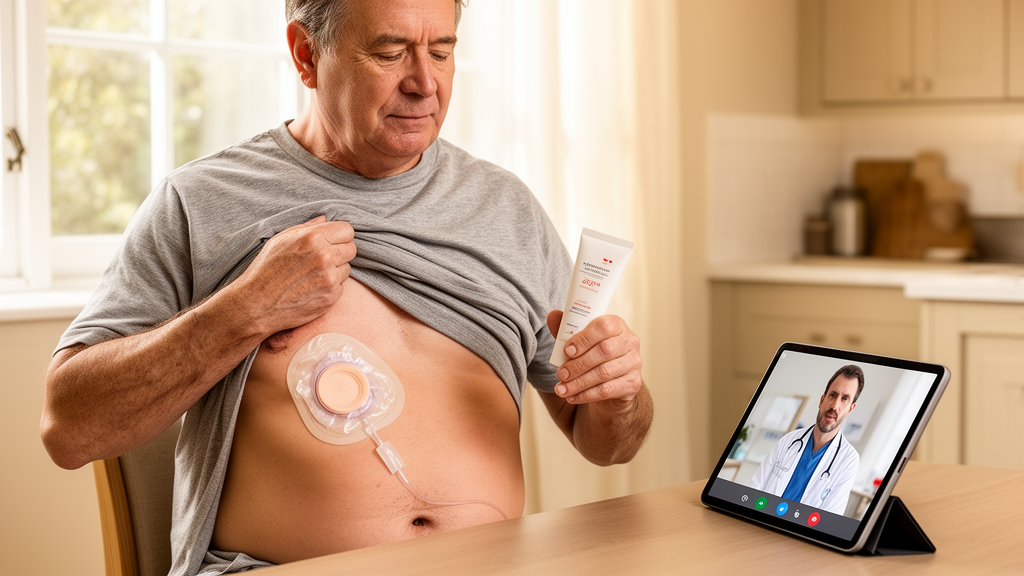
Questions concerned when to clean a stoma, how to respond to changes in output, how to apply paste and how to assess skin and wounds. A recurring technical issue was leakage associated with an adapter that did not fit properly. Some sent photographs during consultations, received suggestions for alternative equipment and adjusted their products accordingly.
One participant whose initially flat adapter produced constant leakage tried a dimpled adapter after remote advice and reported that the leakage stopped. Other participants associated product changes with less irritation or greater comfort. These were individual accounts, not controlled measurements of leakage or skin outcomes.
Skin protection and wound assessment were equally prominent. Patients asked how to use skin-protective pastes, powders and creams, and described sores, cracks, bleeding and open wounds around the stoma. Telenurses gave advice about product choice and application, reviewed photographs and recommended when a problem warranted assessment by a physician.
One participant said that a telenurse suggested a non-allergenic product after sores appeared, but the account did not establish whether the sores subsequently improved. Another reported that recommended creams helped with cracks and bleeding. A participant with an open wound described sending an image every two days and receiving feedback about whether the care was being performed correctly.
The recommendations received by telenursing extended beyond appliance selection. Participants sought guidance about bathing, nutrition, changing adapters, medication use and wound-care products. Some were unsure whether an appliance should be removed before showering, while others described uncertainty about what to eat after colostomy.
They valued detailed demonstrations of how to change an adapter, including which materials to use and how to apply them. Participants also reported receiving advice about creams, powders and medication, including instruction to consult a doctor when inflammation occurred. In their accounts, these tailored recommendations made routine care more manageable and increased their confidence in applying products correctly.
Participants attributed both emotional and practical effects to remote consultations. They described feeling safer, relieved and satisfied when a telenurse answered quickly or helped them decide how to respond to an unfamiliar problem. Several said that reliable information made it possible for them to manage an issue at home that they otherwise might have taken to a hospital.
One participant explained that receiving the right information made the situation easier, while another described phone support as comforting when they felt stuck or worried. Participants valued access to a known professional through messaging, including at weekends, and regarded the explanations as clear, detailed and technically competent. The counselling was perceived as effective because it was accessible, rapid and sufficiently comprehensive, but it operated within a wider support network.
Some participants continued to use one trusted telenurse and did not seek additional solutions. Others contacted product companies, asked physicians for information or searched online, then used the nurse to verify what they had found. Physicians were approached for issues perceived as urgent, while the telenurse remained their main source of technical stoma-care guidance.
The interviews therefore portray remote nursing as a trusted reference point within, rather than a replacement for, the broader healthcare system. Several limitations restrict the findings. All participants came from one private provider, limiting geographical and institutional diversity, although qualitative studies are not designed to produce statistical generalisations.
The interviews drew on retrospective accounts, which may be influenced by recall and by participants’ current adaptation to stoma care. Telenursing was embedded within a broader package of routine care, so the positive experiences cannot be separated from the effects of clinical treatment, earlier education, product design or other support. The interviewer had previously provided telenursing to the participants, creating a risk of socially desirable answers despite separate research appointments and assurances about confidentiality and uninterrupted care.
Interpretive bias also remained possible because coding and preliminary analysis involved a limited number of researchers. The study identifies areas for further evaluation rather than proving clinical efficacy. Participants’ experiences point to repeated product-use education after discharge, review of adapter fit and leakage, skin assessment, clear escalation criteria, secure procedures for sharing images and dependable response times.
The authors also note structural obstacles to wider telehealth use, including limited familiarity with digital tools among some older adults, internet connectivity problems, data-security concerns and incomplete legal standardisation of telehealth in Türkiye. Larger studies involving multiple regions and care organisations, as well as comparisons between service models, would be needed to determine whether telenursing can measurably affect complication rates, quality of life and sustained self-care. For now, the study provides a detailed account of how seven stoma patients used remote advice to navigate product uncertainty, skin problems and everyday complications.
Subject of Research: Patient experiences of stoma product management and telenursing support
Article Title: Product Management Experiences of Patients With a Stoma Receiving Telenursing Services
Article References: Korkmaz, E., Akkaya, G., Can, K., Taylan, S., & Eti Aslan, F. (2026). Product Management Experiences of Patients With a Stoma Receiving Telenursing Services. Nursing Open, 13(10), Article e70755. https://doi.org/10.1002/nop2.70755
Image Credits: AI Generated
DOI: 10.1002/nop2.70755
Keywords: telenursing, stoma care, colostomy, ileostomy, ostomy products, peristomal skin, wound care, digital health, qualitative research, Product, Management, Experiences
Cite Scienmag News
Ophelia Keating. (October 22, 2026). Stoma patients describe telehealth benefits for product and skin care. Scienmag. https://scienmag.com/stoma-patients-describe-telehealth-benefits-for-product-and-skin-care/
Ophelia Keating. "Stoma patients describe telehealth benefits for product and skin care." Scienmag, 22 October 2026, https://scienmag.com/stoma-patients-describe-telehealth-benefits-for-product-and-skin-care/. Accessed 22 October 2026.
Ophelia Keating. "Stoma patients describe telehealth benefits for product and skin care." Scienmag. October 22, 2026. https://scienmag.com/stoma-patients-describe-telehealth-benefits-for-product-and-skin-care/