

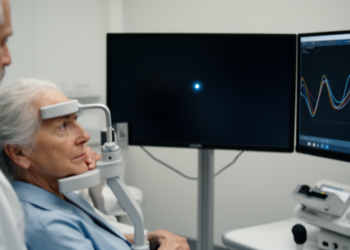
Eye movement test may flag cognitive impairment in small vessel disease
A prospective study of 135 cerebral small vessel disease patients links a higher anti-saccade uncorrected error rate to cognitive impairment.
A prospective study of 135 cerebral small vessel disease patients links a higher anti-saccade uncorrected error rate to cognitive impairment.
An immersive virtual driving study of 284 people shows that eye, head, steering and vehicle movements compress onto fewer effective ...

Three experiments found that webcams can detect word-frequency effects during reading, although noisier tracking and merged fixations make them a ...
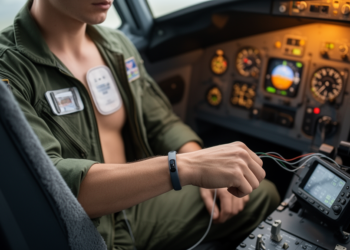
The first synchronized multimodal wearable dataset collected during real general-aviation flight shows heart rate and eye movements genuinely track pilot ...
A new analysis in Frontiers in Cognition evaluates whether predictive coding, a leading theory of perception, can explain how the ...

An eyetracking study of 118 students shows people generally avoid looking at spiders when other arthropods are present, yet their ...
New research shows that spontaneous eye movement sequences mirror the hidden structure of working memory and shift to replay-like patterns ...
A new flanker study of Dutch–English bilinguals shows that language membership information is extracted across multiple words only in a ...

Tracking 100 viewers across 100 real-world scenes, researchers show that distinct semantic features guide eye movements on separate, shifting time ...

New experiments show that the brain can suppress unique-but-unknown distractors based on second-order salience, with low-salience singletons suppressed more strongly ...


Embark on a thrilling journey of discovery with Scienmag.com—your ultimate source for cutting-edge breakthroughs. Immerse yourself in a world where curiosity knows no limits and tomorrow’s possibilities become today’s reality!