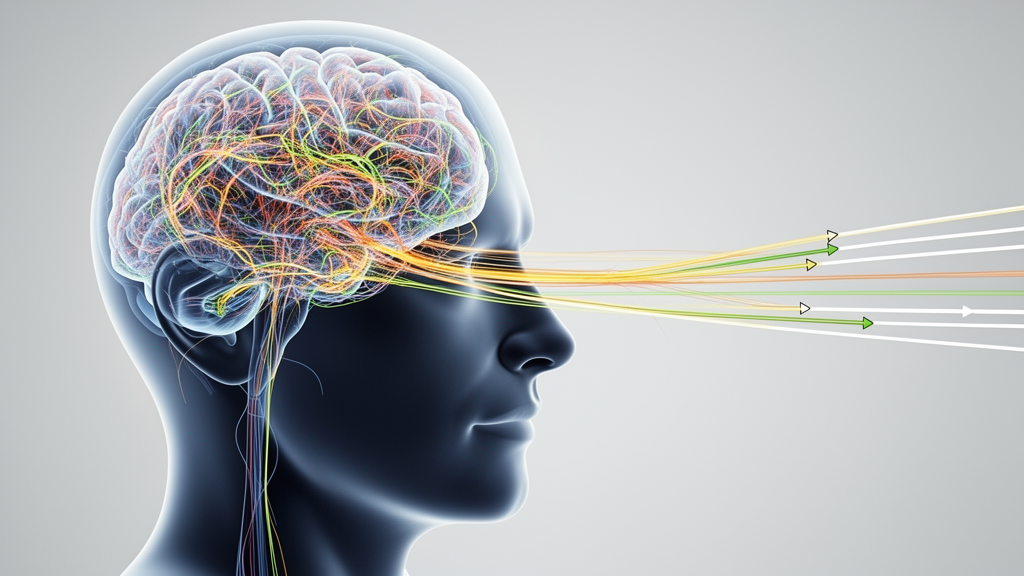
When drivers approach a hazard on the road, their behavior does not become more complex — it becomes simpler, according to a new study of 284 people navigating an immersive virtual drive. Researchers found that the combined movements of the eyes, head, steering wheel and vehicle heading, which together span a high-dimensional behavioral space, reliably collapse onto fewer effective dimensions around critical events, signaling tighter coordination between perception and action precisely when it matters most.
The team, led by John Madrid-Carvajal, Shadi Derakhshan and Peter König, recreated ten hazardous on-road events in a virtual driving simulator. Participants were assigned either to drive manually or to ride in an automated mode, and their eye, head and vehicle movements were recorded throughout. Using principal component analysis across all participants, the researchers built a common, time-resolved behavioral state space — a shared low-dimensional map of visuomotor coordination that captures strategies generalizing across drivers.
Throughout the entire drive, just a few components accounted for most of the variance in behavior. But the study’s key finding concerned how this dimensionality changed over time. Using cosine similarity and several measures of effective dimensionality, the researchers showed that the behavioral state reliably compressed around hazardous events. During these periods of low effective dimensionality, the relative contributions of eye movements, head movements, steering and vehicle heading reorganized toward the leading dimensions in a task-dependent manner, suggesting that the visuomotor system flexibly reallocates its degrees of freedom according to contextual demands.
The compression also carried information about the driving mode. Discriminant analysis revealed that during reorganization, behaviors became more distinct between manual and automated conditions, to the point that the first two components alone were sufficient to classify which driving condition a participant was in. Between-subject similarity across events was partially stable overall, and notably stronger among manual drivers, hinting that active control imposes a more stereotyped coordination pattern than passive travel in an automated vehicle.
The findings support the idea that naturalistic behavior is generated through patterns within a low-dimensional structure, extending evidence from laboratory tasks to the unconstrained, real-world-like setting of driving. Because the same low-dimensional framework links naturally to neural manifold research, human driver modeling and the design of adaptive automated vehicles, the authors propose it as a principled behavioral bridge between neuroscience and automotive engineering. As automated driving systems become more common, understanding how human visuomotor coordination reshapes itself around hazards — and how it differs when the driver is out of the loop — could inform vehicles that monitor and adapt to the behavioral state of the person behind the wheel. The study, based on a virtual simulation, establishes a behavioral framework whose links to neural activity and real-road performance remain to be tested in future work.
Subject of Research: Low-dimensional visuomotor coordination in naturalistic driving behavior
Article Title: Visuomotor coordination on the road: Low-dimensional representations reveal adaptive, context-dependent reductions in the dimensionality of natural driving behavior
Article References: Madrid-Carvajal, J., Derakhshan, S., & König, P. (2026). Visuomotor coordination on the road: Low-dimensional representations reveal adaptive, context-dependent reductions in the dimensionality of natural driving behavior. PLOS Computational Biology, 22(10), e1014056. https://doi.org/10.1371/journal.pcbi.1014056
Image Credits: AI Generated
DOI: 10.1371/journal.pcbi.1014056
Keywords: driving behavior, visuomotor coordination, principal component analysis, effective dimensionality, virtual reality, hazard perception, automated vehicles, eye movements, steering, neural manifolds, driver modeling, perception-action
Cite Scienmag News
Drew Townsend. (October 23, 2026). Drivers’ Brains Simplify: Eye, Head and Steering Movements Collapse Onto Few Dimensions at Hazardous Moments. Scienmag. https://scienmag.com/drivers-brains-simplify-eye-head-and-steering-movements-collapse-onto-few-dimensions-at-hazardous-moments/
Drew Townsend. "Drivers’ Brains Simplify: Eye, Head and Steering Movements Collapse Onto Few Dimensions at Hazardous Moments." Scienmag, 23 October 2026, https://scienmag.com/drivers-brains-simplify-eye-head-and-steering-movements-collapse-onto-few-dimensions-at-hazardous-moments/. Accessed 23 October 2026.
Drew Townsend. "Drivers’ Brains Simplify: Eye, Head and Steering Movements Collapse Onto Few Dimensions at Hazardous Moments." Scienmag. October 23, 2026. https://scienmag.com/drivers-brains-simplify-eye-head-and-steering-movements-collapse-onto-few-dimensions-at-hazardous-moments/