


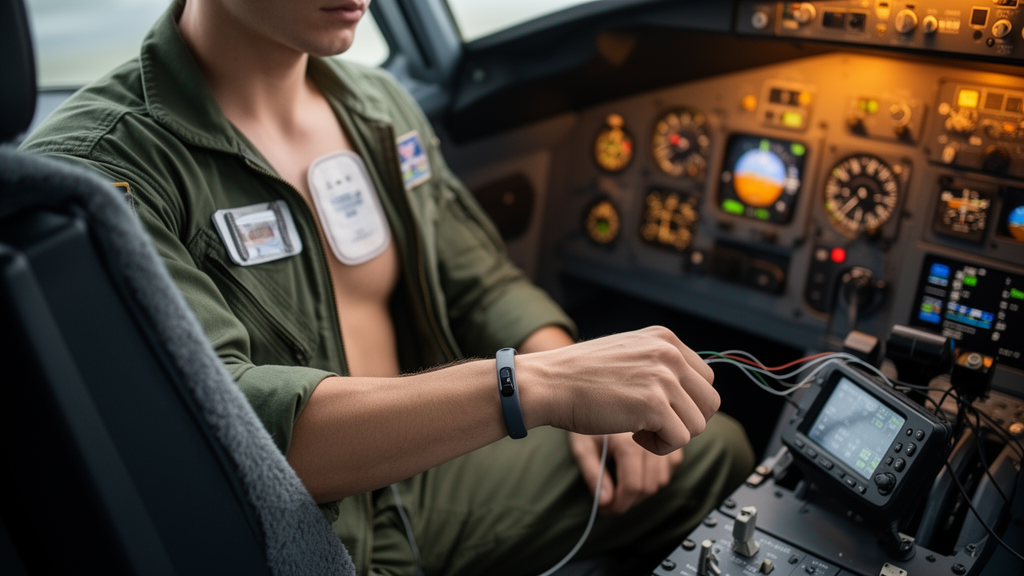
Forty pilots flew five standardized maneuvers in a real Cessna 172 while consumer-grade wearables recorded their brain activity, heart rhythm, skin sweat, eye movements, body temperature, and the aircraft’s own flight dynamics. The result, published in Frontiers in Neuroergonomics, is the first synchronized multimodal wearable dataset ever collected during real general-aviation flight for research, and it delivers a finding that is as sobering as it is useful: the signals are clean enough to trust, they genuinely track pilot stress within individuals, but they do not yet transfer from one pilot to another.
The study, led by Rongbing Xu and colleagues at the University of Waterloo’s Waterloo Institute for Sustainable Aeronautics, set out to answer a question that has haunted field neuroergonomics for decades. Cognitive states such as mental workload, stress, and situation awareness matter most in operational settings like cockpits, yet they are almost always measured in laboratories or simulators where conditions can be controlled. Research-grade instrumentation has been too cumbersome to deploy during real flight, which is why only a handful of studies have ever recorded neural signals in an operating aircraft. Consumer wearables promise to change that, but feasibility is not the same as validity. A device can produce a clean, physiologically plausible recording that still fails to index the cognitive construct a study cares about, because the signal is dominated by motion, posture, or the structure of the task itself rather than by cognitive state.
To disentangle signal from construct, the team assembled three nested tiers of evidence drawn from classical construct validity. The first tier, known-groups sensitivity, asked whether the maneuvers and rating instruments produced structured variation in the outcome labels rather than noise. The second tier, convergent evidence, asked whether sensor features tracked self-reported state within pilots, where between-person differences are statistically removed. The third tier, criterion-related association, asked whether features explained instructor-rated performance after adjusting for both the pilot and the maneuver. Finally, the researchers tested prediction directly in held-out pilots, a deliberately stricter target than within-sample association.
The pilots, recruited from two Ontario flight training organizations, ranged in age from 18 to 78 with median logged flight hours of 155. Each flew a seated ground Baseline before engine start, followed by Normal Takeoff, a 45-degree-bank Steep Turn, a Power-on Stall with entry and recovery, and Normal Landing, accompanied by a certified flight instructor. Five consumer devices recorded simultaneously: a Muse S headband providing four-channel dry-electrode EEG from frontal and temporal sites, a Polar H10 chest strap capturing beat-to-beat cardiac intervals, an Embrace Plus wristband recording electrodermal activity at 4 Hz and skin temperature, Pupil Labs Neon glasses tracking binocular gaze at 200 Hz, and a Sentry Plus logging GPS-derived flight dynamics including ground speed, bank, pitch, and g-load.
Signal quality, the precondition for everything that followed, proved adequate across the board. Trial-level availability ranged from 85 percent for EEG to 97 percent for electrodermal activity and temperature, with complete data across all nine modality streams present in 67 percent of trials. Frontal EEG channels held good contact 94 to 96 percent of the time, while temporal channels fared much worse at 62 to 73 percent, which is why the analyses relied on frontal sites. Cardiac quality was high, with a beat-level signal-quality index of 0.996 and an outlier rate of just 0.20 percent. Eye tracking showed a 99.9 percent worn-rate at 195 Hz effective sampling, and all eight physiological-plausibility checks passed at the sample-mean level.
Self-reported stress rose from the ground Baseline through the more demanding maneuvers, with a Kruskal-Wallis statistic of 61.1 and an effect size of 0.29. Instructor-rated technical performance, workload management, and problem-solving also differed across maneuvers. But the researchers are careful about what this tier can establish. Because the maneuvers were flown in a largely fixed order, maneuver identity moves together with elapsed flight time, accumulating fatigue, the physical dynamics of the aircraft, and the settling of sensors on the body. Any of these can produce graded variation in a physiological signal without cognitive demand playing a part, so the known-groups result shows that the outcome labels carry systematic structure but cannot show that any signal is specific to stress.
Removing between-pilot differences revealed the study’s strongest finding: within-person convergence between cardiac and oculomotor activity and self-reported stress. Mean heart rate tracked stress most strongly among the physiological channels, with a repeated-measures correlation of 0.57 and a 95 percent confidence interval from 0.44 to 0.67. Saccade and fixation rates followed at 0.39 each. Phasic electrodermal variability carried stress-related information that the tonic level did not, and frontal theta band power was the only EEG feature to reach significance at this tier. Flight-dynamics features were among the strongest correlates overall, which the researchers flag as a caution: more demanding maneuvers are also more physically dynamic, so part of what the physiology tracks is the intensity of the maneuver rather than cognitive state alone.
The criterion tier, which adjusted for both pilot and maneuver, separated cleanly under corrected inference. Kinematic and electrodermal associations held: g-load variability related to self-reported workload, ground speed related to workload and to non-technical performance, and skin-conductance response rate related negatively to non-technical performance. But every frontal theta/alpha association proved to rest on individual pilots and did not survive. The ratio was heavy-tailed in this recording setting, with a skewness of 8.8 and its largest value 156 times the median, and deleting the single pilot who contributed its extreme values moved one coefficient from 0.18 to 2.56. The conventional cluster-robust variance, the researchers found, is badly biased when clusters are as small as these, roughly four observations per pilot, and they recommend that field studies with similar structure avoid the conventional estimator entirely.
The deployment-relevant result came from cross-pilot generalization. In grouped cross-validation where no pilot appeared in both training and test folds, adding the sensor panel did not exceed a maneuver-only baseline for any outcome. For stress classification, area under the curve actually fell from 0.75 with maneuver indicators alone to 0.66 with sensors added, and the regression models drove cross-validated R-squared below zero. Yet when a pilot’s own trials were allowed into the training set, the same sensor panel recovered meaningful performance, with stress classification returning to 0.68 and cross-validated regression R-squared for stress rising from negative 0.56 to positive 0.07. The researchers read this as state-relevant information that is real but entangled with stable individual differences: usable once a model has seen the pilot, and not yet transferable to a new pilot without calibration.
The implications reach beyond aviation. For neuroergonomics, the study offers a template for field measurement: verify signal quality as a precondition, build construct-relevant evidence in nested tiers, subject each tier to inference that suits the cluster structure actually available, weigh results across modalities, and test generalization explicitly. The last two steps did real work here, since they removed a finding the team had been prepared to report. For aviation training specifically, the within-person sensitivity of low-cost cardiac and oculomotor measures means physiological indicators may eventually complement instructor judgment during ordinary training, where ratings are observational and retrospective. A minimal cardiac-plus-eye configuration is the starting point the present evidence supports, and any such use would need reference measures stronger than the single-item self-reports and single-rater scores available here before it could be evaluated properly. The researchers conclude that low-cost cardiac and oculomotor channels are the most promising basis for within-person stress monitoring, while pilot-general prediction will require individual calibration, stronger reference measures, and larger samples.
Subject of Research: A field study of 40 pilots flying real Cessna 172 maneuvers with consumer wearables found that cardiac and oculomotor signals track stress within pilots but fail cross-pilot prediction, mapping the current boundary of construct-relevant cockpit sensing.
Article Title: From signal to construct evidence: multimodal consumer-wearable sensing in real general-aviation flight
Article References: Xu, R., Cao, S., Barnett-Cowan, M., Bulbul, G., Kearns, S., & Niechwiej-Szwedo, E. (2026). From signal to construct evidence: multimodal consumer-wearable sensing in real general-aviation flight. Frontiers in Neuroergonomics, 7, Article 1911259. https://doi.org/10.3389/fnrgo.2026.1911259
Image Credits: AI Generated
DOI: 10.3389/fnrgo.2026.1911259
Keywords: wearable sensors, general aviation, pilot stress, neuroergonomics, construct validity, EEG, heart rate, eye movements, electrodermal activity, cross-pilot prediction, Cessna 172, flight training
Cite Scienmag News
Ophelia Keating. (October 17, 2026). Wearable Sensors in Real Cockpits Reveal How Far Pilot Stress Monitoring Can Actually Go. Scienmag. https://scienmag.com/wearable-sensors-in-real-cockpits-reveal-how-far-pilot-stress-monitoring-can-actually-go/
Ophelia Keating. "Wearable Sensors in Real Cockpits Reveal How Far Pilot Stress Monitoring Can Actually Go." Scienmag, 17 October 2026, https://scienmag.com/wearable-sensors-in-real-cockpits-reveal-how-far-pilot-stress-monitoring-can-actually-go/. Accessed 17 October 2026.
Ophelia Keating. "Wearable Sensors in Real Cockpits Reveal How Far Pilot Stress Monitoring Can Actually Go." Scienmag. October 17, 2026. https://scienmag.com/wearable-sensors-in-real-cockpits-reveal-how-far-pilot-stress-monitoring-can-actually-go/


