


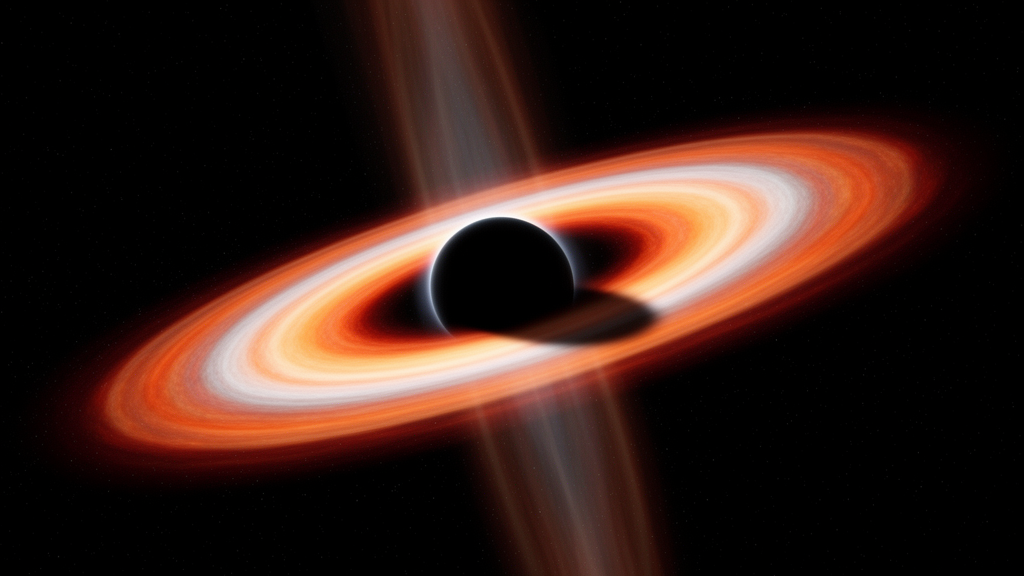
A multiwavelength study of a fading black hole X-ray binary found that its inner accretion disk appeared vertically extended even when the system reached a peak luminosity of approximately 0.2 times the Eddington limit. The reported observations indicate that this elevated inner structure shielded the outer disk from high-energy radiation produced close to the black hole. The result, supported by contemporaneous X-ray spectra, suggests that self-shadowing accretion geometry can emerge well below the Eddington limit and can strongly affect what telescopes detect during a bright outburst.
The key evidence came from optical and near-infrared spectroscopy acquired as the outburst declined. At its peak, the spectrum was relatively cool and dominated by strong recombination lines from hydrogen and neutral helium, or He I. As the luminosity decreased, the spectrum switched to a hotter, highly irradiated and nearly featureless form. This spectral reversal was interpreted as evidence that a vertically extended inner disk was shielding the outer regions when the source was brightest. Under that configuration, radiation generated near the black hole was intercepted by the raised inner flow before it could illuminate the outer disk directly, allowing the comparatively cool outer material to produce prominent recombination lines.
The change in appearance was also examined through the evolution of the H-alpha line profile with orbital period and luminosity. A schematic view developed for the observations connects the changing line formation with the evolving disk structure. The authors interpret the progression as a transition between two spectral regimes rather than a simple change in overall brightness: a cool, line-rich state at the outburst peak and a hot, strongly irradiated, nearly featureless state during the subsequent decay. Contemporaneous X-ray spectra supported the self-shadowing scenario. The combined measurements therefore point to a three-dimensional inner accretion flow whose geometry controlled the illumination of the disk’s outer regions, although the observations do not by themselves establish how common that geometry is among all black hole binaries.
Comparisons with similar systems suggest that self-shadowing structures at luminosities below the Eddington limit may be common, but the reported result remains an observation of a particular fading X-ray binary rather than a universal survey of black holes. The study is nevertheless significant because disk geometry can shape several measurements used to investigate active black holes. A shadowing inner structure may influence inferred black hole spins, X-ray polarization measurements and the physical conditions of the outer disk and its associated outflows. The findings also place observational boundaries on the transition away from the standard thin-disk solution: instead of appearing only as luminosity approaches the Eddington limit, a vertically extended inner region may already affect the spectrum at about 0.2 times that limit. In this case, that effect was strong enough to reverse the optical and near-infrared spectral character of the source as its outburst faded, providing a multiwavelength view of an accretion flow whose visible structure did not simply scale with its declining luminosity.
Subject of Research: Self-shadowing inner accretion-disk structure in a fading black hole X-ray binary
Article Title: A self-shadowing black hole accretion disk at sub-Eddington luminosities
Article References: Armas Padilla, M., Muñoz-Darias, T., Sánchez-Sierras, J., Shidatsu, M., Mata Sánchez, D., Cúneo, V. A., Saavedra, E. A., Ambrifi, A., Baglio, M. C., Casares, J., Corral-Santana, J. M., Fender, R. P., Fernández-Ontiveros, J. A., Ponti, G., Russell, D. M., Torres, M. A. P., Ueda, Y., Vincentelli, F. M., & Yanes-Rizo, I. (2026). A self-shadowing black hole accretion disk at sub-Eddington luminosities. Nature Astronomy. https://doi.org/10.1038/s41550-026-03005-2
Image Credits: AI Generated
DOI: 10.1038/s41550-026-03005-2
Keywords: black holes, accretion disks, X-ray binaries, Eddington limit, spectroscopy, self-shadowing, outburst decay, near-infrared astronomy, X-ray astronomy, black, hole, accretion
Cite Scienmag News
Grant Pearson. (October 22, 2026). A self-shadowing black hole accretion disk at sub-Eddington luminosities. Scienmag. https://scienmag.com/a-self-shadowing-black-hole-accretion-disk-at-sub-eddington-luminosities/
Grant Pearson. "A self-shadowing black hole accretion disk at sub-Eddington luminosities." Scienmag, 22 October 2026, https://scienmag.com/a-self-shadowing-black-hole-accretion-disk-at-sub-eddington-luminosities/. Accessed 22 October 2026.
Grant Pearson. "A self-shadowing black hole accretion disk at sub-Eddington luminosities." Scienmag. October 22, 2026. https://scienmag.com/a-self-shadowing-black-hole-accretion-disk-at-sub-eddington-luminosities/


