


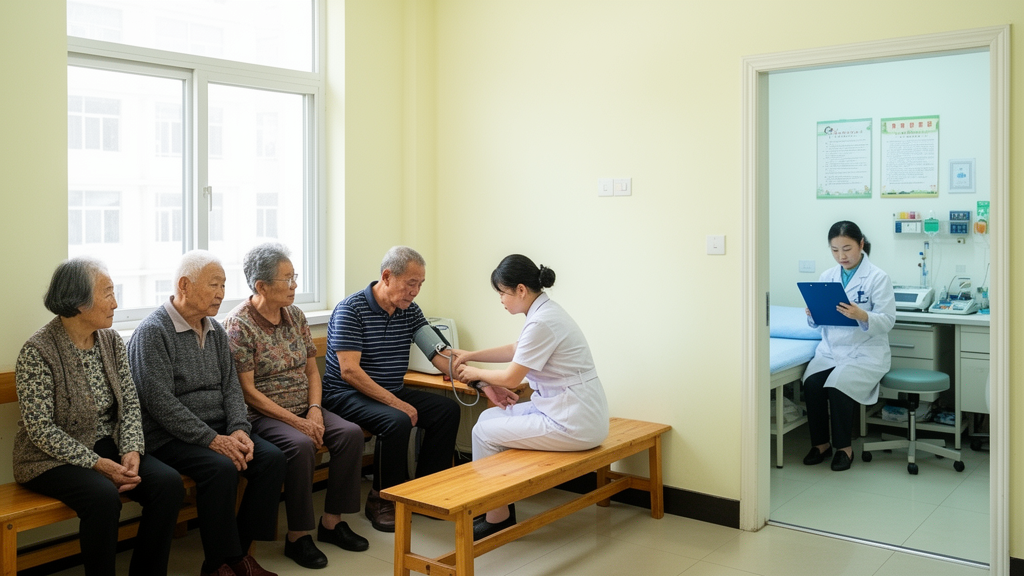
A longitudinal analysis of older adults in China found that free health check-ups were associated with smaller socioeconomic inequalities in hospital admissions and inpatient expenditure, while self-paid check-ups were associated with higher healthcare utilization and medical spending. The researchers divided participants into three groups: those who had received no health check-up, those who had received a free health check-up and those who had obtained a self-paid examination. Overall, 52.8% of participants took part in a check-up, including 27.86% who received a free examination and 24.94% who paid for one themselves.
The investigators used two-way fixed-effects models to assess associations between check-up type and healthcare utilization while accounting for stable, time-invariant individual characteristics. Compared with participants who had not received a check-up, those in the self-paid group had a significantly higher probability of hospital admission and higher medical expenditure. Free health check-ups showed no consistent association with greater overall healthcare utilization.
Their clearest association was with inequality in inpatient outcomes. The pro-rich concentration index for annual hospital admissions was 0.07 lower in the free check-up group than in the no-check-up group, with a P value of 0.018. The difference in annual inpatient expenditure was 0.06, with a P value of 0.026.
The free check-up group also had a lower pro-rich inequality index than the self-paid group for annual hospital admissions, by 0.10 (P = 0.003), and for annual inpatient expenditure, by 0.07 (P = 0.013). The study did not define the term “pro-rich” in the supplied research summary, so the inequality measures should not be interpreted more specifically than the reported concentration-index comparisons allow. The authors additionally applied Recentered Influence Function regression decomposition, including an Oaxaca decomposition, to identify factors correlating with differences in inequality between check-up groups.
The factors accounting for those differences varied across pairwise comparisons, indicating that the statistical sources of inequality were not uniform across the three check-up categories or across the measured outcomes. Because the analysis was observational, its findings describe associations rather than causal effects. The fixed-effects approach reduced the influence of persistent individual differences, but the design could not rule out every source of confounding.
The results also apply to the older-adult population and setting covered by the CHARLS survey rather than establishing the effects of free or self-paid check-ups in other populations. The study did not show that free examinations reduced total hospitalization or spending, nor did it show that self-paid examinations caused greater use. Instead, it separated two related findings: self-paid check-ups were associated with more utilization and expenditure, while free check-ups were associated with smaller measured inequalities in selected inpatient outcomes.
The researchers argued that policy should go beyond expanding check-up coverage by strengthening follow-up, referral support and financial protection. Its central result is that the type of check-up was linked to different patterns of healthcare utilization and inequality: self-paid participation accompanied higher utilization and medical expenditure, whereas free participation did not consistently increase overall utilization and was associated with lower pro-rich inequality in hospital admissions and inpatient expenditure among older Chinese adults.
Subject of Research: Health check-up type, healthcare utilization and inequality among older adults in China
Article Title: Associations of different health check-up types with healthcare utilization and its inequalities among older adults in China: evidence from a nationally representative survey
Article References: Qian, Y., Liu, Y., Zhu, R., Wang, G., & Wang, Z. (2026). Associations of different health check-up types with healthcare utilization and its inequalities among older adults in China: evidence from a nationally representative survey. International Journal for Equity in Health. https://doi.org/10.1186/s12939-026-03086-5
Image Credits: AI Generated
DOI: 10.1186/s12939-026-03086-5
Keywords: health check-ups, older adults, healthcare utilization, health inequality, hospital admissions, inpatient expenditure, CHARLS, free screening, self-paid care, China, Associations, different
Cite Scienmag News
Courtney Benton. (October 22, 2026). Free check-ups linked to smaller inpatient inequality among older Chinese adults. Scienmag. https://scienmag.com/free-check-ups-linked-to-smaller-inpatient-inequality-among-older-chinese-adults/
Courtney Benton. "Free check-ups linked to smaller inpatient inequality among older Chinese adults." Scienmag, 22 October 2026, https://scienmag.com/free-check-ups-linked-to-smaller-inpatient-inequality-among-older-chinese-adults/. Accessed 22 October 2026.
Courtney Benton. "Free check-ups linked to smaller inpatient inequality among older Chinese adults." Scienmag. October 22, 2026. https://scienmag.com/free-check-ups-linked-to-smaller-inpatient-inequality-among-older-chinese-adults/


