


A 24-year field study at Tatoosh Island in Washington state found that declining seawater pH coincided with reduced dissolved silicon availability and a steep fall in surface-water phytoplankton chlorophyll. In the productive coastal ecosystem, annual pH declined by 0.027 units per year, faster than predicted from equilibrium with rising atmospheric carbon dioxide. Over the same period, the molar ratio of soluble silicon to dissolved inorganic nitrogen fell by 56%, while measured chlorophyll a declined by 92%. The results provide ecosystem-scale evidence consistent with a mechanism previously observed in laboratory and mesocosm experiments: lower pH may slow the dissolution and recycling of silica, allowing more silicon to remain in sinking particles rather than returning to surface waters in a form that diatoms can use.
Diatoms are photosynthetic algae that construct glass-like structures called frustules from dissolved silicon. They are estimated to generate about 40% of global oceanic primary production and support numerous consumers throughout marine food webs. Silicon therefore has a distinct role alongside nitrogen, phosphorus and other nutrients. As soluble silicon becomes scarce relative to nitrogen, diatoms must spend more energy acquiring it and maintaining elemental balance, potentially diverting resources from growth and reproduction. Global models have projected that ocean acidification could reduce diatom production through losses of biologically available silicon in surface waters, but much of the previous evidence came from controlled experiments, mesocosms or models rather than continuous observations of a natural coastal ecosystem.
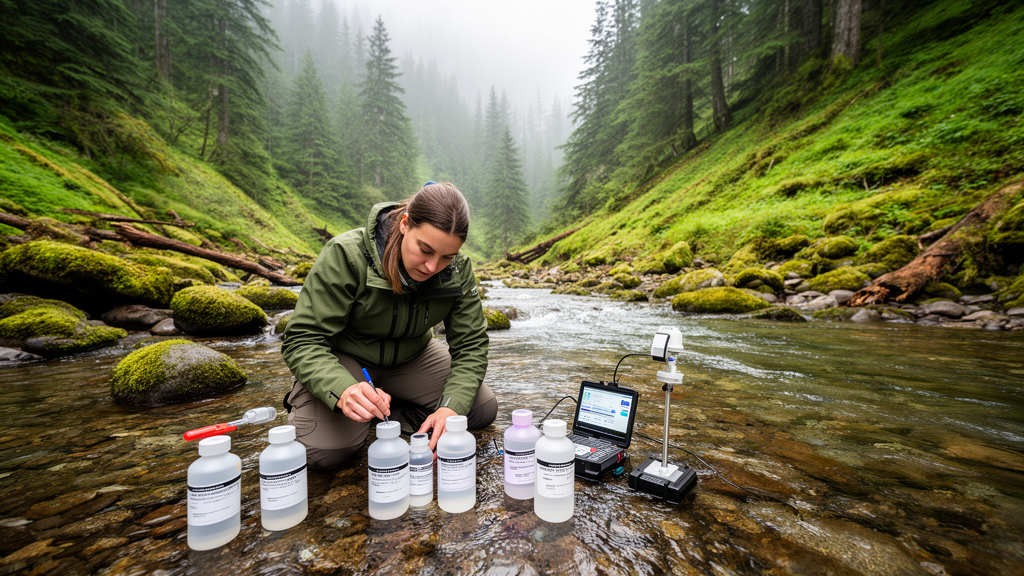
The research combined monthly water sampling with autonomous measurements of temperature, salinity, pH, dissolved oxygen and chlorophyll fluorescence. Nutrient records began in 1998, while automated instruments began operating in 2000 and were later supplemented by a solid-state pH sensor. Nutrient samples were collected around and offshore from the island, generally during the April-to-September growing season, and analyzed for nitrate, nitrite, ammonium, phosphate and silicic acid. The main pH trend was based on 21 annual averages derived from 77,891 measurements; the silicon-to-nitrogen analysis used 24 annual averages derived from 1,364 nutrient measurements; and the chlorophyll trend used 22 annual averages based on 80,195 fluorescence measurements. Researchers analyzed annual means because variables were not always sampled simultaneously, frequent measurements within seasons could be non-independent, and silica dissolution was expected to integrate conditions over longer periods. Regressions using individual observations produced the same statistical conclusions.
Across the record, the logarithmic ratio of soluble silicon to dissolved inorganic nitrogen declined from an average molar ratio of 0.28 to 0.13. Dissolved inorganic nitrogen was the sum of nitrate, nitrite and ammonium. Surface chlorophyll a fell from 65.4 to 5.3 milligrams per litre. As pH declined, the silicon-to-nitrogen ratio decreased; as that ratio declined, chlorophyll a also decreased. The statistical relationships were significant, with the pH-to-silicon ratio association explaining 41.7% of the variation and the silicon-ratio-to-chlorophyll association explaining 45.5%. These are associations within one coastal time series, rather than direct experimental measurements of acidification causing the entire productivity decline, but their joint direction matches the predicted silicon-loss pattern.
The researchers tested several alternative processes that might account for the trends. Surface salinity fell by 0.89 parts per thousand, but the silicon-to-nitrogen ratio was not significantly associated with salinity. The Bakun coastal upwelling index for the region showed no statistically supported decline. Average annual discharge from the Calawah and Hoko rivers showed no significant time trend and was not significantly related to the silicon-to-nitrogen ratio. Dissolved inorganic nitrogen and phosphate also showed no consistent long-term changes, and neither was significantly associated with chlorophyll. Time-varying mixing models indicated that changing contributions from deep ocean water, precipitation and local rivers could not readily explain the silicon trend. A model allowing an additional deep-water source depleted of silicon fitted substantially better than one assuming a constant dissolved-silicon concentration in deep source water, supporting an increasing contribution from silicon-poor water.
More extensive controls did not eliminate the central relationships. After the researchers statistically removed the effects of upwelling, salinity and river discharge, the decline in the silicon-to-nitrogen ratio remained significant, as did its positive association with log-transformed chlorophyll. Piecewise structural equation modeling attributed most annual variation in the silicon-to-nitrogen ratio to pH rather than to those measured transport variables. A model run at the scale of individual nutrient samples produced a similar pattern but gave greater relative weight to upwelling and salinity, indicating that the prominence of pH was strongest in the annual analysis. The study also tested a direct pH effect on chlorophyll beyond the silicon pathway; adding that term provided minimal additional explanatory power, with a P value of 0.824. The field observations therefore align more closely with loss and recycling of silicon than with a simple direct pH effect on measured chlorophyll.
The silicon-loss hypothesis proposes that lower pH slows the dissolution of silica in seawater. Under those conditions, biogenic silica in diatom frustules may remain in solid form or be exported more efficiently from surface waters instead of dissolving into biologically accessible soluble silicon. Another proposed mechanism holds that declining pH changes the balance between ionized silicate and non-ionized silicic acid, making silicon harder for diatoms to acquire. That mechanism would predict falling diatom abundance but stable or even increasing non-ionized dissolved silicon. Instead, total soluble silicon declined alongside chlorophyll. Near a silicon-to-nitrogen ratio of one, diatoms are reported to begin actively pumping silicate at high energetic cost to maintain elemental balance, which may limit resources available for reproduction. Although the field study cannot directly visualize the fate of individual silica particles, the measured pattern is more compatible with reduced recycling than with a change in chemical form alone.
The food web may help explain why the 92% decline in chlorophyll was much larger than the 56% decline in the silicon-to-nitrogen ratio. One proposed mechanism combines weaker bottom-up resource control with altered predator control. Reduced diatom production could leave less food for grazers such as zooplankton, allowing grazing pressure on the remaining phytoplankton to increase. At the same time, fewer diatoms would take up silicon, partly muting the nutrient decline expected from reduced production. Annual Washington state catch records for Pacific herring, a dominant planktivorous fish in the system, declined as the dissolved-silicon-to-nitrogen ratio fell and rose in association with higher chlorophyll in the preceding year. That pattern is consistent with the proposed food-web mechanism, but the researchers did not directly measure diatom-grazing zooplankton, so the pathway remains a supported interpretation rather than a demonstrated causal chain.
Changes in diatom production could also affect the ocean carbon cycle. Diatoms consume dissolved inorganic carbon during photosynthesis, and reduced primary production could mean less biological uptake of that carbon. In principle, the resulting increase in dissolved inorganic carbon could lower pH further and promote still more silicon loss, creating a positive feedback between diminished productivity and acidification. In the short term, more persistent frustules from dead diatoms could increase the sinking of detrital material and associated organic carbon. The net effect is not straightforward: it may depend on diatom morphology, including the role of spines, physiological responses, sinking rates and the recalcitrance of organic carbon. The authors expect sequestration to decline broadly over the long term as the abundance of relatively heavy diatom producers falls, even though the short-term balance between enhanced sinking and reduced production remains uncertain.
Other primary producers might replace part of the lost diatom production, but they may not provide equivalent support for larger marine consumers. Benthic seaweeds could benefit from reduced shading or competition, although the limited area of seafloor within the photic zone may constrain compensation and kelps can also contain silicon-derived phytoliths with defensive functions. Dinoflagellates could assume a larger role, as has occurred in some nutrient-rich coastal systems, but they include species associated with harmful algal blooms and can be mixotrophic. Cyanobacteria such as Prochlorococcus and Synechococcus might increase, yet their picoplanktonic cells are too small to be efficiently captured by many larger crustaceans and mollusks. Their production may instead support viral, bacterial and protozoan pathways, with lower efficiency in transferring energy to larger marine animals. The study also cannot rule out unmeasured drivers because it was observational, relied on chlorophyll fluorescence as a broad indicator of phytoplankton biomass and covered one coastal site rather than the global ocean.
Despite those limitations, the combination of continuous measurements, environmental controls, Bayesian mixing models and structural equation analysis offers unusually extensive field evidence that declining pH can coincide with silicon loss and reduced phytoplankton biomass in a productive coastal ecosystem. The work does not establish that reduced silicon caused every observed decline in chlorophyll, nor does it demonstrate how widespread the process has become. It also concerns a site whose observed pH decline exceeded an equilibrium-based projection based on measured increases in atmospheric carbon dioxide, not a direct comparison with a measured global average. Nevertheless, the findings show how a process captured in small experiments can emerge across a natural ecosystem and potentially affect food webs, carbon cycling and human reliance on marine resources. The authors call for long-term field studies, in situ experiments and large-scale comparisons to determine the geographic extent and ecological consequences of reduced silicon recycling as ocean acidification progresses.
Subject of Research: Long-term field study of ocean acidification, silicon recycling and phytoplankton productivity at Tatoosh Island, Washington
Article Title: Ocean acidification, reduced silicate availability and declines in Ocean productivity
Article References: Wootton, J. T., Tanda, M. O., Bogan, E. M., Gaskins, L. C., Wootton, A. M., & Pfister, C. A. (2026). Ocean acidification, reduced silicate availability and declines in Ocean productivity. Nature Communications, 17(1), Article 10824. https://doi.org/10.1038/s41467-026-78463-3
Image Credits: AI Generated
DOI: 10.1038/s41467-026-78463-3
Keywords: ocean acidification, dissolved silicon, diatoms, phytoplankton productivity, silica cycling, coastal ecosystem, marine food webs, carbon cycle, Tatoosh Island, Washington coast, Ocean, acidification
Cite Scienmag News
Violet Maxwell. (October 22, 2026). Washington field study links acidification, silicon loss and productivity decline. Scienmag. https://scienmag.com/washington-field-study-links-acidification-silicon-loss-and-productivity-decline/
Violet Maxwell. "Washington field study links acidification, silicon loss and productivity decline." Scienmag, 22 October 2026, https://scienmag.com/washington-field-study-links-acidification-silicon-loss-and-productivity-decline/. Accessed 22 October 2026.
Violet Maxwell. "Washington field study links acidification, silicon loss and productivity decline." Scienmag. October 22, 2026. https://scienmag.com/washington-field-study-links-acidification-silicon-loss-and-productivity-decline/


