


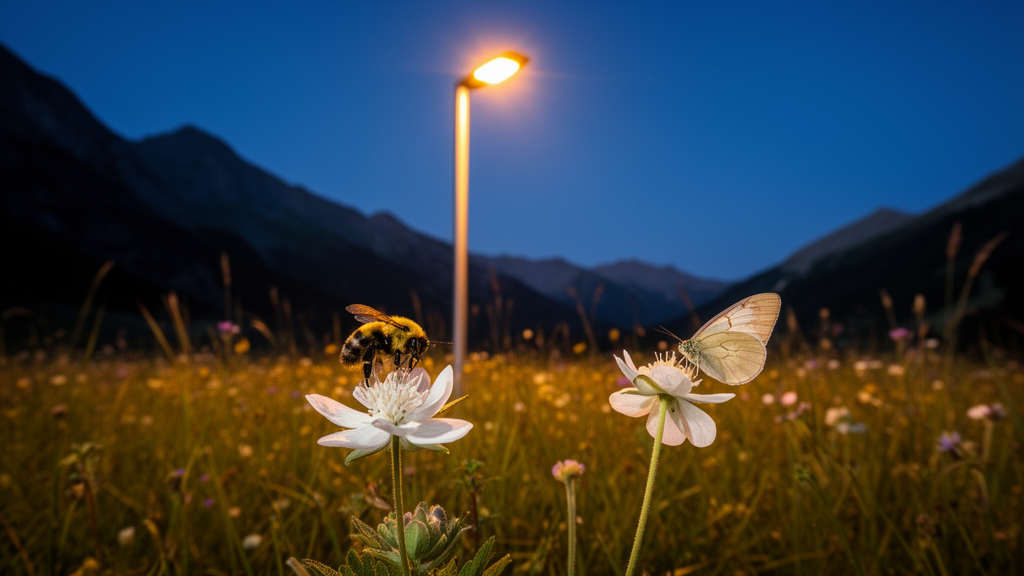
High on the eastern edge of the Qinghai–Tibetan Plateau, where night skies remain among the darkest in China, a single white LED streetlamp has revealed how profoundly artificial light at night can scramble the partnerships between flowers and their insect visitors. A new field experiment published in Ecology and Evolution shows that a modest dose of nighttime illumination—comparable to the glow of an ordinary urban street—restructured both nocturnal and diurnal pollination networks in alpine meadows, even though the flowering plant communities themselves were left essentially untouched. The findings provide some of the clearest experimental evidence yet that light pollution does not merely disturb insects after dark: its effects ripple across the day–night boundary, reshaping ecological networks at hours when the lamps are not even lit.
The research team, working at the Gansu Gannan Grassland Ecosystem National Observation and Research Station at roughly 3,540 meters above sea level, set up five paired plots in June 2024. In each pair, one 5-by-5-meter plot was centered on an 8,000-kelvin white LED streetlamp mounted three meters above the ground, switched on nightly from 19:30 to 05:30 in step with local sunset, while the matching control plot held an identical unlit pole. The lit plots averaged 4.52 lux—right in line with local urban street lighting—whereas control plots stayed below 0.1 lux. From July through August, observers recorded flower visits at night with night-vision equipment and by day with standardized camera surveys, logging every insect that contacted the reproductive parts of a flower and identifying visitors to species or morphospecies using reference collections.
The scale of the dataset—2,160 nocturnal and 3,381 diurnal plant–pollinator interactions across 29 night-blooming and 40 day-blooming plant species—allowed the researchers to build quantitative interaction networks for each plot, time period, and replicate block, and to calculate three classic structural metrics: connectance, nestedness, and modularity. Connectance measures the density of links in a network, nestedness describes how specialist species interact with subsets of the partners of generalists, and modularity captures how strongly the network splits into isolated subgroups. Together, these metrics describe the architecture that underpins the stability and resilience of mutualistic communities.
At night, the effects were dramatic. Overall flower visitation fell by 35.4 percent under the lamps, driven overwhelmingly by moths: Lepidopteran visits collapsed by 57.5 percent, consistent with the well-documented phototactic behavior of nocturnal moths, which rely on celestial light cues for navigation and become disoriented, exhausted, or exposed to predators under artificial illumination. Yet the story was not one of simple loss. Dipteran visitation surged by 179.6 percent, largely on caraway (Carum carvi) and Bupleurum chinense, as typically day-active flies from families such as Tachinidae, Sarcophophidae, and Syrphidae extended their activity into the illuminated night. Beetles and bees showed no significant response.
These behavioral shifts translated directly into network reorganization. Nocturnal network nestedness plummeted by 64.7 percent, while modularity rose by 12.8 percent; connectance was unchanged. Statistically, the loss of nestedness tracked both total visitation and moth visitation under the lamps, supporting the idea that interaction structure is abundance-driven: as moths vanished from the illuminated flowers, the hierarchical fabric of the network frayed, and the opportunistic flies could not compensate. The rise in modularity, negatively correlated with visitation by both flies and moths, indicates that reduced activity by highly mobile pollinators weakened the links between subgroups, leaving a more compartmentalized community in which interactions concentrate within isolated clusters.
The functional stakes are considerable. Moths and flies differ in how effectively they transfer pollen, so a wholesale substitution of flies for moths may reduce pollination success even when visitation counts appear healthy. Previous work has shown that light pollution can cut pollination network nestedness severely and depress seed set in night-pollinated plants, and the new results reinforce the concern that ALAN does not just reshuffle who visits which flower—it may erode the reproductive output of entire plant communities, with consequences that compound over seasons.
What makes the study genuinely surprising is what happened during the day. Total diurnal visitation did not change significantly, but the composition of visitors shifted sharply: bees, butterflies, and beetles declined by 20.0, 51.8, and 61.7 percent respectively, while flies increased by 46.3 percent, partially offsetting the losses. Species-level contrasts pinpointed the winners and losers—bee visits dropped mainly on Oxytropis ochrocephala, butterfly visits on Anaphalis hancockii, and beetle visits on Stellera chamaejasme and Dasiphora fruticosa—while flies flocked to edelweiss-like Leontopodium, thistles, and Bupleurum. In other words, lamps burning only at night reorganized the daytime pollinator community.
Diurnal network structure shifted accordingly. Connectance rose by 16.1 percent, positively correlated with fly visitation and negatively with bee visitation, reflecting the generalized, multi-species foraging habits of Diptera: as flies took over, the network accumulated more links and became more densely connected, even as its modular and nested architecture stayed statistically intact. The authors propose several non-exclusive mechanisms for this cross-temporal carry-over. Artificial light can disrupt plant circadian regulation of nectar production and scent emission, altering when floral rewards become available and disadvantaging scent-dependent groups. It can also disturb the circadian rhythms or nocturnal larval stages of day-active insects such as butterflies. And because light-suppressed moths consume less nectar at night, a resource surplus may linger into the morning, favoring flexible daytime flies.
The choice of study system sharpens the message. Alpine meadows above 3,000 meters endure short growing seasons, pollen limitation, and heavy dependence on a few generalist pollinators such as bumblebees, leaving little slack for disruption. Although the Tibetan Plateau currently has the lowest light pollution levels in China, it has experienced the fastest growth of any region over recent decades, particularly in the east. Studying ALAN in this relatively pristine setting isolates the effect of light from the urban stressors—habitat loss, pesticides, heat—that usually confound light-pollution research near cities, and the results suggest that even remote ecosystems are vulnerable as lighting footprints expand.
The authors caution that their experiment captures responses over a single flowering season, and whether the observed structural shifts persist, accumulate, or trigger long-term declines in plant reproduction and pollinator populations remains an open question for multi-year studies. Still, the conclusion is difficult to escape: artificial light at night acts as a pervasive ecological disturbance that propagates through time, reorganizing mutualistic networks in both darkness and daylight. As global artificial lighting continues its rapid expansion, the researchers argue that conservation strategies must treat light pollution as a key environmental stressor in its own right, prioritizing optimized nighttime lighting regimes—dimmer, warmer, better shielded, and switched off where possible—to protect ecosystems that evolved under the rhythm of the stars.
Subject of Research: Effects of artificial light at night on nocturnal and diurnal plant–pollinator interaction networks in alpine meadows
Article Title: Artificial Light at Night Alters Both of Nocturnal and Diurnal Pollination Networks in Alpine Meadows
Article References: Lu, N., Wang, Y., Cai, W., Chen, Y., Yin, L., Chen, X., Cao, J., & Luo, Q. (2026). Artificial Light at Night Alters Both of Nocturnal and Diurnal Pollination Networks in Alpine Meadows. Ecology and Evolution, 16(10), Article e74368. https://doi.org/10.1002/ece3.74368
Image Credits: AI Generated
DOI: 10.1002/ece3.74368
Keywords: artificial light at night, light pollution, pollination networks, alpine meadows, moths, Diptera, plant–pollinator interactions, network ecology, Qinghai–Tibetan Plateau, nestedness, modularity, insect decline
Cite Scienmag News
Gavin Prescott. (October 9, 2026). Streetlights Rewire Pollination Networks Day and Night in Alpine Meadows. Scienmag. https://scienmag.com/streetlights-rewire-pollination-networks-day-and-night-in-alpine-meadows/
Gavin Prescott. "Streetlights Rewire Pollination Networks Day and Night in Alpine Meadows." Scienmag, 9 October 2026, https://scienmag.com/streetlights-rewire-pollination-networks-day-and-night-in-alpine-meadows/. Accessed 9 October 2026.
Gavin Prescott. "Streetlights Rewire Pollination Networks Day and Night in Alpine Meadows." Scienmag. October 9, 2026. https://scienmag.com/streetlights-rewire-pollination-networks-day-and-night-in-alpine-meadows/


