

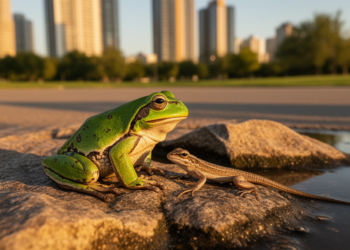
Urban Heat and Rising Stress: How Amphibians and Reptiles Cope in a Changing World
New research reveals that geckos, toads, and sea turtles respond to urbanization and climate change through behavioral flexibility, hormonal shifts, ...
New research reveals that geckos, toads, and sea turtles respond to urbanization and climate change through behavioral flexibility, hormonal shifts, ...

A new BMC Medicine Debate article argues that light epidemiology must adopt a construct-centred framework that explicitly defines what each ...
A survey of 754 residents in two of Chile's most light-polluted coastal cities finds that public support for reducing artificial ...
A field experiment on the Tibetan Plateau shows that artificial light at night collapses moth visitation, boosts flies, and restructures ...
A first-of-its-kind University of Plymouth-led assessment identifies the Adriatic Sea, Baltic Sea and western Mediterranean as Europe's most light-polluted waters ...
A new editorial in BMC Environmental Science warns that exponentially increasing artificial light at night is disrupting circadian biology in ...
A field study across 58 St. Louis sites shows that artificial light at night and extreme daytime heat interact to ...
A field study along the Turin-Lyon railway found that habitat and environmental factors, not artificial construction lighting, best explained moth ...
A new experiment shows that artificial light at night completely blocked mating in fall webworm moths and may also reduce ...
A laboratory study of Finnish water fleas shows that white LED light at night suppresses diel vertical migration in both ...

Embark on a thrilling journey of discovery with Scienmag.com—your ultimate source for cutting-edge breakthroughs. Immerse yourself in a world where curiosity knows no limits and tomorrow’s possibilities become today’s reality!