A team of Canadian and American researchers has built a species distribution model for the Leach's storm-petrel (Hydrobates leucorhous) that integrates GPS tracking, behavioural classification, breeding phenology and colony population sizes to estimate how many birds from this threatened species are exposed to offshore hazards during the breeding season. The work, published in Frontiers in Marine Science, reveals that the highest densities of these small, nocturnal foragers occur in deepwater areas east of Newfoundland—precisely where new oil and gas exploration is expanding. The Atlantic population of Leach's storm-petrel has declined sharply in recent decades, yet little has been known about where these birds go at sea and what threats they encounter there.
To close that gap, the research team deployed GPS trackers on 451 birds between 2016 and 2023, drawing data from six colonies that together account for more than 90 percent of the Atlantic population. Because a bird sitting on the water faces different hazards than one flying above it—oil slicks threaten birds resting on the surface, while artificial light disorients birds in flight—the researchers used a Hidden Markov Model to classify each tracked bird's behavioural state. These states were then assigned to risk categories, distinguishing primarily in-air from on-water exposure.
The resulting dynamic model predicts monthly relative densities at sea from June through September for the entire western North Atlantic regional population, incorporating all sixteen colonies with more than 10,000 breeding individuals. By weighting colony distributions by population size, the model translates tracking data from a sample of birds into an estimate of where the bulk of the population concentrates throughout the breeding season. The geographic pattern that emerged is striking.
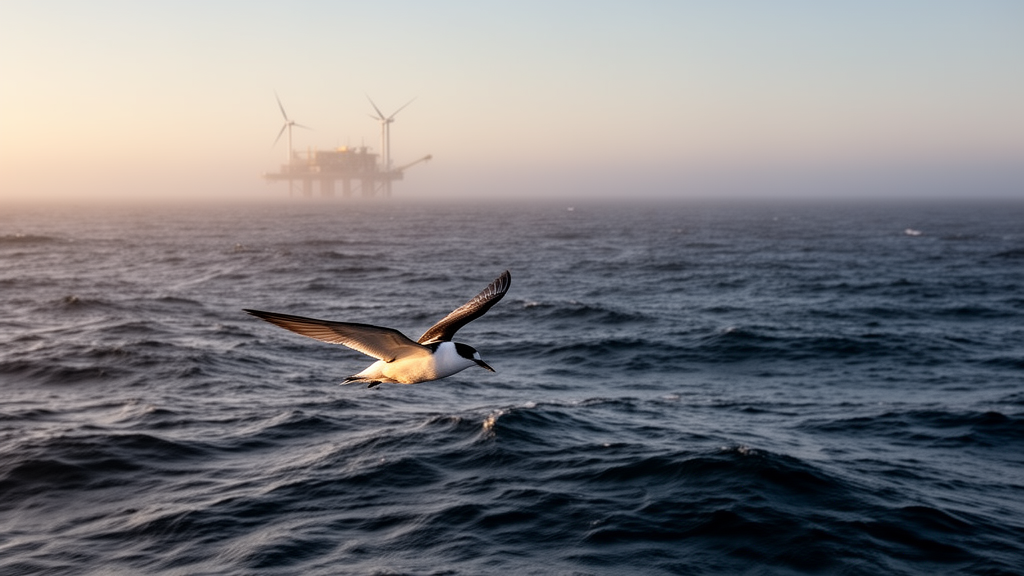
Regional densities were highest east of Newfoundland in deepwater areas off the northern Grand Bank, specifically the Orphan Basin and Flemish Pass, and south of the Flemish Cap in the Newfoundland Basin. These are not shallow shelf waters but deep offshore zones—and they overlap directly with the frontier of offshore petroleum development in Canada. The model showed that at-sea densities increased through the summer, reaching their lowest levels in June, when one parent of each pair remains incubating the egg on land, and peaking in September, when both parents forage at sea to feed nearly grown chicks.
Case studies applying the model to concrete scenarios underscored the conservation stakes. Relative to risks within existing Grand Bank oil and gas production areas, the commencement of deepwater drilling in the Orphan Basin and Flemish Pass has substantially increased risk for the species, because bird densities in those frontier areas are two to four times higher than in the established production zones. In other words, the industry's eastward expansion is moving directly into the storm-petrel's densest offshore concentrations.
Artificial light emerged as an even greater concern than oil. Across the study region, the risk from ALAN was consistently estimated to be higher than the risk from hypothetical oil spills. This finding carries practical weight: offshore installations, drilling vessels and even fishing boats emit lights that can pull storm-petrels out of the night sky, and the model now allows managers to estimate how many birds from which colonies are exposed to light sources at particular locations and times.
The spatial picture also shifted on the human side of the equation. Offshore facilities have been removed from the Scotian Shelf, easing pressure on birds from Nova Scotia colonies, but ongoing bids for exploration licences in that region suggest future risks for specific populations there. The model's colony-specific structure means such future developments can be evaluated against the populations they would most affect, rather than treated as generic regional impacts.
The authors emphasize that their framework, though focused on oil and gas, is not limited to that sector. For a bird that spends most of its life far from land, invisible to most observers, the model offers something it has long lacked: a quantitative, seasonally resolved picture of where it goes and what awaits it there.
Subject of Research: Species distribution modelling of at-sea risk exposure for the threatened Leach's storm-petrel during breeding
Article Title: A species distribution model integrating at-sea behaviour, phenology, and population size to inform marine risk exposure for a threatened seabird during breeding
Article References: Hedd, A., Studholme, K. R., McFarlane Tranquilla, L. A., Cunningham, J. T., Robertson, G. J., Collins, S. M., Fifield, D. A., Gjerdrum, C., Hoeg, R., Jones, P. L., Montevecchi, W. A., Pollet, I. L., Pratte, I., Rock, J. C., Ronconi, R. A., Shutler, D., Wilhelm, S. I., Wong, S. N. P., & Patterson, A. (2026). A species distribution model integrating at-sea behaviour, phenology, and population size to inform marine risk exposure for a threatened seabird during breeding. Frontiers in Marine Science, 13, 1950203. https://doi.org/10.3389/fmars.2026.1950203
Image Credits: AI Generated
DOI: 10.3389/fmars.2026.1950203
Keywords: Leach's storm-petrel, species distribution model, GPS tracking, Hidden Markov Model, artificial light at night, offshore oil and gas, Grand Bank, Orphan Basin, marine megafauna, seabird conservation, Northwest Atlantic, breeding phenology
Cite Scienmag News
Violet Maxwell. (October 27, 2026). Tracking a Threatened Seabird Reveals Hotspots of Offshore Risk in the Northwest Atlantic. Scienmag. https://scienmag.com/tracking-a-threatened-seabird-reveals-hotspots-of-offshore-risk-in-the-northwest-atlantic/
Violet Maxwell. "Tracking a Threatened Seabird Reveals Hotspots of Offshore Risk in the Northwest Atlantic." Scienmag, 27 October 2026, https://scienmag.com/tracking-a-threatened-seabird-reveals-hotspots-of-offshore-risk-in-the-northwest-atlantic/. Accessed 27 October 2026.
Violet Maxwell. "Tracking a Threatened Seabird Reveals Hotspots of Offshore Risk in the Northwest Atlantic." Scienmag. October 27, 2026. https://scienmag.com/tracking-a-threatened-seabird-reveals-hotspots-of-offshore-risk-in-the-northwest-atlantic/