


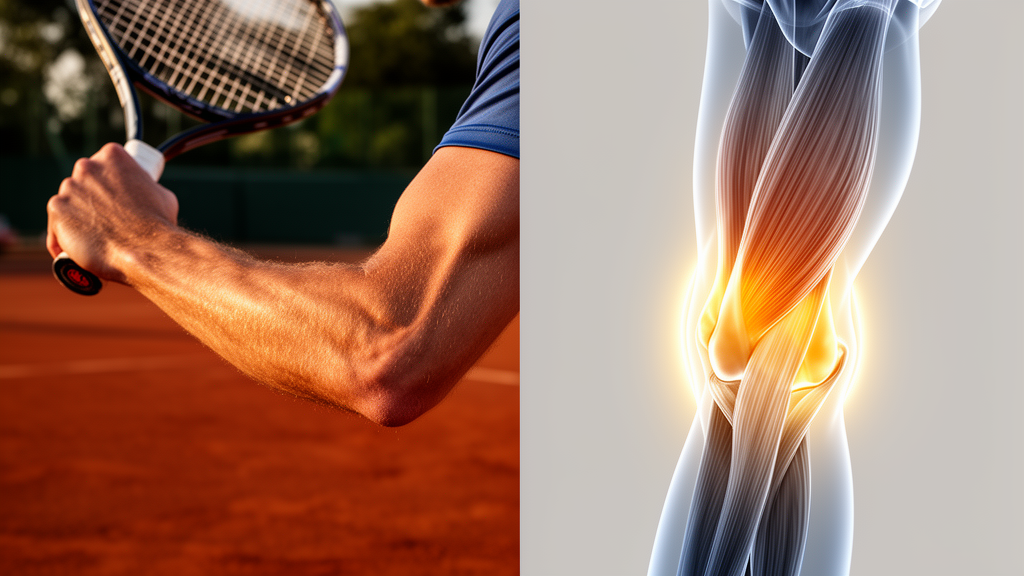
Racket-sport players’ elbows are not just sore from years of serves and backhands — they are measurably different. A new cross-sectional study from researchers at Hospital Universitario Ramón y Cajal in Madrid reports that the tendon attachments, or entheses, at the lateral and medial epicondyles of the dominant elbow are significantly thicker and stiffer in racket players than in matched controls, and that the degree of thickening tracks closely with cumulative practice time. The findings, published in Frontiers in Musculoskeletal Disorders, suggest that chronic mechanical loading leaves a distinct structural and elastographic signature in these non-weight-bearing attachment sites.
The research team enrolled 45 racket-sport players and 45 matched non-racket-sport controls, and examined both elbows of every participant using three complementary ultrasound techniques. B-mode ultrasound provided measurements of enthesis thickness and echotexture, power Doppler imaging detected hyperemia, and shear-wave elastography quantified tissue stiffness. The assessment also recorded the presence of enthesophytes, the bony outgrowths that can develop at tendon insertions.
The results were striking in their consistency. Players showed significantly greater enthesis thickness and stiffness in the dominant elbow compared with controls, with p-values below 0.001 for all such comparisons. Thickness of the dominant lateral epicondyle enthesis correlated with cumulative practice time at r = 0.899, and the medial epicondyle at r = 0.928 — correlations of a magnitude indicating that, in this cohort, cumulative loading explains most of the variation in enthesis size.
Bony changes told a parallel story. Enthesophytes were found in 24.4 percent of players but only 6.6 percent of controls, an odds ratio of 4.52 with a p-value of 0.04. The distribution of these outgrowths proved particularly informative.
Among racket players, every enthesophyte appeared in the dominant elbow, the side exposed to the repetitive grip-and-swing mechanics of the sport. In controls, by contrast, enthesophytes were also observed in non-dominant elbows, a pattern more consistent with incidental change than with sport-driven remodeling. Perhaps the most notable finding was what the researchers did not see.
Clinically significant power Doppler signal — the ultrasound hallmark of active inflammatory hypervascularity — was absent in every control and present in only one player. This near-complete absence of Doppler activity, set against abundant structural change, is precisely the dissociation the study was designed to detect: mechanical adaptation and inflammatory enthesopathy can share ultrasonographic features, but they differed in Doppler signal in this cohort. That distinction matters because the elbow epicondyles are non-weight-bearing entheses, and the study’s authors note that adaptive changes and disease-related alterations can overlap in these locations.
Entheses are the target structures in spondyloarthritis, and the authors argue that recognising these adaptive patterns may help refine ultrasound scoring systems and improve the discrimination between physiological adaptation and inflammatory enthesopathy in that disease. A thickened, stiffened enthesis in an athlete may represent a response to training, yet on a standard ultrasound assessment it could be mistaken for pathology.
Shear-wave elastography added a quantitative dimension to the comparison. The finding that players’ entheses were stiffer than controls’ indicates that chronic tensile loading in this cohort was associated not only with greater size but also with different material properties at the tendon-bone interface. Whether a specific stiffness threshold could help separate adaptive from inflammatory change remains an open question, but the study establishes that stiffness differed systematically between loaded and unloaded entheses in these otherwise healthy individuals.
The study’s cross-sectional design imposes important limits on interpretation. Because players and controls were compared at a single point in time, the strong correlations between practice time and enthesis thickness demonstrate association, not a documented trajectory of change within individuals. The sample of 45 per group, while adequate for the comparisons reported, is modest, and the single player with Doppler signal cannot support any conclusion about inflammation in this population.
Nevertheless, the implications for imaging are concrete. The authors conclude that chronic biomechanical stress may induce structural and elastographic changes in non-weight-bearing entheses, and that recognising these adaptive patterns may help refine ultrasound scoring systems and improve discrimination between physiological adaptation and inflammatory enthesopathy in spondyloarthritis. For rheumatologists scanning the elbow of a tennis or padel player, the study offers quantitative evidence that a thick, stiff, enthesophyte-bearing epicondylar enthesis — without Doppler signal — may reflect years of sport rather than active disease, while the near-absence of Doppler activity in this loaded cohort underscores how rarely such signal appeared in these healthy, trained entheses.
Subject of Research: Ultrasound and shear-wave elastography assessment of elbow enthesis adaptation in racket-sport players
Article Title: Ultrasound and shear-wave elastography of the lateral and medial epicondylar entheses in racket-sport players: a cross-sectional comparative study
Article References: Navarro, A., Salazar, A., Rufino-Barrio, P., Dominguez-Barahona, J., Paris-Jiménez, M., Blanco-Caceres, B., & Guillen-Astete, C. A. (2026). Ultrasound and shear-wave elastography of the lateral and medial epicondylar entheses in racket-sport players: a cross-sectional comparative study. Frontiers in Musculoskeletal Disorders, 4, 1948925. https://doi.org/10.3389/fmscd.2026.1948925
Image Credits: AI Generated
DOI: 10.3389/fmscd.2026.1948925
Keywords: ultrasound, shear-wave elastography, enthesis, enthesophytes, racket sports, epicondyle, power Doppler, spondyloarthritis, musculoskeletal imaging, tendon adaptation, sports medicine, cross-sectional study
Cite Scienmag News
Gavin Prescott. (October 27, 2026). Racket Sports Reshape Elbow Tendons: Ultrasound Reveals Adaptive Thickening and Stiffening. Scienmag. https://scienmag.com/racket-sports-reshape-elbow-tendons-ultrasound-reveals-adaptive-thickening-and-stiffening/
Gavin Prescott. "Racket Sports Reshape Elbow Tendons: Ultrasound Reveals Adaptive Thickening and Stiffening." Scienmag, 27 October 2026, https://scienmag.com/racket-sports-reshape-elbow-tendons-ultrasound-reveals-adaptive-thickening-and-stiffening/. Accessed 27 October 2026.
Gavin Prescott. "Racket Sports Reshape Elbow Tendons: Ultrasound Reveals Adaptive Thickening and Stiffening." Scienmag. October 27, 2026. https://scienmag.com/racket-sports-reshape-elbow-tendons-ultrasound-reveals-adaptive-thickening-and-stiffening/


