


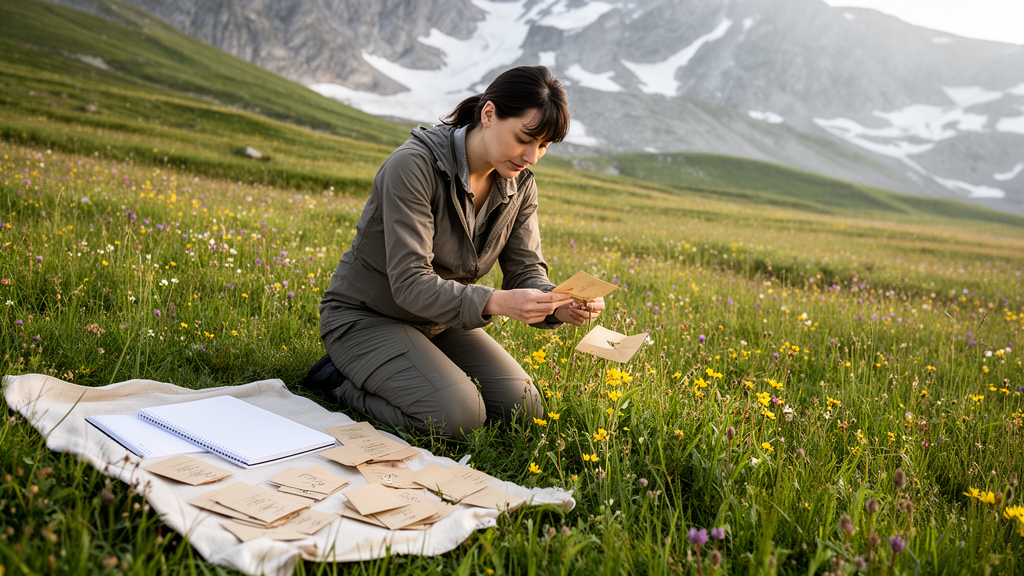
On the eastern Qinghai–Tibetan Plateau, alpine meadow communities do not all regenerate the same way. A new study published in BMC Plant Biology reports that when seed traits are averaged across plant communities, the clearest differences between elevations lie not in how seeds respond to specific germination cues, but in how many seeds germinate at all. The finding comes from a survey of 60 quadrats nested within 12 plots spanning four elevations and three slope aspects, and it offers a community-level view of the earliest and most vulnerable stage of the plant life cycle.
The research team, led by Shu-xia Li and colleagues, measured six community-weighted seed traits, including seed mass, germination percentage, germination rate, and responsiveness to germination cues. Rather than examining individual species in isolation, the community-weighted approach asks which regeneration strategies dominate the vegetation as a whole. When the researchers analyzed these traits together, two independent dimensions emerged.
The first axis combined seed mass with overall germination capacity, while the second captured how strongly seeds responded to specific cues that trigger germination. The elevational signal was concentrated almost entirely in the first dimension. Communities at 3000 meters showed higher values of the seed trait axis, higher community-weighted germination percentage, and faster germination than communities at the three higher elevations.
In contrast, the cue responsiveness axis showed no clear pattern with elevation, suggesting that responses to particular germination cues are structured less consistently by the broad environmental gradient associated with elevation than overall germination capacity is. Understanding why germination capacity declines with elevation requires looking at the environment itself, and here the study reveals a complication. Along the elevational gradient, growing season temperature strongly covaried with a plot-level gradient in soil moisture and organic resources.
In other words, warmer sites were also wetter and richer in organic soil resources, so climate and soil conditions changed together rather than independently. When the researchers evaluated each environmental gradient separately, the seed mass–germination capacity axis was positively associated with both growing season temperature and the soil moisture–organic resource gradient. The cue responsiveness axis, by contrast, showed no detectable association with either the climatic or the soil gradient.
But because temperature and soil conditions were so tightly correlated, the authors could not disentangle independent climatic effects from independent edaphic effects on germination capacity. The two environmental dimensions of the gradient move as one, and the data cannot split them apart. This coupling of climate and soil is a familiar challenge in mountain ecology.
The study's design, which sampled multiple elevations and aspects, reflects an attempt to capture that covariation explicitly rather than assume it away, and the results suggest that interpretation of community regeneration along such gradients must account for it. The broader significance lies in what seed traits add to community ecology. Adult vegetative traits have long been used to understand how plant communities assemble, but seed traits describe the regeneration phase, the stage at which recruitment succeeds or fails.
The authors note that seed traits remain less integrated into community-level trait studies, and their results show that regeneration strategies can be organized into distinct dimensions that respond differently, or not at all, to the same environmental gradient. The study's conclusions are deliberately measured. The authors emphasize that alpine meadow communities differed primarily in germination capacity rather than cue responsiveness along the elevational gradient, and that these contrasting seed-strategy dimensions were embedded within a coupled climate–soil gradient.
They highlight the need to consider regeneration traits and environmental covariation together when interpreting alpine community assembly, rather than attributing patterns to climate or soil alone. As an observational study of a single mountain region, the work does not establish causal mechanisms, and the authors are explicit that the correlated nature of the gradient limits inference.
Subject of Research: Elevational differentiation of community-weighted seed regeneration strategies along a climate‒soil covariation gradient in alpine meadows
Article Title: Elevational differentiation of community-weighted seed regeneration strategies along a climate‒soil covariation gradient in alpine meadows
Article References: Li, S.-X., Zhang, T.-T., Liu, K., Zhang, S.-T., Zhang, Z.-L., Bu, H.-Y., & Xiao, S. (2026). Elevational differentiation of community-weighted seed regeneration strategies along a climate‒soil covariation gradient in alpine meadows. BMC Plant Biology. https://doi.org/10.1186/s12870-026-10264-8
Image Credits: AI Generated
DOI: 10.1186/s12870-026-10264-8
Keywords: Elevational, differentiation, community-weighted, seed, regeneration, strategies, along, climate, soil, covariation, gradient, alpine
Cite Scienmag News
Alan Morgan. (October 27, 2026). Seed Strategies Shift With Elevation in Alpine Meadow Communities. Scienmag. https://scienmag.com/seed-strategies-shift-with-elevation-in-alpine-meadow-communities/
Alan Morgan. "Seed Strategies Shift With Elevation in Alpine Meadow Communities." Scienmag, 27 October 2026, https://scienmag.com/seed-strategies-shift-with-elevation-in-alpine-meadow-communities/. Accessed 27 October 2026.
Alan Morgan. "Seed Strategies Shift With Elevation in Alpine Meadow Communities." Scienmag. October 27, 2026. https://scienmag.com/seed-strategies-shift-with-elevation-in-alpine-meadow-communities/


