


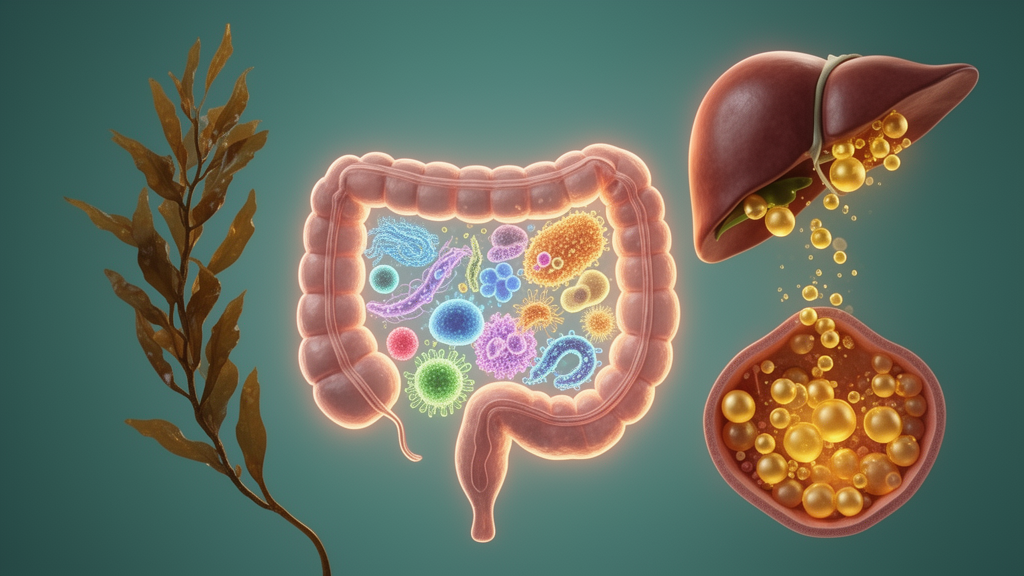
A sulfated polysaccharide extracted from brown seaweed has emerged as a striking candidate against one of the world’s most common chronic liver diseases. In a study published in Frontiers in Microbiology, researchers at the Affiliated Hospital of Qingdao University report that daily supplementation with fucoidan, a molecule derived from the kelp species Saccharina japonica, markedly attenuated the features of metabolic dysfunction-associated fatty liver disease (MAFLD) in mice fed a high-fat diet. Over 14 weeks, the treated animals gained less weight, accumulated less fat in their livers, showed healthier blood lipid and glucose profiles, and carried a gut microbial community that looked measurably different from that of untreated mice on the same fattening diet.
The scale of the underlying problem gives the finding its urgency. MAFLD affects more than 30 percent of the global population, according to the researchers, and is closely tied to obesity, type 2 diabetes, insulin resistance, and cardiovascular disease. In its progressive forms it can advance to steatohepatitis, fibrosis, cirrhosis, and even hepatocellular carcinoma. Effective pharmacological therapies remain limited, and current strategies focus mainly on restoring lipid homeostasis and enhancing fatty acid oxidation. That gap has pushed scientists toward dietary interventions, particularly those that act through the gut microbiota, whose metabolic output constantly shapes the liver through what is known as the gut-liver axis.
Fucoidan is an unusual candidate molecule. Chemically, it is a sulfated polysaccharide built largely from α-L-fucose sugars, and its high molecular weight means that host digestive enzymes barely touch it. Instead, it travels largely intact into the colon, where intestinal bacteria can break it down into smaller oligosaccharides and metabolites. This limited host digestibility is precisely why the Qingdao team suspected that fucoidan’s biological effects might be mediated substantially through the microbiota rather than through direct absorption into the bloodstream.
Previous work had suggested the compound could reshape microbial communities, suppress inflammation, and ameliorate metabolic disorders, but its relationship to a key hepatic signaling pathway had not been clearly characterized. The experimental design was straightforward but rigorous in its details. Eighteen six-week-old male C57BL/6J mice were randomly assigned to three groups of six: a control group on standard chow, a group on a diet in which 60 percent of calories came from fat, and a group receiving the same high-fat diet plus daily oral fucoidan at 200 milligrams per kilogram of body weight.
The fucoidan preparation, supplied by a Chinese seaweed processor, had a purity of at least 90 percent and a molecular mass of 83.5 kilodaltons as determined by gel permeation chromatography. Animals were housed to distribute each group across different cages, minimizing cage effects, and body weight, food intake, and blood chemistry were tracked longitudinally from the same animals throughout the intervention. The metabolic results were consistent across nearly every measure the team recorded. High-fat feeding drove progressive weight gain and enlargement of both white and brown adipose tissue, along with microscopic adipocyte hypertrophy; fucoidan significantly blunted all of these changes without any detectable difference in food intake between the two high-fat groups.
Serum triglycerides and total cholesterol, which climbed steadily in the untreated high-fat mice, were consistently lower with fucoidan, with cholesterol significantly reduced by week 12 and triglycerides by week 14. A glucose tolerance test performed in week 13 showed that treated mice cleared injected glucose far more efficiently, and both fasting and random blood glucose levels were significantly lower at the end of the study. The liver itself told a parallel story. Alanine and aspartate aminotransferases, the standard blood markers of liver injury, rose progressively in the high-fat group from week 8 onward, but fucoidan markedly attenuated the elevation throughout the intervention. Treated livers were lighter, and macroscopic examination revealed that the enlarged, pale, lipid-laden appearance typical of fatty liver was substantially improved.
Under the microscope, hematoxylin and eosin staining showed pronounced macrovesicular steatosis and hepatocyte swelling in untreated mice, while Oil Red O staining, which highlights neutral lipids, revealed extensive droplet accumulation that fucoidan sharply reduced. Hepatic levels of the inflammatory cytokines interleukin-6 and tumor necrosis factor-α, measured by enzyme-linked immunosorbent assay, were also significantly lower after treatment. Beneath these visible improvements, the team probed a molecular signaling axis central to hepatic fat handling. AMP-activated protein kinase, or AMPK, is the cell’s master energy sensor: when activated by phosphorylation under energy stress, it suppresses lipogenesis and promotes fatty acid β-oxidation, helping to drain fat from the liver.
The high-fat diet significantly suppressed AMPK phosphorylation, but fucoidan restored the phosphorylated-to-total AMPK ratio. At the same time, expression of PPARγ, a nuclear receptor that regulates adipocyte differentiation and lipid homeostasis genes, was significantly downregulated by fucoidan compared with the high-fat group. The authors are careful to note the interpretive limit here: because they did not pharmacologically inhibit or genetically manipulate this pathway, the causal contribution of AMPK/PPARγ signaling to fucoidan’s benefits remains to be established.
The gut-side findings were equally detailed. 16S ribosomal RNA gene sequencing of fecal samples showed that the high-fat diet reduced both microbial richness and evenness, measured by the Chao and Shannon indices, and fucoidan partially restored both. Principal coordinates analysis separated the three groups clearly, and the community shift was statistically confirmed by permutational multivariate analysis of variance. At the phylum level, fucoidan lowered the Bacillota-to-Bacteroidota ratio, a broad marker often shifted in metabolic disease. At the genus level, the treatment enriched Akkermansia and Lachnospiraceae_NK4A136_group, raised Adlercreutzia, and reduced Dubosiella. The team also documented structural recovery in the intestine itself: fucoidan restored colon length, repaired villus architecture, replenished goblet cells and acidic mucin, and upregulated the tight junction protein Occludin and the mucus protein MUC2 at both the messenger RNA and protein levels.
Untargeted serum metabolomics added a third layer to the picture. High-fat feeding produced 179 upregulated and 445 downregulated serum metabolites relative to controls, while fucoidan shifted 34 metabolites up and 209 down relative to the untreated high-fat group. Pathway enrichment pointed most strongly at the tricarboxylic acid, or TCA, cycle, the mitochondrial core of energy metabolism. Circulating citric acid, cis-aconitic acid, L-malic acid, and fumaric acid were all elevated in the high-fat mice and partially reversed by fucoidan. Spearman correlation analysis then linked these metabolites to the microbial and biochemical data: citrate and fumarate were positively associated with Dubosiella abundance and with week-14 cholesterol and triglyceride levels, suggesting a coordinated gut-metabolism-liver relationship, though the authors stress that circulating metabolite concentrations do not directly reflect mitochondrial TCA-cycle flux.
The limitations, which the authors enumerate candidly, matter for anyone hoping to translate this into a supplement regimen. Fucoidan was given concurrently with the high-fat diet, making this a preventive rather than a therapeutic intervention, so no conclusion can be drawn about treating established disease. Only one dose was tested, only male mice were studied, and no chow-plus-fucoidan group existed to isolate effects of the compound in lean animals. Because fucoidan also reduced weight gain, the microbial changes could be secondary consequences of improved metabolic health rather than direct microbial effects, and no microbiota depletion, fecal transplant, or germ-free experiments were performed to test causality. Short-chain fatty acids and bile acids were not measured, and the barrier improvements reflect structural and molecular changes rather than direct permeability measurements. Within those bounds, the study offers a coherent, multi-layered association linking a marine polysaccharide, a remodeled gut community, altered circulating TCA-cycle metabolites, and shifted hepatic AMPK/PPARγ signaling, and it makes a case for subjecting seaweed-derived fibers to the causal experiments that will determine whether they can genuinely help manage metabolic liver disease.
Subject of Research: Fucoidan supplementation and gut microbiota remodeling in a mouse model of metabolic dysfunction-associated fatty liver disease
Article Title: Fucoidan attenuates metabolic dysfunction-associated fatty liver disease in mice and is associated with gut microbiota remodeling and AMPK/PPARγ signaling
Article References: Li, Y., Shan, M., Liu, Q., Jing, X., Wang, Z., Mao, T., Qi, X., Cao, B., Tian, Z., & Han, R. (2026). Fucoidan attenuates metabolic dysfunction-associated fatty liver disease in mice and is associated with gut microbiota remodeling and AMPK/PPARγ signaling. Frontiers in Microbiology, 17, 1936901. https://doi.org/10.3389/fmicb.2026.1936901
Image Credits: AI Generated
DOI: 10.3389/fmicb.2026.1936901
Keywords: fucoidan, MAFLD, fatty liver disease, gut microbiota, gut-liver axis, AMPK, PPARγ, TCA cycle, high-fat diet, intestinal barrier, marine polysaccharide, mouse study
Cite Scienmag News
Morgan Morrow. (October 27, 2026). Seaweed fiber fucoidan reshapes gut microbiota and protects mice from fatty liver disease. Scienmag. https://scienmag.com/seaweed-fiber-fucoidan-reshapes-gut-microbiota-and-protects-mice-from-fatty-liver-disease/
Morgan Morrow. "Seaweed fiber fucoidan reshapes gut microbiota and protects mice from fatty liver disease." Scienmag, 27 October 2026, https://scienmag.com/seaweed-fiber-fucoidan-reshapes-gut-microbiota-and-protects-mice-from-fatty-liver-disease/. Accessed 27 October 2026.
Morgan Morrow. "Seaweed fiber fucoidan reshapes gut microbiota and protects mice from fatty liver disease." Scienmag. October 27, 2026. https://scienmag.com/seaweed-fiber-fucoidan-reshapes-gut-microbiota-and-protects-mice-from-fatty-liver-disease/


