


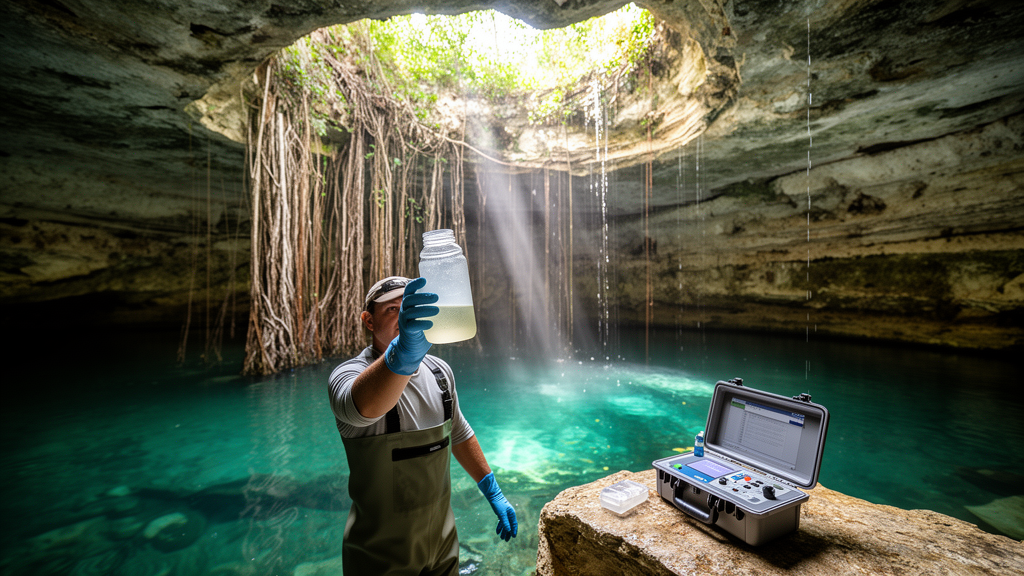
Every cenote sampled in the Mexican resort city of Cancun carries faecal coliform bacteria, and concentrations climb dramatically when the rains arrive, according to a new study of ten urban sinkholes that serve the city as natural swimming pools and freshwater sources. The findings, published by researchers at the Polytechnic University of Quintana Roo, add Cancun's celebrated karst pools to a growing list of Yucatan Peninsula groundwater bodies showing contamination linked to human activity. Cancun, on the northern coast of Quintana Roo State, sits on a vast plain of calcite laid down from the shells and exoskeletons of marine organisms.
Rainwater and underground currents slowly dissolve these calcareous layers, carving out the depressions, holes and caverns known as cenotes, which punctuate the whole Yucatan Peninsula. Because the peninsula's fractured limestone lets water filter downward rather than pool on the surface, the aquifers beneath it constitute essentially the only source of freshwater for human settlements in the state. Since its founding in 1971, Cancun has grown exponentially, from 628,306 inhabitants in 2010 to 743,626 in 2015, and the resulting domestic, agricultural and industrial waste has strained the very aquifer the city depends on.
The study focused on coliform bacteria, a broad group of microbes that live in the intestines of humans and warm- and cold-blooded animals, where they aid digestion. A subset of these, the faecal coliforms, is defined by the ability to grow at elevated temperatures and by its association with faecal material; its most familiar member is Escherichia coli. These organisms are gram-negative bacilli that ferment lactose with acid and gas production within 48 hours at 44 degrees Celsius.
Although faecal coliforms are generally not pathogenic themselves, they serve as indicator organisms: when they are present, pathogenic bacteria are likely present too, because both inhabit the same gastrointestinal tracts, and the pathogens occur in quantities too small to monitor directly. The presence of faecal coliforms in underground water is a recognised warning sign. Contaminated groundwater in tropical cities has been associated with outbreaks of cholera, dysentery, paratyphoid fever, hepatitis, stomach infections and septicaemia.
Coliform surveys of urban cenotes have been scarce, with tourist cenotes receiving most of the attention, so the research team set out to determine and analyse total and faecal coliform concentrations in cenotes across Cancun itself. Between May and June 2018, the dry season, and again between September and October, the rainy season, the researchers collected one 500-millilitre sample from each of ten cenotes, drawing water from ten centimetres below the surface in the middle of each pool in the morning. Samples were chilled and transported to the laboratory within two hours.
Coliforms were quantified with the Most Probable Number technique, following Mexican Norm NMX-AA-042-SCFI-2015 and standard APHA methods. For total coliforms, sample volumes of 10, 1.0 and 0.1 millilitres were added to lactose-rich medium with inverted Durham fermentation tubes and incubated at 37 degrees Celsius for 48 hours; turbid tubes with trapped gas counted as positive. Positive samples were then transferred to Brilliant Green Bile Lactose medium and incubated at 45 degrees Celsius for 24 hours to confirm faecal coliforms, with MPN values read from statistical tables in the Mexican norm.
The results were stark. In the dry season, three cenotes exceeded the detection ceiling of 2,400 Most Probable Number units per 100 millilitres for total coliforms, and one more registered 1,100 MPN/100 ml. Under the Mexican norm, the limit for swimming is below 200 MPN/100 ml, so even the low end of the measured range matters.
Six cenotes showed low total coliform concentrations between 3 and 240 MPN/100 ml in the dry season, but only five stayed within the norm's limits. When the rains came, the picture deteriorated: eight cenotes reached the maximum detectable level of total coliforms, and every sampled cenote exceeded the Mexican norm. Faecal coliforms followed a similar seasonal pattern, with high concentrations in three cenotes in the dry season and four in the rainy season, while the remaining cenotes ranged from 79 to 253 MPN/100 ml in the wet months.
The seasonal shift points to rain as the principal driver of contamination. The authors suggest several mechanisms. In heavily populated areas, accumulated garbage and surface runoff can flush waste into the underground water system during heavy rainfall.
Illegal settlements using latrines and septic tanks may release their contents into the drainage system during storms, and the porous ground beneath Cancun allows that material to infiltrate the groundwater and the cenotes. Previous research has consistently found a directly proportional relationship between human activity and faecal coliform presence, and the new findings align with earlier reports that total coliforms and E. coli rise in the rainy season in Cancun cenotes, including one site that overlaps with cenote C2 in this study. Because the Yucatan Peninsula hosts the largest underwater cave system in the world, with many caves interconnected by an extensive hydrological network, the team also ran a computational proximity analysis on the ten sites.
Using the Haversine formula and a k-means clustering algorithm over latitude and longitude, they identified three clusters. Cenotes C1, C2 and C5 fell within the minimum two-kilometre perimeter of cluster CL2, while C3, C7 and C8 sat near the centroid of CL3, with C6 and C9 at the outer 2.8-kilometre perimeters. C10 stood alone in CL1.
On this distance-based analysis, at least seven of the ten cenotes could be hydrologically connected, although the authors stress that this is a predictive computational result and that tracer studies would be needed to confirm actual connections. Roughly 150 cenotes are registered within Cancun's locality, so many more underground links may exist. The contamination pattern fits a wider regional picture.
In Scotland's Cairngorms National Park, 85 percent of 480 river samples near a camping area tested positive for total coliforms, with risk rising as visitor numbers grew. In Seoul, South Korea, all sampled spring waters contained total coliforms and E. coli turned up in 68 percent of samples, with the highest concentrations near public spring baths. Closer to home, a study of rural Yucatan groundwater found E. coli, Serratia and Enterobacter at levels far exceeding Mexican limits, and surveys of tourist cenotes in the Cancun-Tulum corridor and the State of Yucatan detected faecal coliforms in every site tested, with concentrations up to and beyond 1,000 MPN/100 ml.
Wells west of Cancun have also yielded total and faecal coliforms, supporting the authors' suggestion that the aquifer beneath the city is likely contaminated. The implications reach beyond swimming safety. Cenote water is the only freshwater source in the Cancun region, so contamination forces extraction from more distant locations and raises costs.
The bacterial load also alters the microenvironment: the team observed, in unpublished data, changes in populations of certain microalgae and protozoa in cenotes with high faecal coliform levels, and polluted groundwater may ultimately affect nearby lagoons, estuaries and coral reefs. Cenote C9 was the least contaminated site in both seasons, possibly because wooded ground above it filters infiltrating water, while C2's rainy-season decline may reflect an underground flow diverting contaminants or a municipal cenote-cleaning programme that does not operate across the whole city. The authors recommend a government sanitation policy for cenotes used as recreational centres, tracer studies to trace contaminant sources and destinations, continuous monitoring of underground water, stricter controls on household waste, and greater ecological education, noting that many cenotes are already used as garbage dumps and that the resulting damage could prove irreparable and costly.
Subject of Research: Faecal and total coliform contamination of urban cenotes and groundwater in Cancun, Mexico
Article Title: Total and faecal coliforms presence in cenotes of Cancun; Quintana Roo, Mexico
Article References: Borbolla-Vazquez, J., Ugalde-Silva, P., León-Borges, J., & Díaz-Hernández, J. A. (2020). Total and faecal coliforms presence in cenotes of Cancun; Quintana Roo, Mexico. BioRisk, 15, 31-43. https://doi.org/10.3897/biorisk.15.58455
Image Credits: AI Generated
Keywords: cenotes, Cancun, coliform bacteria, faecal contamination, groundwater, E. coli, Yucatan Peninsula, aquifer, water quality, rainy season, MPN, Quintana Roo
Cite Scienmag News
Morgan Morrow. (October 27, 2026). Faecal Bacteria Taint Cancun’s Cenotes, Rising Sharply in the Rainy Season. Scienmag. https://scienmag.com/faecal-bacteria-taint-cancuns-cenotes-rising-sharply-in-the-rainy-season/
Morgan Morrow. "Faecal Bacteria Taint Cancun’s Cenotes, Rising Sharply in the Rainy Season." Scienmag, 27 October 2026, https://scienmag.com/faecal-bacteria-taint-cancuns-cenotes-rising-sharply-in-the-rainy-season/. Accessed 27 October 2026.
Morgan Morrow. "Faecal Bacteria Taint Cancun’s Cenotes, Rising Sharply in the Rainy Season." Scienmag. October 27, 2026. https://scienmag.com/faecal-bacteria-taint-cancuns-cenotes-rising-sharply-in-the-rainy-season/


