


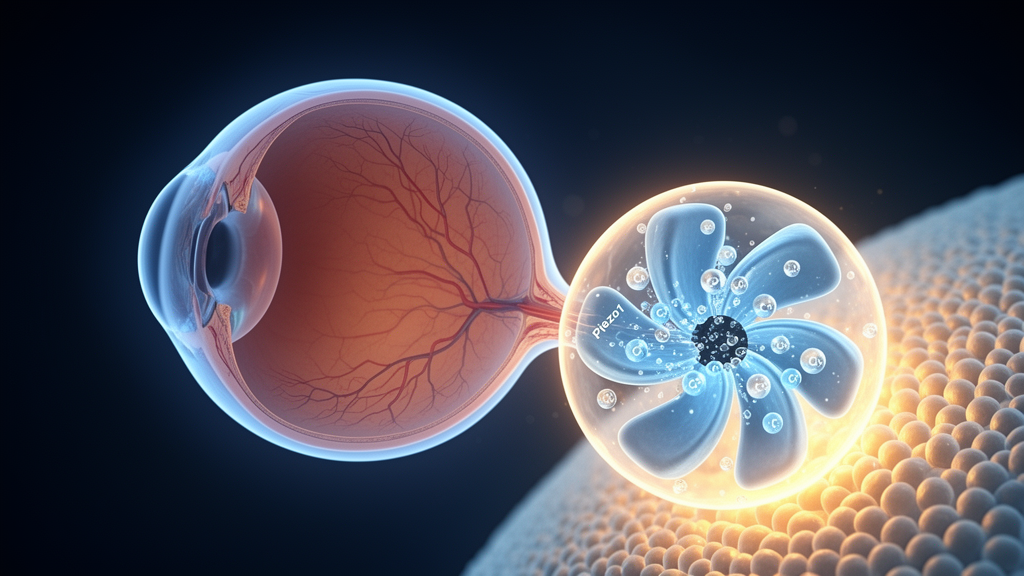
High myopia and glaucoma are usually treated as separate eye diseases, but a new review argues they may share a mechanobiological thread: the mechanically activated ion channel Piezo1. Writing in Frontiers in Bioengineering and Biotechnology, a team at the Second Xiangya Hospital of Central South University assembles evidence from across the eye and proposes a hypothesis-generating framework in which Piezo1-mediated mechanotransduction could link the chronic mechanical stresses of eyeball elongation to the pressure-related damage that defines glaucoma. Crucially, the authors stress that this axis remains a hypothesis, not an established causal pathway.
Piezo1 is a cation channel that opens when the cell membrane is stretched, converting mechanical force into calcium signaling. Because it sits at the interface of membrane tension, extracellular matrix state, calcium influx, reactive oxygen species signaling, and cellular remodeling, the authors argue it is well positioned to mediate the responses of ocular tissues to sustained mechanical load. Both high myopia, marked by axial elongation, posterior-segment stretch, and scleral remodeling, and glaucoma, driven by intraocular pressure-related outflow stress, optic nerve head strain, and vulnerable retinal ganglion cells, converge on chronic mechanical stress acting on compartment-specific weak points in the eye.
The review grades the evidence by ocular compartment, and the grades differ sharply. There, multiple lines of investigation converge: channel activation and perturbation experiments, calcium signaling measurements, matrix and prostaglandin readouts, and assays of outflow function all point to Piezo1 as a functional mechanotransducer in this tissue. Findings in retinal ganglion cells, the neurons that die in glaucoma, are described as emerging.
In the myopia context, the current data support retinal or posterior-segment stress signaling more strongly than a specific causal role for scleral fibroblasts in extracellular matrix remodeling, the process thought to drive the thinning and weakening of the sclera in highly myopic eyes. Two areas remain explicitly exploratory: Piezo1 evidence specific to scleral fibroblasts in myopia, and evidence from the peripapillary sclera, the ring of sclera surrounding the optic nerve head that transmits mechanical load to the nerve. These are precisely the compartments that a full myopia-to-glaucoma axis would need to traverse, which is why the authors frame their proposal as a scaffold for future experiments rather than a conclusion.
The central caveat is stated bluntly. Current evidence does not demonstrate a continuous, Piezo1-dependent causal chain running from scleral remodeling or peripapillary load redistribution to optic nerve head deformation and subsequent degeneration of retinal ganglion cells. This evidence-graded approach is the review's methodological contribution.
Rather than treating all mechanotransduction findings as equivalent, the authors separate directly supported tissue-level mechanisms from cross-compartment relationships that require targeted validation. That distinction matters for experimental design: studies in trabecular meshwork cells can build on a solid foundation, whereas claims about scleral fibroblasts or peripapillary biomechanics will need purpose-built models before they can be considered established. The authors are careful, however, to distinguish such a susceptibility framework from proof of causation.
For now, the review's practical output is a map of what is known, what is moderately supported, and what remains speculative. The trabecular meshwork stands on firm ground, the optic nerve head occupies an intermediate position, and the myopia-side compartments await decisive experiments.
Subject of Research: Piezo1 mechanotransduction as a hypothesized mechanobiological link between high myopia and glaucoma
Article Title: Piezo1 mechanobiology in high myopia and glaucoma: compartment-specific evidence, gaps, and a hypothesis-generating susceptibility framework
Article References: Zhao, C., Chen, G., Wang, C., Chen, H., & Shi, J. (2026). Piezo1 mechanobiology in high myopia and glaucoma: compartment-specific evidence, gaps, and a hypothesis-generating susceptibility framework. Frontiers in Bioengineering and Biotechnology, 14, 1925939. https://doi.org/10.3389/fbioe.2026.1925939
Image Credits: AI Generated
DOI: 10.3389/fbioe.2026.1925939
Keywords: Piezo1, high myopia, glaucoma, mechanotransduction, ocular biomechanics, trabecular meshwork, scleral remodeling, retinal ganglion cells, optic nerve head, intraocular pressure, calcium signaling, review article
Cite Scienmag News
Denise Maddox. (October 27, 2026). Mechanosensitive channel Piezo1 proposed as a shared link between high myopia and glaucoma. Scienmag. https://scienmag.com/mechanosensitive-channel-piezo1-proposed-as-a-shared-link-between-high-myopia-and-glaucoma/
Denise Maddox. "Mechanosensitive channel Piezo1 proposed as a shared link between high myopia and glaucoma." Scienmag, 27 October 2026, https://scienmag.com/mechanosensitive-channel-piezo1-proposed-as-a-shared-link-between-high-myopia-and-glaucoma/. Accessed 27 October 2026.
Denise Maddox. "Mechanosensitive channel Piezo1 proposed as a shared link between high myopia and glaucoma." Scienmag. October 27, 2026. https://scienmag.com/mechanosensitive-channel-piezo1-proposed-as-a-shared-link-between-high-myopia-and-glaucoma/


