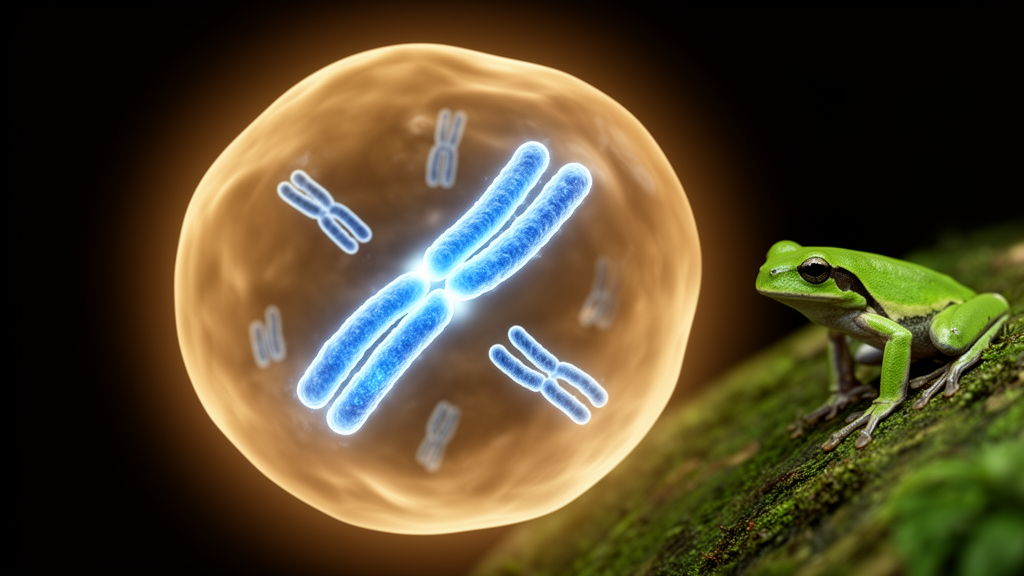
Madagascar's mantelline frogs, the most species-rich amphibian radiation on the island, have long been studied through their DNA and their dazzling ecological variety, but their chromosomes remained largely a blank spot on the evolutionary map. A new comparative cytogenetic study has now filled in a substantial part of that picture, analyzing eight species across the genera Gephyromantis, Mantidactylus and Spinomantis and synthesizing nearly every karyotype ever published for the subfamily. The result is a coherent model of how chromosome numbers and structures diversified in this group, and it points to a striking conclusion: the same kind of chromosomal reduction happened repeatedly and independently in different lineages of mantelline frogs.
The research team, working with cell suspensions collected in Madagascar between 1999 and 2004 and preserved at the University of Naples Federico II, examined thirteen samples representing eight mantelline species. Before touching a single chromosome slide, the researchers first confirmed the identity of every specimen using molecular barcoding. They amplified and sequenced a fragment of roughly 550 base pairs of the mitochondrial 16S rRNA gene, a marker widely used for identifying Malagasy amphibians, and compared the new sequences against a curated reference database of mantellid lineages using a local BLAST analysis.
All sequences matched reference material with identity scores above 97 percent, ensuring that each karyotype was attributed to the correct species, a step the authors emphasize as essential given how frequently frog taxonomy has been revised in recent decades. With taxonomy settled, the team turned to the chromosomes themselves. Using the air-drying method on dissociated tissues, they prepared metaphase plates and applied a battery of staining techniques: conventional Giemsa staining to reveal overall chromosome morphology, silver staining (Ag-NOR) to locate the nucleolus organizer regions where ribosomal RNA genes cluster, C-banding to map constitutive heterochromatin, and sequential staining with the fluorochromes CMA and DAPI to distinguish GC-rich from AT-rich heterochromatic blocks.
Karyotypes were reconstructed from at least five metaphase plates per sample, and detailed morphometric parameters, including relative chromosome lengths and centromeric indices, were recorded for every chromosome pair. The results split the studied species into two clear chromosomal camps. Three species, Gephyromantis striatus, Mantidactylus (Brygoomantis) alutus and Spinomantis prope aglavei "North", carried karyotypes of 2n = 24 chromosomes, with six conspicuously large pairs dominating the complement.
The remaining five species, including Gephyromantis sp. Ca19, Mantidactylus (Chonomantis) sp. Ca11, Mantidactylus (Hylobatrachus) cowanii, Spinomantis phantasticus and Spinomantis sp. Ca3, all showed the more typical 2n = 26 configuration, with five large pairs followed by eight smaller ones. Within these broad patterns, the details varied considerably: some species had entirely biarmed chromosomes, while others carried one or two pairs of telocentric elements, chromosomes with centromeres at their very ends. The position of the nucleolus organizer regions proved equally informative.
In most of the 2n = 26 species, the NORs sat on the sixth chromosome pair, a placement the authors interpret as the ancestral state for the entire family Mantellidae. But in the chromosome-reduced species, the story became more complicated. In Mantidactylus alutus, the large sixth pair itself bore the NORs, consistent with that pair having formed through a fusion involving the primitive NOR-bearing chromosome.
In Gephyromantis striatus and Spinomantis prope aglavei "North", by contrast, the sixth pair carried no NORs at all; the ribosomal gene clusters instead sat on the tenth and seventh pairs respectively. This mismatch matters, because it shows that similar-looking reduced karyotypes were not built the same way in every lineage. Putting the new data together with roughly forty previously published mantelline karyotypes, the researchers assembled the most comprehensive overview of chromosomal diversity in the subfamily to date.
The picture that emerges is one of a deeply conserved ancestral blueprint. Across all three mantellid subfamilies, including the tree frog clade Boophinae and the species-poor Laliostominae, the dominant karyotype is 2n = 26 with all biarmed chromosomes and NORs on the sixth pair. The authors propose that this configuration represents the primitive condition for the whole family, a hypothesis reinforced by the fact that Boophinae, considered a basal branch of the mantellid radiation, shows this karyotype uniformly across its roughly eighty described species of Boophis.
Against that conserved backdrop, the reduced 2n = 24 karyotype stands out as a derived and surprisingly repeatable innovation. The synthesis identified nine species with 24 chromosomes, distributed across three genera: six species of the Mantidactylus subgenus Brygoomantis, two species of Spinomantis, and Gephyromantis striatus. Crucially, these reduced karyotypes do not form a single tidy branch on the mantelline family tree; they appear in lineages where the 2n = 26 configuration also persists among close relatives.
The authors therefore conclude that chromosome number reduction from 26 to 24 occurred multiple times, independently, in different mantelline lineages, most plausibly through tandem fusions, a translocation joining two of the smaller chromosome pairs to produce an additional large element. Chromosome inversions added a second layer of diversification. By flipping segments within the primitive biarmed elements, inversions generated variable numbers of telocentric chromosomes in different lineages, contributing to the marked differences in chromosome morphology that earlier studies had already noticed even among species sharing the same chromosome count.
The heterochromatin landscape added a third. C-banding revealed species-specific patterns of constitutive heterochromatin, with centromeric and telomeric blocks differing in amount, position and fluorochrome affinity even between closely related species with otherwise similar karyotypes. Gephyromantis striatus and Mantidactylus cowanii, for example, show heterochromatin distributions clearly distinct from their close relatives Gephyromantis sp. Ca19 and Mantidactylus alutus.
Such variation typically reflects differing levels of amplification of highly repetitive DNA, and in the mantellids it appears to have accumulated largely without altering chromosome shape, probably through symmetric additions and deletions of heterochromatic material. The study also mapped the relocation of NORs across the subfamily, documenting ribosomal gene clusters on chromosome pairs one, two, six, seven, eight, nine, ten and eleven in different mantelline species. The authors discuss several mechanisms that could shuffle NOR positions, including cryptic structural rearrangements, minute insertions, the reintegration of rDNA genes amplified during egg cell development, or the activation of previously silent rDNA sites.
They note a technical caveat: Ag-NOR staining reveals only active NORs, so inactive ribosomal clusters could hide elsewhere in these genomes. However, the correspondence they found between Ag-NOR staining and C-banding combined with CMA, which can also uncover rDNA clusters, strengthens confidence in the mapped positions. Notably, no sex-specific heterochromatic chromosomes, B chromosomes or heteromorphic autosome pairs turned up in any of the studied samples, and differentiated sex chromosomes remain undocumented for the entire family Mantellidae.
Beyond the evolutionary story, the work carries practical messages for anyone studying Madagascar's frogs. The authors underline that molecular taxonomic identification should precede karyotype attribution, since candidate species and revised classifications pervade the group, and they call for cytogenetic work on the still-unsampled mantellid genera Laliostoma, Wakea, Boehmantis and Tsingymantis, along with the many undersampled subgenera. With around 230 described mantellid species and new candidates still being described from DNA barcodes, the chromosomal dimension of this radiation is only beginning to come into focus.
Subject of Research: Comparative cytogenetics and karyotype evolution of Malagasy mantelline frogs
Article Title: Comparative cytogenetics on eight Malagasy Mantellinae ( Anura , Mantellidae ) and a synthesis of the karyological data on the subfamily
Article References: Mezzasalma, M., Andreone, F., Odierna, G., Guarino, F. M., & Crottini, A. (2022). Comparative cytogenetics on eight Malagasy Mantellinae (Anura, Mantellidae) and a synthesis of the karyological data on the subfamily. Comparative Cytogenetics, 16(1), 1-17. https://doi.org/10.3897/compcytogen.v16.i1.76260
Image Credits: AI Generated
DOI: 10.3897/compcytogen.v16.i1.76260
Keywords: Mantellinae, Mantellidae, Madagascar, cytogenetics, karyotype, chromosome fusion, NOR, heterochromatin, anurans, Gephyromantis, Mantidactylus, Spinomantis
Cite Scienmag News
Gavin Prescott. (October 27, 2026). Chromosome fusions shaped frog evolution in Madagascar again and again. Scienmag. https://scienmag.com/chromosome-fusions-shaped-frog-evolution-in-madagascar-again-and-again/
Gavin Prescott. "Chromosome fusions shaped frog evolution in Madagascar again and again." Scienmag, 27 October 2026, https://scienmag.com/chromosome-fusions-shaped-frog-evolution-in-madagascar-again-and-again/. Accessed 27 October 2026.
Gavin Prescott. "Chromosome fusions shaped frog evolution in Madagascar again and again." Scienmag. October 27, 2026. https://scienmag.com/chromosome-fusions-shaped-frog-evolution-in-madagascar-again-and-again/