


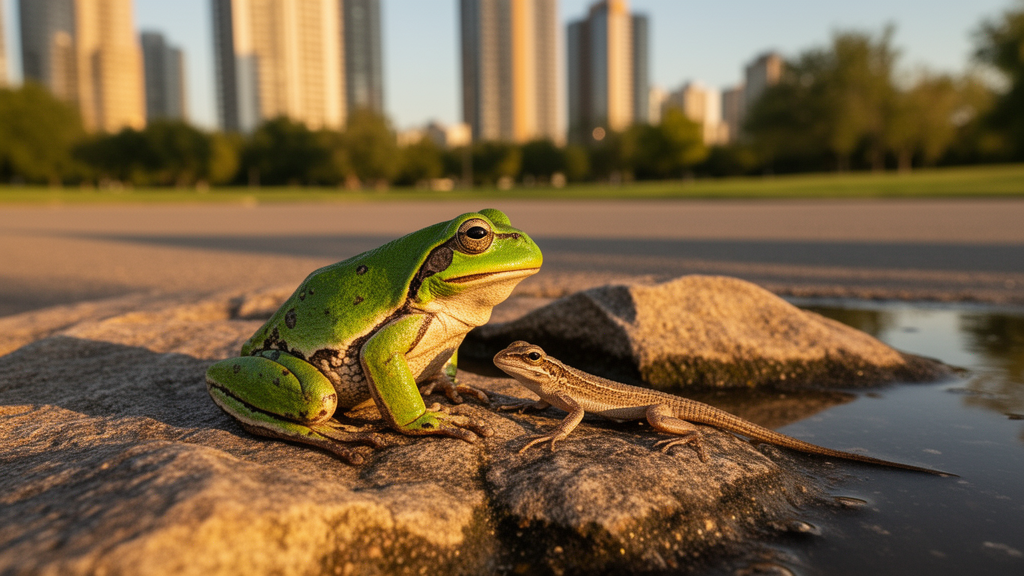
Amphibians and reptiles are among the most ecologically sensitive vertebrate groups on Earth, and they are now confronting unprecedented challenges in the Anthropocene. As ectotherms, their thermoregulation, metabolism, and virtually every physiological process are tightly coupled to external temperature and habitat quality. Urbanization and climate change are rapidly reshaping their environments, driving temperatures upward, intensifying heat extremes, and increasing spatial overlap between cities and biodiversity hotspots. Beyond heat, urban landscapes impose additional stressors such as artificial light at night, anthropogenic noise, and chemical contaminants, all of which can disrupt communication, predator detection, and long-term health outcomes.
A new editorial published in Frontiers in Amphibian and Reptile Science brings together four studies spanning continents and life stages to tackle some of the most pressing research gaps in this field. The findings fall into two broad themes: thermal physiology and behavioral responses on one hand, and stress physiology and contaminant exposure on the other. Together, they reveal that herpetofauna responses to urbanization and climatic change are rarely uniform, cautioning against broad generalizations and reinforcing the need for multispecies, multiparameter approaches.
In one study, researchers investigated the thermal physiology of the Mysore day gecko (Cnemaspis mysoriensis) in the major metropolitan city of Bengaluru, India. They found that human-made microhabitats had slightly higher and more variable environmental temperatures than natural microhabitats, but the geckos did not exhibit significant shifts in their thermal physiology. Instead, they relied on behavioral thermoregulation to maintain body temperatures within their preferred range. This highlights the importance of retaining natural microhabitats in urban landscapes, as the temperature range of natural microhabitats closely matches the thermal range of these species.
In a second study, researchers examined the physiological and behavioral responses of the Gulf Coast toad (Incilius nebulifer), an urban exploiter, to urbanization and climate variation. Interestingly, populations in the warmest and least urbanized sites exhibited the highest locomotor performance, suggesting that the energetic costs of living in urban areas might have a nuanced relationship with the thermal tolerance of the species. These two studies demonstrate that multiple stressors must be studied together to accurately predict population outcomes.
The same Gulf Coast toad research also revealed that populations in more urbanized sites showed elevated baseline and stress-induced corticosterone release rates, faster negative feedback recovery, and higher lipid storage. Climate, on the other hand, had a non-linear relationship with these traits, with populations at both thermal extremes showing reduced corticosterone and lipid levels. The rate of glucocorticoid recovery following stress increased with urbanization but decreased with temperature, consistent with the on-again, off-again hypothesis of glucocorticoid regulation, whereby efficient post-stress recovery enables organisms to mount repeated stress responses without chronic physiological costs.
A third study explored the hormonal and behavioral responses of young common toads (Bufo bufo) to artificial light at night and noise pollution. This work marked a shift from population-level responses to measuring individual consistencies in phenotypic traits. The researchers found that while corticosterone profiles changed during ontogeny, individual consistency in stress responses was low. Interestingly, foraging rates increased under both light and noise pollution, but these behavioral changes were not correlated with stress hormone levels. This decoupling suggests that phenotypic plasticity, rather than individual variation in the stress axis, may enable common toads to tolerate urban stressors during early life.
A fourth study examined a distinct but equally critical axis of anthropogenic threat: chemical contamination. Researchers investigated heavy metal accumulation in olive ridley sea turtles (Lepidochelys olivacea) at two mass nesting rookeries in India. As long-lived, wide-ranging reptiles occupying higher trophic positions, sea turtles are particularly susceptible to bioaccumulation of heavy metals across multiple life stages. By measuring the concentrations of nine heavy metals in adults, in utero and oviposited eggs, hatchlings, and nesting beach sand, the team showed that contaminants move across both maternal and environmental pathways. Heavy metals in in utero eggs provided direct evidence of maternal transfer, while correlations between sand and hatchling metal concentrations suggested environmental exposure. This multistage design highlights how industrial and agricultural pollution can affect sea turtles across life stages.
Taken together, the studies show that species differ in their responses through physiological adjustment, behavioral flexibility, or a combination of both. The Mysore day gecko primarily relies on behavioral adjustments while maintaining relatively conserved physiology. In contrast, the Gulf Coast toad shows population-level variation in glucocorticoid dynamics, whereas the common toad displays flexible behavior that is largely independent of hormonal state. This diversity cautions against generalizations and reinforces the need for multispecies, multiparameter approaches. Multiple stressors frequently co-occur and interact with thermal changes, sensory pollution, and chemical contamination, yet they are mostly studied individually.
The life-stage dependency of responses, illustrated both by ontogenetic shifts in corticosterone profiles in common toads and by maternal contaminant transfer in olive ridley sea turtles, highlights that vulnerability assessments must span the full life cycle. Future research should prioritize the simultaneous measurement of multiple physiological traits across environmental gradients. Geographically diverse datasets on herpetofaunal communities, spanning tropical, subtropical, and temperate regions, are particularly needed, given that the majority of global amphibian and reptile diversity occurs in regions that are disproportionately underrepresented in physiological research. Ultimately, insights from this collection of studies will help guide conservation interventions that consider the complex and interacting pressures now facing herpetofauna worldwide.
Subject of Research: Editorial: Effects of urbanization and climate change on the physiology of amphibians and reptiles
Article Title: Editorial: Effects of urbanization and climate change on the physiology of amphibians and reptiles
Article References: Batabyal, A., & Dissanayake, D. (2026). Editorial: Effects of urbanization and climate change on the physiology of amphibians and reptiles. Frontiers in Amphibian and Reptile Science, 4, Article 1873581. https://doi.org/10.3389/famrs.2026.1873581
Image Credits: AI Generated
DOI: 10.3389/famrs.2026.1873581
Keywords: amphibians, reptiles, urbanization, climate change, thermal physiology, corticosterone, artificial light at night, heavy metals, sea turtles, ectotherms, behavioral thermoregulation, conservation
Cite Scienmag News
Margaret Porter. (October 16, 2026). Urban Heat and Rising Stress: How Amphibians and Reptiles Cope in a Changing World. Scienmag. https://scienmag.com/urban-heat-and-rising-stress-how-amphibians-and-reptiles-cope-in-a-changing-world/
Margaret Porter. "Urban Heat and Rising Stress: How Amphibians and Reptiles Cope in a Changing World." Scienmag, 16 October 2026, https://scienmag.com/urban-heat-and-rising-stress-how-amphibians-and-reptiles-cope-in-a-changing-world/. Accessed 16 October 2026.
Margaret Porter. "Urban Heat and Rising Stress: How Amphibians and Reptiles Cope in a Changing World." Scienmag. October 16, 2026. https://scienmag.com/urban-heat-and-rising-stress-how-amphibians-and-reptiles-cope-in-a-changing-world/


