


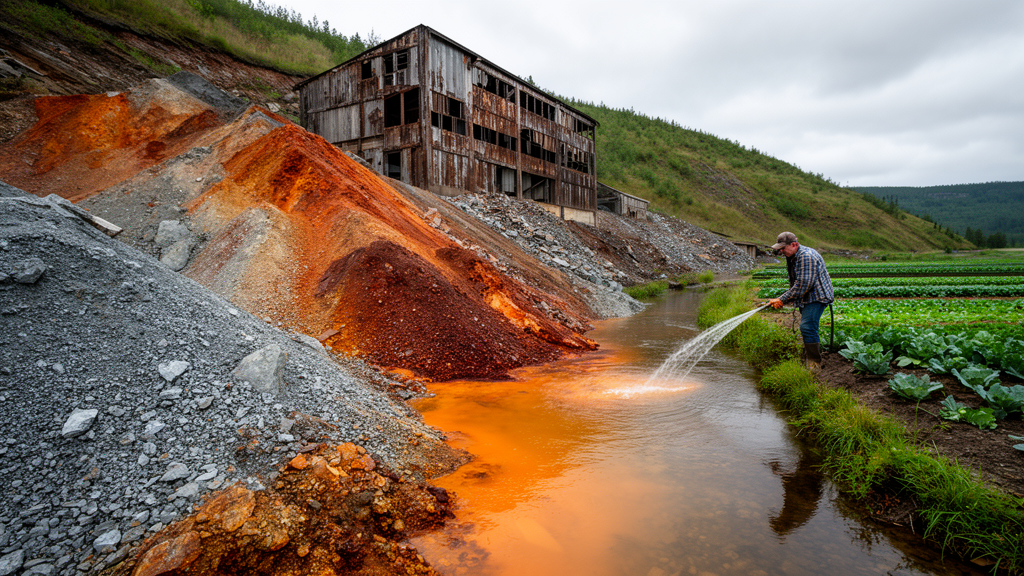
A quiet environmental time bomb may be ticking in the abandoned mine sites of two continents. New research from the University of Exeter has revealed that cobalt — a metal now classified as a “Critical Raw Material” by the European Commission and multiple governments — behaves with alarming consistency when left to weather in century-old mine waste, regardless of where on Earth it was dumped. The findings suggest that as the world races to mine more cobalt for electric vehicle batteries and digital technologies, the wastes left behind could pose far greater risks to water supplies and food chains than previously understood.
The study, published in Frontiers in Geochemistry, examined mine wastes from two strikingly different legacy mining regions: the town of Cobalt in Ontario, Canada, and three historic mine sites in Cornwall, England. Despite vast differences in geology, ore type, and processing methods spanning a millennium of mining history, the researchers found that cobalt in both locations showed consistently high potential for mobilization — meaning it could readily dissolve and travel into aquatic environments where it might enter the food chain.
“The concentrations we found at Cobalt, Canada were extraordinary,” the research indicates, with high-grade Nipissing tailings containing up to 5,630 milligrams of cobalt per kilogram of material — roughly 900 times higher than the Cornwall sites. Even the low-grade tailings at Cobalt reached 1,230 milligrams per kilogram, dwarfing the averages of 40, 76, and 59 milligrams per kilogram found at Poldice, Wheal Unity, and Dolcoath mines in Cornwall respectively. These concentrations far exceed residential soil quality guidelines set by regulatory bodies in Ontario, Canada, the United States, and the European Union.
The research team, led by Gabriel Ziwa of the Camborne School of Mines at the University of Exeter, employed a sophisticated battery of analytical techniques to understand not just how much cobalt was present, but in what chemical forms. Using X-ray diffraction, scanning electron microscopy, and electron microprobe analysis, they identified the specific minerals hosting the cobalt — a crucial step because a metal locked inside a stable crystal is far less dangerous than one sitting on a mineral surface ready to dissolve at the first change in water chemistry.
At Cobalt, Canada, the picture was dominated by a striking pink mineral called erythrite — a cobalt arsenate that formed as needle-like crystals growing on silicate and carbonate grains throughout the tailings. This secondary mineral, containing roughly 20.8 percent cobalt by weight, proved to be the most widespread cobalt-bearing phase at the site. The researchers also identified primary cobalt minerals including cobaltite, safflorite, and skutterudite, alongside cobalt incorporated into arsenopyrite, loellingite, pyrite, and chalcopyrite. Secondary phases such as arseniosiderite, scorodite, and iron oxyhydroxides also harboured significant cobalt concentrations.
In Cornwall, by contrast, no dedicated cobalt minerals were found at all. Instead, cobalt existed only as a trace component — typically less than one percent by weight — hidden inside common sulfide minerals like pyrite, chalcopyrite, and arsenopyrite, and in secondary phases such as scorodite and iron-manganese oxyhydroxides. Yet this difference in mineralogical hosting made almost no difference to the metal’s behaviour when subjected to sequential extraction testing.
The most alarming result came from the BCR sequential extraction analysis, a standardized European protocol that subjects mine waste to progressively stronger chemical leaches to simulate what might happen under different environmental conditions. In both the Canadian and British samples, an average of 46 percent of the total cobalt was extracted in the very first, mildest step — the “exchangeable” fraction that represents metal most easily dissolved by slight changes in acidity. This means nearly half the cobalt in these wastes is sitting in a form that could be released into water with only minor pH shifts.
Applying the Risk Assessment Code framework developed by Perin and colleagues, the researchers classified cobalt in the Cornwall samples as ranging from high risk to very high risk, with individual samples reaching exchangeable fractions of up to 62 percent. At Cobalt, Canada, values ranged from 28 to 58 percent, placing the metal in medium to very high risk categories. According to the RAC guidelines, metals exceeding 50 percent in the exchangeable fraction are considered to easily enter the food chain — a classification that directly implicates these mine wastes as potential vectors for human cobalt exposure through crops, livestock, and water supplies.
The chemistry behind this mobilization is well understood. At Cornwall’s acidic sites, where paste pH values ranged from 3.72 to 5.77, sulfide minerals like pyrite generate acid through oxidation, and any cobalt-bearing phases dissolve readily, releasing cobalt ions and arsenic oxyanions into solution. At Cobalt, Canada, the near-neutral pH of 7.50 to 7.84 currently stabilizes erythrite within its thermodynamic stability field — but the researchers warn this equilibrium is fragile. A shift toward acidity, whether from changing oxidation conditions or altered hydrology, could dissolve the erythrite and release its cobalt payload. The iron and manganese oxyhydroxides that scavenge cobalt in both locations are themselves thermodynamically unstable under reducing conditions, meaning buried or waterlogged wastes could also release their stored metal.
What makes this research particularly significant is its implication for the future. Cobalt demand is projected to surge as electric vehicle adoption accelerates globally, and governments worldwide have designated it a strategic resource. Yet the environmental behaviour of cobalt in mine waste has been remarkably understudied compared to metals like arsenic or lead. The Exeter team’s finding that cobalt behaves similarly across such geologically different settings — a five-element silver-cobalt-nickel vein deposit in Precambrian rocks versus polymetallic tin-copper-arsenic veins in Devonian-Carboniferous host rocks — suggests that the metal’s mobility in mine waste may follow predictable patterns worldwide. If confirmed by further research, this would mean that every new cobalt mine opening today is generating waste with the same latent capacity to contaminate water and food chains that century-old sites in Canada and England are only now revealing.
Subject of Research: Geochemistry and mineralogy of cobalt mobility in legacy mine wastes from Cobalt, Canada and Cornwall, England
Article Title: Geochemistry and mineralogy of Cobalt in mine wastes: examples from Cobalt, Canada and Cornwall, England
Article References: Ziwa, G., Crane, R., & Hudson-Edwards, K. A. (2025). Geochemistry and mineralogy of Cobalt in mine wastes: examples from Cobalt, Canada and Cornwall, England. Frontiers in Geochemistry, 3, Article 1543695. https://doi.org/10.3389/fgeoc.2025.1543695
Image Credits: AI Generated
DOI: 10.3389/fgeoc.2025.1543695
Keywords: cobalt, mine waste, tailings, geochemistry, mineralogy, erythrite, sequential extraction, mobility, critical raw materials, contamination, Cornwall, Ontario
Cite Scienmag News
William Thompson. (October 16, 2026). Cobalt’s Hidden Threat: Century-Old Mine Waste Could Poison Water and Food Chains. Scienmag. https://scienmag.com/cobalts-hidden-threat-century-old-mine-waste-could-poison-water-and-food-chains/
William Thompson. "Cobalt’s Hidden Threat: Century-Old Mine Waste Could Poison Water and Food Chains." Scienmag, 16 October 2026, https://scienmag.com/cobalts-hidden-threat-century-old-mine-waste-could-poison-water-and-food-chains/. Accessed 16 October 2026.
William Thompson. "Cobalt’s Hidden Threat: Century-Old Mine Waste Could Poison Water and Food Chains." Scienmag. October 16, 2026. https://scienmag.com/cobalts-hidden-threat-century-old-mine-waste-could-poison-water-and-food-chains/


