


…
…
The choice of magnesium as a dopant in hydrated tungsten oxide is notable when considered against the broader landscape of cation substitution in pseudocapacitive metal oxides. Magnesium ions carry a divalent charge similar to the host tungsten-oxygen framework requirements for charge compensation, yet their ionic radius is considerably smaller than that of tungsten in its hexavalent state. This mismatch, rather than being a drawback, can be advantageous: when a smaller divalent cation substitutes into the lattice, it perturbs the local coordination environment in ways that tend to generate oxygen vacancies and lattice strain. Oxygen vacancies are widely recognized in the electrochemistry literature as beneficial defects for pseudocapacitive materials because they act as preferential adsorption and intercalation sites for protons, raise the density of states near the Fermi level, and thereby improve the apparent electronic conductivity of an otherwise poorly conducting oxide. The authors’ observation that Mg doping improved electrical conductivity while preserving the layered hydrated structure is consistent with this defect-engineering picture, since moderate doping levels can introduce defects without collapsing the interlayer spacing that accommodates structural water and fast proton transport.
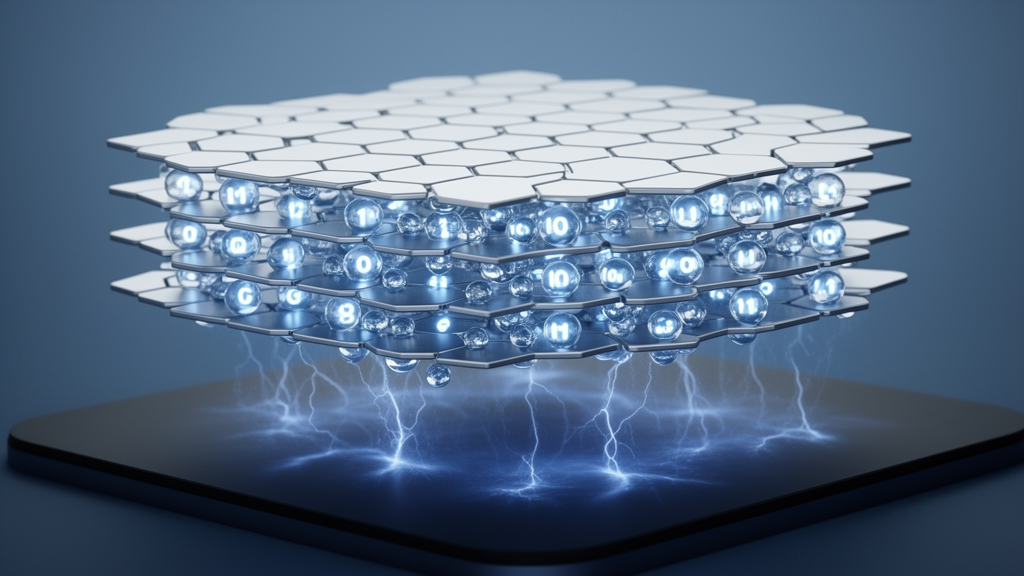
The layered nature of WO3·H2O itself deserves emphasis. Unlike anhydrous tungsten oxide polymorphs, the hydrated phase incorporates water molecules between tungsten oxide planes, and these structural water molecules serve a dual purpose. First, they widen the interlayer gap, lowering the activation barrier for proton insertion and extraction during charge and discharge. Second, they can buffer the mechanical stress that accompanies repeated ion intercalation, which is one of the principal causes of capacity fade in intercalation-type electrode materials. This helps explain why hydrated tungsten oxides have attracted attention as pseudocapacitive candidates despite tungsten oxide’s intrinsically modest electronic conductivity compared with, for example, ruthenium oxide. The present work builds on this foundation by showing that the hydration framework survives the wet-chemical doping process intact, which is a nontrivial outcome because acidic precipitation routes can sometimes drive partial dehydration or phase transitions if the temperature and pH are not carefully controlled.
The synthesis route described, based on acidification of sodium tungstate with oxalic acid and hydrochloric acid at elevated temperature, is an example of a low-temperature solution-phase approach that favors the formation of well-defined nanoplates. Nanoplate morphologies are particularly favorable for pseudocapacitive charge storage because they expose large basal planes to the electrolyte, shortening the diffusion distance for protons and increasing the fraction of the material that participates in redox reactions within the timescale of a voltammetric sweep. The one-step nature of the synthesis is also practically significant. Doping strategies often require post-synthetic treatments such as high-temperature annealing in controlled atmospheres, which can sinter nanostructures, remove structural water, or complicate scale-up. Incorporating the dopant directly during precipitation avoids these complications and ensures atomic-level mixing of magnesium within the tungsten oxide host, which is generally more effective for modifying electronic properties than surface-only treatments.
The reported specific capacitance of 158 F per gram at 1 A per gram for the optimally doped composition should be interpreted in the context of aqueous acidic electrolytes and the intrinsic properties of tungsten oxide. While some literature values for hydrated tungsten oxide-based electrodes exceed this figure, direct comparisons across studies are complicated by differences in mass loading, electrode preparation, electrolyte choice, and the voltage window used in the capacitance calculation. What is more diagnostic in this study is the combination of capacitance with the kinetic analysis summarized by the b-value. In cyclic voltammetry, the peak current typically scales with scan rate according to a power law, and the exponent, known as the b-value, distinguishes between diffusion-limited battery-like behavior (b near 0.5) and surface-dominated capacitive behavior (b near 1.0). A b-value of 0.82 for the Mg-doped material indicates that a substantial majority of the charge storage occurs through fast, surface-near processes rather than slow solid-state diffusion. This is precisely the regime desired for supercapacitor electrodes, since it supports high-rate operation and reduced susceptibility to diffusion-induced structural degradation during cycling.
The improvement in ion diffusion kinetics attributed to Mg doping can be rationalized through several complementary mechanisms. Divalent cation substitution can widen transport pathways through lattice expansion and defect formation, lower the energy barrier for proton hopping between adjacent oxygen sites, and increase the density of electroactive sites where interfacial charge transfer occurs. Electrochemical impedance spectroscopy, which the authors employed, typically reveals such effects as reduced charge-transfer resistance and altered Warburg behavior corresponding to more facile ion diffusion in the electrode. The fact that the intermediate doping level, approximately three percent magnesium, outperformed both the pristine material and the higher-doped compositions reflects a common pattern in doped oxides: too little dopant leaves the electronic structure largely unmodified, while too much dopant can disrupt the crystal framework, create insulating secondary phases, or block diffusion channels, all of which degrade performance. The existence of an optimal doping concentration near the lower end of the tested range suggests that the beneficial effects of magnesium incorporation saturate quickly relative to the structural penalties of heavier doping.
The fabrication of an aqueous asymmetric supercapacitor represents an important step beyond half-cell characterization. Asymmetric devices pair a battery-like or pseudocapacitive positive electrode with a capacitive negative electrode, in this case activated carbon, allowing the operating voltage window of the full cell to exceed the thermodynamic stability limit of water at a single electrode. By balancing the charges stored on the two electrodes, the device exploits the full electrochemical stability window of the aqueous electrolyte, which can push cell voltages toward or beyond 1.6 volts in acidic media. Because energy density scales with the square of voltage, even modest extensions of the window translate into meaningful gains in deliverable energy. The use of a dilute sulfuric acid electrolyte also aligns with the proton-conduction mechanism of hydrated tungsten oxide, since protons are the working ions for intercalation in this material, and acidic media provide them at high concentration with minimal transport resistance.
Long-term cycling stability is arguably the most demanding metric for pseudocapacitive intercalation materials, because repeated insertion and extraction of protons induces volume changes that can pulverize nanostructures, delaminate electrodes, and dissolve active material. The demonstration of stable coulombic efficiency over 5,000 cycles in the asymmetric device suggests that the Mg-doped nanoplates resist these degradation pathways. Several features of the material plausibly contribute to this durability. The structural water in the hydrated phase cushions intercalation-induced strain, the nanoplate morphology accommodates volume change in two dimensions rather than three, and the dopant-stabilized defect structure may pin domain boundaries against coarsening. Additionally, the surface-dominated charge storage indicated by the high b-value reduces the depth of ion penetration per cycle, lessening the mechanical fatigue associated with bulk expansion and contraction.
From a practical standpoint, the choice of abundant, low-toxicity elements is worth noting. Tungsten and magnesium are both relatively inexpensive compared with the noble metals that defined early pseudocapacitor research, and magnesium in particular is benign and plentiful. The wet-chemical synthesis operates at modest temperatures with water and ethanol as solvents, avoiding energy-intensive calcination steps. These attributes matter for the economic viability of supercapacitor electrodes at scale, where the cost of active material and processing can dominate device cost. The aqueous electrolyte further enhances safety and environmental profile relative to organic electrolytes used in commercial double-layer capacitors, albeit at the cost of a narrower voltage window that asymmetric architectures partially compensate for.
Looking forward, the results suggest several avenues that follow naturally from this work. Systematic variation of dopant identity among alkaline-earth cations could clarify whether the observed benefits stem primarily from defect generation, lattice strain, or electronic structure modification, since these cations differ systematically in radius and charge density. Quantitative separation of capacitive and diffusion-limited contributions across scan rates, which the b-value analysis gestures toward, could be extended with methods such as Dunn analysis to map how doping shifts the balance of storage mechanisms. Coupling the electrodes with complementary pseudocapacitive or battery-type positive materials in full cells might further raise energy density while retaining the power capability that motivates supercapacitor use. Finally, evaluating performance under realistic operating conditions, including elevated temperature, partial states of charge, and mechanical flexing, would help bridge the gap between laboratory half-cell metrics and the durability requirements of portable electronics, electric vehicles, and industrial power buffering applications that motivate research in this field.
Subject of Research: …
Article Title: Mg-doped hydrated tungsten oxide nanostructures as pseudocapacitive electrodes for high-performance aqueous asymmetric supercapacitors
Article References: Nishad, H. S., Jaiswar, R. R., Shirodkar, M., Patil, B. M., Chaskar, A. C., & Walke, P. S. (2026). Mg-doped hydrated tungsten oxide nanostructures as pseudocapacitive electrodes for high-performance aqueous asymmetric supercapacitors. Frontiers in Batteries and Electrochemistry, 5, Article 1883507. https://doi.org/10.3389/fbael.2026.1883507
Image Credits: AI Generated
DOI: 10.3389/fbael.2026.1883507
Keywords: supercapacitors, pseudocapacitance, hydrated tungsten oxide, magnesium doping, nanoplates, asymmetric supercapacitor, energy storage, electrochemistry, oxygen vacancies, ion diffusion, Mg-doped, hydrated
Cite Scienmag News
Denise Maddox. (October 16, 2026). Magnesium Doping Turns Hydrated Tungsten Oxide Nanoplates Into High-Performance Supercapacitor Electrodes. Scienmag. https://scienmag.com/magnesium-doping-turns-hydrated-tungsten-oxide-nanoplates-into-high-performance-supercapacitor-electrodes/
Denise Maddox. "Magnesium Doping Turns Hydrated Tungsten Oxide Nanoplates Into High-Performance Supercapacitor Electrodes." Scienmag, 16 October 2026, https://scienmag.com/magnesium-doping-turns-hydrated-tungsten-oxide-nanoplates-into-high-performance-supercapacitor-electrodes/. Accessed 16 October 2026.
Denise Maddox. "Magnesium Doping Turns Hydrated Tungsten Oxide Nanoplates Into High-Performance Supercapacitor Electrodes." Scienmag. October 16, 2026. https://scienmag.com/magnesium-doping-turns-hydrated-tungsten-oxide-nanoplates-into-high-performance-supercapacitor-electrodes/


