


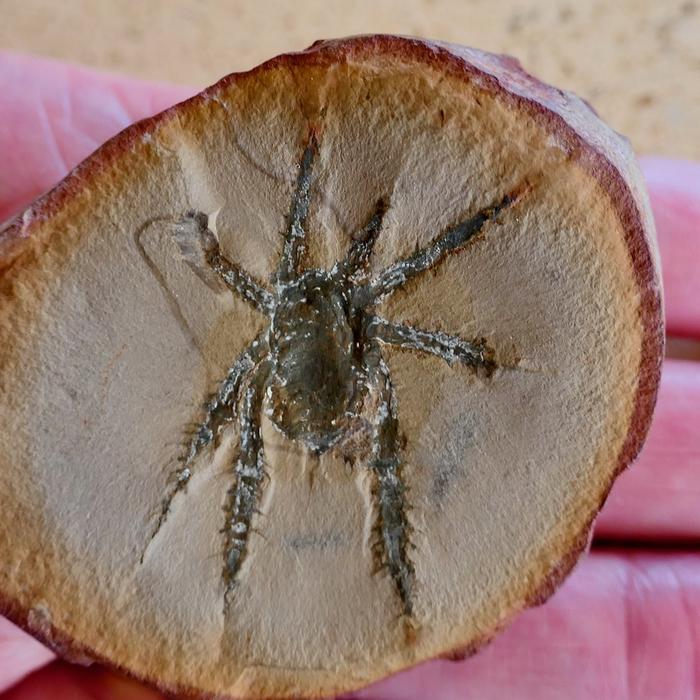
LAWRENCE — More than 300 million years ago, all sorts of arachnids crawled around the Carboniferous coal forests of North America and Europe. These included familiar ones we’d recognize, such as spiders, harvestmen and scorpions — as well exotic animals that now occur in warmer regions like whip spiders and whip scorpions.

Credit: Paul Selden
LAWRENCE — More than 300 million years ago, all sorts of arachnids crawled around the Carboniferous coal forests of North America and Europe. These included familiar ones we’d recognize, such as spiders, harvestmen and scorpions — as well exotic animals that now occur in warmer regions like whip spiders and whip scorpions.
But there were also quite bizarre arachnids in these habitats belonging to now extinct groups. Even among these stranger species now lost to time, one might have stood out for its up-armored legs.
The ancient critter recently was described in a new paper published in the Journal of Paleontology, co-written by Paul Selden from the University of Kansas and the Natural History Museum of London and Jason Dunlop from the Museum für Naturkunde Berlin.
“Douglassarachne acanthopoda comes from the famous Mazon Creek locality in Illinois and is about 308 million years old,” said lead author Selden. “This compact arachnid had a body length of about 1.5 centimeters and is characterized by its remarkably robust and spiny legs — such that it is quite unlike any other arachnid known, living or extinct.”
The KU researcher said Carboniferous Coal Measures are an important source of information for fossil arachnids, representing the first time in Earth’s history when most living groups of arachnids occurred together. Yet, the fauna was still quite different to today.
“Spiders were a rather rare group, only known at that time from primitive lineages, and they shared these ecosystems with various arachnids which have long since died out,” said co-author Dunlop. “Douglassarachne acanthopoda is a particularly impressive example of one of these extinct forms. The fossil’s very spiny legs are reminiscent of some modern harvestmen, but its body plan is quite different from a harvestman or any other known arachnid group.”
This led the two scientists to conclude it doesn’t belong in any of the known arachnid orders.
“Unfortunately, details such as the mouth parts cannot be seen, which makes it difficult to say exactly which group of arachnids are its closest relatives, Selden said. “It could belong to a wider group, which includes spiders, whip spiders and whip scorpions. Whatever its evolutionary affinities, these spiny arachnids appear to come from a time when arachnids were experimenting with a range of different body plans. Some of these later became extinct, perhaps during the so-called ‘Carboniferous Rainforest Collapse,’ a time shortly after the age of Mazon Creek when the coal forests began to fragment and die off. Or perhaps these strange arachnids clung on until the end Permian mass extinction?”
According to the team, Mazon Creek fossil locality is one of the most important windows into life in the late Carboniferous, producing a wide range of fascinating plants and animals. The present fossil was discovered in a clay-ironstone concretion in the 1980s by Bob Masek and later acquired by the David and Sandra Douglass Collection and displayed in their Prehistoric Life Museum.
“The genus name Douglassarachne acknowledges the Douglass family, who kindly donated the specimen to the Field Museum of Natural History in Chicago for scientific study once it became apparent that it represented an undescribed species,” Dunlop said. “Then, acanthopoda refers to the unique and characteristic spiny legs of the animal.”
Journal
Journal of Paleontology
Cite Scienmag News
Violet Maxwell. (May 17, 2024). Ancient arachnid from coal forests of America stands out for its spiny legs. Scienmag. https://scienmag.com/ancient-arachnid-from-coal-forests-of-america-stands-out-for-its-spiny-legs/
Violet Maxwell. "Ancient arachnid from coal forests of America stands out for its spiny legs." Scienmag, 17 May 2024, https://scienmag.com/ancient-arachnid-from-coal-forests-of-america-stands-out-for-its-spiny-legs/. Accessed 3 September 2026.
Violet Maxwell. "Ancient arachnid from coal forests of America stands out for its spiny legs." Scienmag. May 17, 2024. https://scienmag.com/ancient-arachnid-from-coal-forests-of-america-stands-out-for-its-spiny-legs/

