


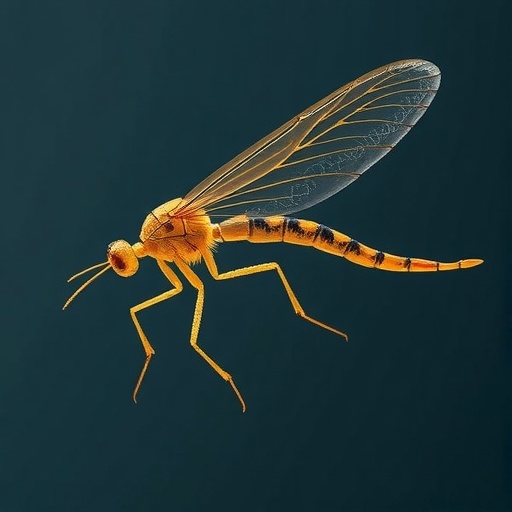
In a groundbreaking discovery that reshapes our understanding of insect evolution and biogeography, an international consortium of scientists has unveiled a new species of fossilized non-biting midge from the Jurassic period of Australia, dating back approximately 151 million years. This exceptional find, led by the Doñana Biological Station (EBD-CSIC), represents the oldest known chironomid from the Southern Hemisphere, a group of winged insects widely recognized for inhabiting freshwater ecosystems.
The fossil was unearthed within the famed Talbragar fish beds of New South Wales, a site renowned for its extraordinary preservation of Jurassic fauna and flora. It captures a remarkable snapshot of a prehistoric ecosystem, distinctively characterized by freshwater conditions, which contrasts with previous assumptions that similar adaptations were exclusive to marine settings. The newly identified species, designated Telmatomyia talbragarica, meaning “fly from the stagnant waters,” pays homage to its lacustrine habitat, and its discovery offers unprecedented insight into the evolutionary trajectory of Chironomidae.
What makes this midge particularly fascinating is the presence of a sophisticated morphological adaptation—a specialized anchoring mechanism known as the terminal disc. Until now, such a feature was solely associated with marine dipterans, facilitating their attachment to unstable substrates in tide-affected environments. The presence of this mechanism in T. talbragarica indicates a much broader ecological plasticity among ancient chironomids, challenging long-held notions about their habitat-specific adaptations and hinting at convergent evolutionary strategies in freshwater biotas.
Analyzing six exquisitely preserved fossil specimens, encompassing both pupal and emerging adult stages, researchers were able to detail the anatomy of this anchoring structure, further corroborating its functional significance in a paleoenvironment inferred through sedimentological and fossil evidence. This discovery underscores the versatility and adaptability of midges across geological timescales, providing crucial data on how freshwater organisms might have responded to Jurassic environmental pressures.
From a biogeographical perspective, the study yields profound implications for the origin and diversification of the Podonominae subfamily, a lineage of Chironomidae that serves as an exemplary model for understanding vicariant patterns in Southern Hemisphere fauna. Historical hypotheses posited a Northern Gondwanan or even Laurasian genesis for Podonominae, shaped largely by fossil finds predominantly from the Northern Hemisphere, thereby biasing evolutionary reconstructions. However, the identification of T. talbragarica as the oldest Southern Hemisphere representative robustly supports a Gondwanan cradle for these midges, preceding widespread dispersion and diversification.
The distribution of extant Podonominae aligns with the classical biogeographic pattern of vicariance, wherein geographical fragmentation—driven by the breakup of supercontinents like Gondwana—segregated populations, fostering allopatric speciation. Today’s populations across South America, Australia, South Africa, and New Zealand mirror this ancient divide, reinforcing the theory proposed decades ago by entomologist Lars Brundin. This new fossil evidence not only bolsters Brundin’s seminal hypothesis but also fills a critical temporal gap, linking Jurassic origins directly to present-day biodiversity.
Nevertheless, the paucity of Southern Hemisphere fossil records remains a limiting factor in fully elucidating the evolutionary narrative of chironomids in these regions. Most known Podonominae fossils have traditionally come from Laurasia, with only a handful of previously documented exceptions, including an Eocene specimen from Australia and a Paleocene fossil from India. This skewed fossil record has perpetuated a Northern Hemisphere-centric view, underscoring the imperative need for targeted paleontological exploration in the Southern Hemisphere.
Experts involved in the study emphasize the consequences of this hemispheric bias on biogeographical inference. Matthew McCurry from the Australian Museum highlights that the current geographical disparities in fossil discoveries can mislead scientific interpretations regarding the true origins and dispersal pathways of taxa. Meanwhile, Steven A. Trewick of Massey University points out the rarity and scientific value of fossilized freshwater insects, like T. talbragarica, in unraveling broader questions about biodiversity evolution and Earth’s changing ecosystems over geological time.
Future research directions will integrate detailed morphological assessments with cutting-edge genomic analyses, aiming to reconstruct the dispersal dynamics of Podonominae species following Gondwana’s fragmentation. Determining whether this movement was largely passive drift mediated by continental separation or involved active dispersal mechanisms will significantly enhance our understanding of evolutionary processes shaping freshwater insect distribution and resilience.
The evolutionary story narrated by Telmatomyia talbragarica resonates far beyond its Jurassic origins. It exemplifies how paleontological discoveries provide a window into the adaptations and historical biogeography of organisms that have survived and thrived through deep time. Moreover, this research underscores the intricate interplay between environmental change, morphological innovation, and species diversification—fundamental themes in evolutionary biology that continue to influence contemporary biodiversity and conservation efforts.
As the fossil record diversifies through such pivotal discoveries, scientists stand to gain an enriched temporal and spatial framework for tracing lineage histories, calibrating molecular clocks, and understanding the effects of ancient supercontinent dynamics on modern ecosystems. T. talbragarica is not merely an ancient fly fossil but a key piece in the complex puzzle of life’s evolutionary saga on our planet.
News Publication Date: 8-Oct-2025
Web References: DOI: 10.1016/j.gr.2025.09.001
Cite Scienmag News
Gavin Prescott. (October 14, 2025). Ancient 150-Million-Year-Old Fossil Reveals Key Adaptation Sheds Light on the Origins of Chironomids. Scienmag. https://scienmag.com/ancient-150-million-year-old-fossil-reveals-key-adaptation-sheds-light-on-the-origins-of-chironomids/
Gavin Prescott. "Ancient 150-Million-Year-Old Fossil Reveals Key Adaptation Sheds Light on the Origins of Chironomids." Scienmag, 14 October 2025, https://scienmag.com/ancient-150-million-year-old-fossil-reveals-key-adaptation-sheds-light-on-the-origins-of-chironomids/. Accessed 3 September 2026.
Gavin Prescott. "Ancient 150-Million-Year-Old Fossil Reveals Key Adaptation Sheds Light on the Origins of Chironomids." Scienmag. October 14, 2025. https://scienmag.com/ancient-150-million-year-old-fossil-reveals-key-adaptation-sheds-light-on-the-origins-of-chironomids/


