


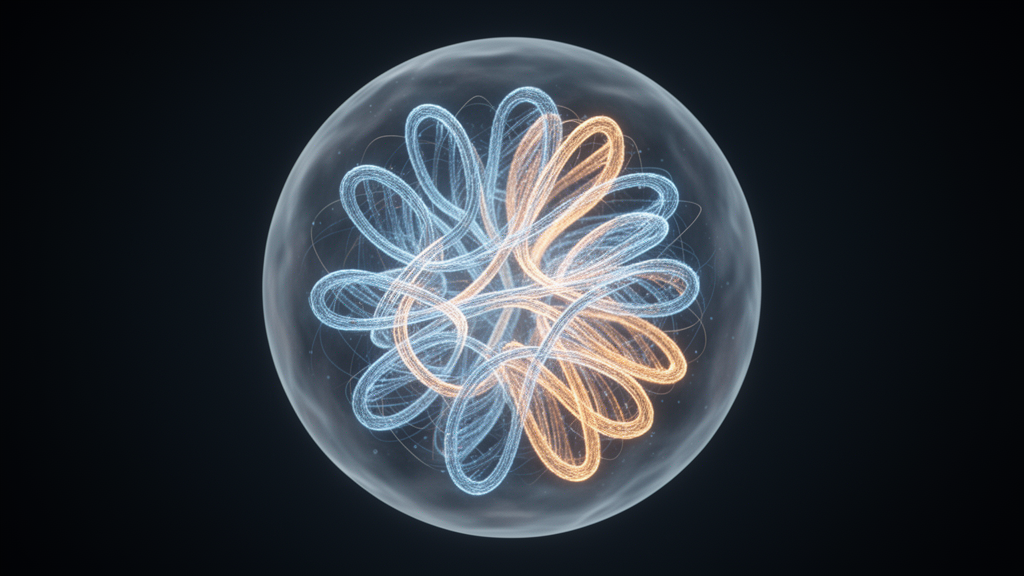
Deep inside every human cell, roughly two meters of DNA are packed into a nucleus only a few micrometers wide, and the way that packing is achieved is far from random. An opinion article published in Frontiers in Molecular Biosciences by Andrea Fontana and Andrea M. Chiariello of the University of Naples Federico II lays out how modern physics, particularly polymer physics and statistical mechanics, is being used to decode the rules that govern the three-dimensional architecture of chromatin, the complex of DNA and proteins that stores the genome. The authors argue that a handful of physical processes, including liquid-liquid phase separation, loop extrusion, and membrane adsorption at the nuclear periphery, act together like a molecular machine shop, shaping the folding of chromosomes and, through that folding, determining which genes are switched on and which remain silent.
The stakes of this research are enormous. Genome organization is intimately connected to essential cellular functions such as gene expression, DNA replication, and DNA repair. Enhancers, the distal regulatory elements that boost gene activity, may lie millions of DNA letters away from the genes they control along the linear chromosome, yet they must physically find and contact their targets within the crowded nuclear space. Understanding how the chromatin fiber brings the right pieces together requires more than biology alone; it requires quantitative models in which chromosomes are treated as polymer chains and proteins as interacting particles whose collective behavior can be simulated, perturbed, and compared against experimental data from microscopy and chromosome-conformation assays.
The first pillar of the framework discussed by Fontana and Chiariello is phase separation, the same process that causes oil to bead up in water, here operating on proteins inside the nucleus. Many regulatory proteins carry intrinsically disordered regions that allow them to interact with copies of themselves, forming stable condensates. Well-studied examples include Mediator and RNA polymerase II, which cluster together at active genes, as well as coactivators that assemble at super-enhancers and transcription factors whose activation domains can condense to drive gene expression. At larger scales, phase separation helps build Cajal bodies and the nucleolus, a multi-phase structure assembled from distinct molecular species of proteins and RNA. Crucially, when the phase-separation properties of these proteins go wrong, the result can be disease, ranging from rare genetic disorders involving nucleolar dysfunction to cancer driven by aberrant condensates.
To capture this phenomenon computationally, theorists have built models in which chromatin is represented as a polymer and proteins are represented as particles that bind to it. Some of the simplest versions include only polymer-protein interactions, leaving out direct protein-protein attraction. Even so, these bridging models give rise to what is known as polymer-polymer phase separation, in which the polymer itself nucleates condensates of bound proteins that then glue distant chromatin segments together. Despite their minimalism, such models have successfully reconstructed the three-dimensional structures of real genomic regions, described chromatin remodeling across different cell types, and even tracked how genome architecture is rearranged following viral infections, including SARS-CoV-2.
More realistic systems require explicit protein-protein interactions alongside chromatin-protein affinity, and, in the most complete versions, loop extrusion as well. In loop extrusion, molecular motors of the cohesin or condensin families slide along the chromatin fiber, enlarging DNA loops until they are halted at anchor points, often corresponding to binding sites of the architectural protein CTCF. Single-molecule imaging has now captured this process in real time, and computational studies show that extrusion contributes to global chromosome condensation during mitosis as well as to the local loops and domains that organize the interphase genome. When all these ingredients coexist, the behavior of the system is governed by a set of control parameters, including protein concentration, self-interaction affinity, chromatin affinity, and motor density and processivity, and the resulting equilibrium states fall into complex phase diagrams reminiscent of those studied in condensed matter physics.
One of the most striking predictions to emerge from large-scale molecular dynamics simulations concerns a scenario now called polymer-assisted condensation, or PAC. Simulations revealed that phase-separated condensates can arise in two distinct ways: either spontaneously through strong protein-protein affinity, independently of the polymer, or in a polymer-assisted route in which protein-protein attraction alone is too weak to drive condensation, but binding to chromatin concentrates the proteins enough to tip the system over the threshold. This second mechanism, first predicted computationally and later explored theoretically, has been proposed as a potentially general principle of chromatin organization, with implications for heterochromatin formation and epigenetic memory.
The power of the integrated approach was demonstrated in recent work on PHF13, a protein that binds chromatin enriched with the histone methylation marks H3K4me3 and H3K27me3 and can also self-associate through specific N-terminal sub-domains. Molecular dynamics simulations showed that when both chromatin-protein and protein-protein interactions were enabled at sufficient PHF13 concentration, the modeled polymer collapsed into a compact, roughly spherical globule decorated with PHF13 clusters, mirroring microscopy images of interphase cells overexpressing PHF13, in which chromosomes condense into rounded structures. When the self-interaction domains were disabled in silico, compaction was reduced and condensation disappeared, exactly matching the behavior of engineered PHF13 variants lacking those domains in living cells. The close agreement between simulation and experiment provides a compelling validation of the physics-based framework.
The same modeling philosophy is now being applied to disease. The chimeric protein NUP98-HOXA9, an oncofusion associated with leukemia, can undergo phase separation and bind chromatin, promoting the formation of aberrant loops that bring oncogenes such as PBX3 into contact with distant regulatory elements. Models of the relevant genomic regions accurately recapitulated the aberrant looping patterns observed in experimental Hi-C contact maps from human cells and in single-molecule mobility measurements, while also capturing the interplay between phase separation and loop extrusion that underlies the pathological rewiring. Because altered phase separation has been implicated in cancers and rare genetic diseases, such models offer a route to understanding how molecular-scale misfolding translates into gene misregulation.
The third pillar of the framework concerns the nuclear envelope. The nuclear lamina, a protein network embedded in the inner membrane, adsorbs peripheral chromatin, spatially segregating specific genomic regions from the nuclear interior and repressing their activity. Computational models represent the lamina as an adsorbing membrane that attracts or sterically excludes chromatin segments, with interactions parameterized from DamID profiles that quantify locus-specific lamina association. When loop extrusion and lamina adsorption are combined in a single simulation, the framework accurately reproduces the organization of peripheral loci such as the mouse Sox9 and Kcnj2 region, and tuning chromatin-lamina affinity allows different degrees of peripheral association and distinct cell populations to be described. Simulations of genomic editing, including deletion of CTCF boundary elements, quantitatively matched experimental outcomes, establishing a link between loop extrusion and lamina association even though the two processes act independently.
Fontana and Chiariello conclude that the great advantage of these physics-based models is their versatility: phase separation, loop extrusion, and membrane adsorption can be combined within a single computational framework to describe increasingly detailed biological contexts, at the cost of larger parameter spaces and more complex phase diagrams that molecular dynamics simulations are well suited to explore. Looking forward, the authors point to promising extensions, including modeling pathogenic protein variants, the chromatin changes of ageing, and the architectural disruptions induced by external pathogens such as viruses. As genome-wide datasets grow richer and simulations grow faster, the dream of predicting, and perhaps one day correcting, the physical misfolding events behind human disease moves steadily closer to reality.
Subject of Research: Physics-based computational modeling of chromatin 3D organization through phase separation, loop extrusion, and nuclear lamina adsorption
Article Title: On the physics of chromatin molecular complex: from phase-separation to membrane adsorption
Article References: Fontana, A., & Chiariello, A. M. (2026). On the physics of chromatin molecular complex: from phase-separation to membrane adsorption. Frontiers in Molecular Biosciences, 13, Article 1951961. https://doi.org/10.3389/fmolb.2026.1951961
Image Credits: AI Generated
DOI: 10.3389/fmolb.2026.1951961
Keywords: chromatin, 3D genome organization, phase separation, loop extrusion, polymer physics, nuclear lamina, molecular dynamics, gene regulation, biomolecular condensates, CTCF, cohesin, leukemia
Cite Scienmag News
Juliet Wilcox. (October 16, 2026). Physicists Map the Invisible Forces That Fold the Human Genome Inside the Nucleus. Scienmag. https://scienmag.com/physicists-map-the-invisible-forces-that-fold-the-human-genome-inside-the-nucleus/
Juliet Wilcox. "Physicists Map the Invisible Forces That Fold the Human Genome Inside the Nucleus." Scienmag, 16 October 2026, https://scienmag.com/physicists-map-the-invisible-forces-that-fold-the-human-genome-inside-the-nucleus/. Accessed 16 October 2026.
Juliet Wilcox. "Physicists Map the Invisible Forces That Fold the Human Genome Inside the Nucleus." Scienmag. October 16, 2026. https://scienmag.com/physicists-map-the-invisible-forces-that-fold-the-human-genome-inside-the-nucleus/


