

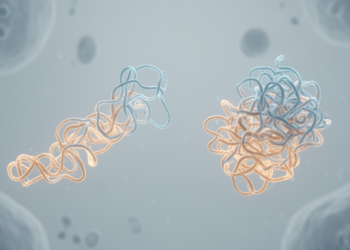
Subtle Shape Shifts, Not Misfolding: How FUS Mutations Drive ALS
A computational study shows that ALS-linked FUS mutations cause disease through subtle, site-specific changes in protein flexibility and molecular recognition ...
A computational study shows that ALS-linked FUS mutations cause disease through subtle, site-specific changes in protein flexibility and molecular recognition ...

A new opinion article explains how phase separation, loop extrusion, and nuclear membrane adsorption together shape the 3D folding of ...
New simulations reveal that rigid β-prone motifs and the rate of molecular delivery jointly determine whether aging condensate interfaces spread ...
A new PLOS Pathogens study shows that human cytomegalovirus induces and recruits the host chromatin remodeler MORC2 to viral replication ...
A Nature Plants highlight describes how singlet oxygen triggers MBS1 protein condensates that shield chloroplasts from excess light, and how ...
Researchers have shown that RNA droplets trap their own DNA templates, and that even low rates of mutation produce stable ...
New research in C. elegans shows that the conserved stress granule protein GTBP-1 reorganizes into P-body-associated granules during heat stress ...
New research shows that young coastal dune landscapes self-organize through phase-separation physics, revealing local tipping points beyond which damage to ...
South Korean researchers have developed a one-step spray-coating method that self-assembles stratified PDMS/P(VDF-TrFE) fibrous composites for high-performance, durable triboelectric nanogenerators ...
A new review in BMC Medicine argues that ALS arises when the cellular systems that keep reversible protein condensates from ...

Embark on a thrilling journey of discovery with Scienmag.com—your ultimate source for cutting-edge breakthroughs. Immerse yourself in a world where curiosity knows no limits and tomorrow’s possibilities become today’s reality!