


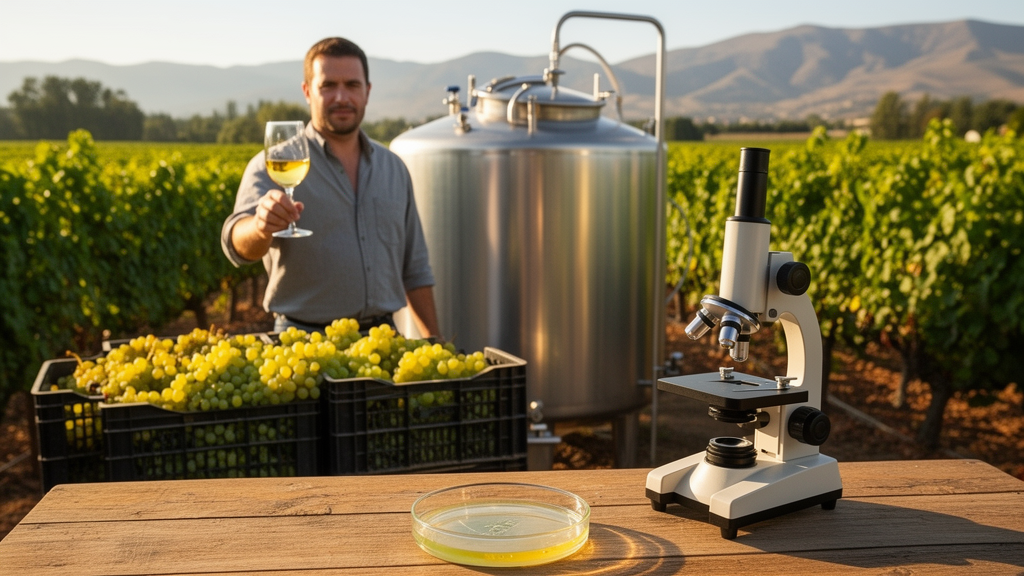
A team of researchers from Chile, Mexico, and Costa Rica has put two native Latin American lactic acid bacteria strains through their paces in Chardonnay winemaking, and the results reveal both tantalizing promise and a cautionary tale about safety. The study, published in Food Science and Biotechnology, tested non-Oenococcus bacteria as starter cultures for malolactic fermentation, the secondary fermentation that softens wine’s sharp malic acid into gentler lactic acid. For decades, this transformation has been almost exclusively the domain of a single species, Oenococcus oeni, but winemakers and microbiologists are increasingly looking beyond it for strains that could impart distinctive regional character to their wines.
Malolactic fermentation is far more than an acid adjustment. As lactic acid bacteria consume malic acid, they also release a cascade of metabolic byproducts that shape a wine’s aroma, mouthfeel, and stability. Diacetyl contributes buttery notes, esters modulate fruit expression, and the bacteria’s enzymatic machinery can either enhance or strip away desirable volatile compounds. The choice of which bacterium performs this transformation is therefore one of the most consequential decisions a winemaker makes, and the industry’s reliance on a narrow genetic pool has long struck researchers as both a limitation and an opportunity.
The research team, led by Carla Vargas-Luna of the Pontificia Universidad Católica de Chile, focused on two indigenous strains: Levilactobacillus brevis BCV-46 and Levilactobacillus brevis C18, both isolated from Chilean grapes. They compared these against a commercial Lactiplantibacillus plantarum strain, a species that has emerged in recent years as the leading alternative to Oenococcus oeni. The experiments were conducted at microvinification scale, using four-liter fermentations of Chardonnay must, with each bacterial strain co-inoculated alongside Saccharomyces cerevisiae, the yeast responsible for the primary alcoholic fermentation. This co-inoculation strategy, in which yeast and bacteria are introduced together rather than sequentially, is gaining favor because it shortens production schedules and reduces the risk of spontaneous bacterial growth between fermentations.
A central concern in any such experiment is whether the bacteria will interfere with the yeast’s work. Alcoholic fermentation depends on Saccharomyces cerevisiae converting sugars to ethanol efficiently and completely, and some lactic acid bacteria produce compounds that inhibit yeast metabolism. The researchers found encouraging news on this front: co-inoculation did not impair alcoholic fermentation in any of the treatments. The yeast completed its task regardless of which bacterial companion was present, confirming that these native strains are compatible with standard winemaking yeast at the timing and conditions tested.
The malolactic conversion itself, however, proved more uneven. Only partial malolactic fermentation occurred across the trials, and the degree of malic acid degradation varied substantially by strain. The commercial Lactiplantibacillus plantarum achieved the highest level of malic acid breakdown, demonstrating why it has become the benchmark alternative starter. Among the native strains, Levilactobacillus brevis BCV-46 outperformed its compatriot C18 in acid conversion. The incomplete fermentation suggests that these strains, while viable, may require further optimization of inoculation timing, cell density, or nutritional conditions to fully complete the acid conversion in white wines, which are generally a harsher environment for lactic acid bacteria than reds due to lower pH, higher acidity, and fewer nutrients.
Despite the partial conversion, the chemical differences among the wines were measurable and meaningful. The researchers documented variations in chemical composition across the treatments, though all wines remained within acceptable enological limits, meaning none of the bacterial interventions pushed the wines outside the ranges considered sound and stable for commercial production. This is a nontrivial finding, because lactic acid bacteria can consume residual sugars, produce acetic acid, or alter pH in ways that compromise wine integrity. The native strains passed this basic quality threshold, establishing their fundamental suitability for further development.
The safety dimension of the study produced the sharpest contrast between the two native isolates. Biogenic amines, including histamine, tyramine, and putrescine, are nitrogen-containing compounds that some lactic acid bacteria generate by decarboxylating amino acids. At elevated concentrations, these amines can trigger headaches, flushing, and blood pressure changes in sensitive individuals, and histamine in particular is regulated in some markets. Using molecular screening, the researchers searched for the amino acid decarboxylase genes that confer the ability to produce these compounds. The genes were detected only in L. brevis C18, and correspondingly, wines fermented with that strain showed higher concentrations of tyramine and putrescine. The other strains, including BCV-46 and the commercial L. plantarum, did not carry the decarboxylase genes and did not elevate these amines.
This single genetic distinction transforms the practical outlook for the two native strains. BCV-46 emerges as a candidate worth pursuing: it degraded malic acid respectably, left the wine chemically sound, and carried no detectable amine-producing potential. C18, by contrast, would require careful evaluation before any commercial use, since its amine production represents a genuine food safety consideration. The finding underscores a principle that wine microbiologists have emphasized repeatedly: safety and quality traits are strain-dependent rather than species-dependent, and each candidate starter must be individually characterized before deployment.
Perhaps the most appealing results came from the sensory analysis. The wines produced with different bacterial strains developed significantly different sensory profiles, and the selected native strains enhanced floral, fruity, and creamy attributes in the Chardonnay. These are precisely the aromatic dimensions that white wine consumers prize, and the fact that indigenous Latin American strains could amplify them hints at a strategy for producing wines with a genuine sense of place. Regional microbial biodiversity, long dismissed as a source of unpredictable spoilage, may instead be a reservoir of distinctive flavor signatures that commercial starter cultures cannot replicate.
The broader significance of the work lies in its demonstration that the next generation of malolactic starter cultures may come from vineyards far removed from the traditional wine heartlands of Europe. As climate change alters growing conditions and winemakers worldwide seek to differentiate their products, native bacterial strains offer a dual advantage: adaptation to local conditions and the potential for unique sensory contributions. The Chilean and Mexican research groups behind this study have shown that careful screening, combining fermentation performance testing, chemical analysis, sensory evaluation, and genetic safety checks, can identify which native strains deserve investment and which should be left in the vineyard. For now, the commercial Lactiplantibacillus plantarum still leads in acid conversion, but the native BCV-46 strain has staked its claim as a safe, flavor-enhancing alternative, and the race to domesticate Latin America’s wine microbiome has only begun.
Subject of Research: Non-Oenococcus lactic acid bacteria as malolactic fermentation starters in Chardonnay wine
Article Title: Latin-American non-Oenococcus lactic acid bacteria in Chardonnay wine: effects on chemical composition, sensory profile, and biogenic amine production
Article References: Vargas-Luna, C., Franco, W., Arvizu-Medrano, S., Cortés-Herrera, C., Redondo-Solano, M., Barboza-Vargas, N., Godoy-Olivares, L., & Miranda-Castilleja, D. (2026). Latin-American non-Oenococcus lactic acid bacteria in Chardonnay wine: effects on chemical composition, sensory profile, and biogenic amine production. Food Science and Biotechnology. https://doi.org/10.1007/s10068-026-02330-6
Image Credits: AI Generated
DOI: 10.1007/s10068-026-02330-6
Keywords: malolactic fermentation, Chardonnay, lactic acid bacteria, Lactiplantibacillus plantarum, Levilactobacillus brevis, biogenic amines, wine microbiology, co-inoculation, Saccharomyces cerevisiae, sensory profile, food safety, Latin America
Cite Scienmag News
Morgan Morrow. (October 16, 2026). Native Latin American Bacteria Could Reshape Chardonnay Winemaking. Scienmag. https://scienmag.com/native-latin-american-bacteria-could-reshape-chardonnay-winemaking/
Morgan Morrow. "Native Latin American Bacteria Could Reshape Chardonnay Winemaking." Scienmag, 16 October 2026, https://scienmag.com/native-latin-american-bacteria-could-reshape-chardonnay-winemaking/. Accessed 16 October 2026.
Morgan Morrow. "Native Latin American Bacteria Could Reshape Chardonnay Winemaking." Scienmag. October 16, 2026. https://scienmag.com/native-latin-american-bacteria-could-reshape-chardonnay-winemaking/


