


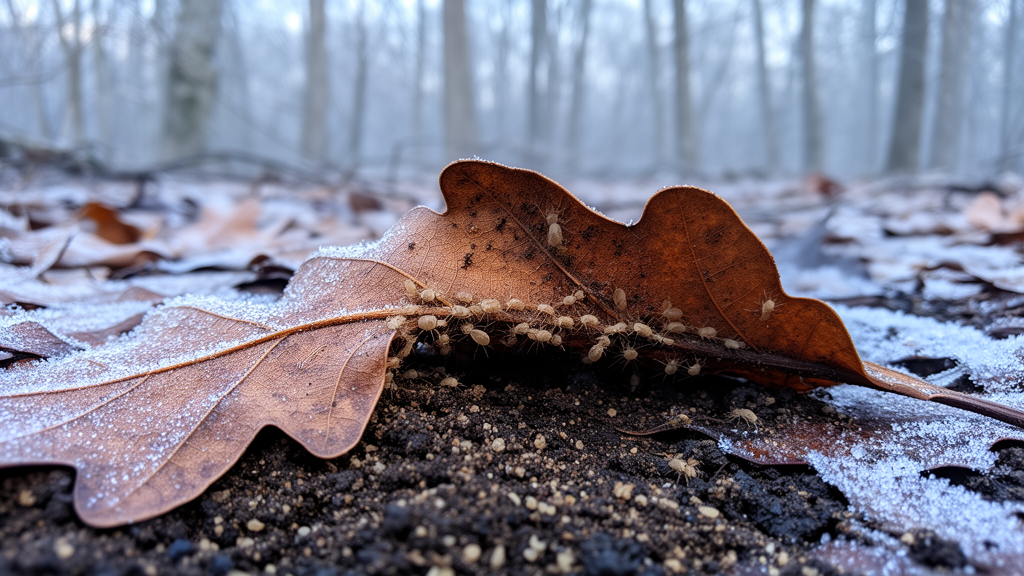
Beneath every autumn forest floor lies a microscopic workforce that most people never see, yet it quietly decides how fast dead leaves return to the soil. A new litterbag experiment conducted in a natural broadleaved forest in the Caucasus region has revealed, in remarkable detail, how communities of soil microarthropods — chiefly oribatid mites, predatory mesostigmatid mites, and springtails — colonize freshly defaunated leaf litter, restructure their feeding guilds over time, and adapt to the specific chemistry and structure of the leaves they encounter. The findings, published in the journal Caucasiana, offer one of the clearest seasonal portraits yet of the hidden succession that unfolds inside decomposing litter.
The research team set out to answer a deceptively simple question: when soil animals encounter a new microhabitat, how quickly do they colonize it, and do they perform better on leaves from their own local trees than on leaves transported from a different forest stand? To find out, the researchers collected oak (Quercus iberica) and beech (Fagus orientalis) leaves directly from the trees in November 2023, deliberately avoiding any contact with the ground so that no soil fauna could already be present. The leaves were dried at 70°C for 24 hours and packed into forty small litterbags measuring 15 by 15 centimeters, each made of insect-protective mesh with a 2-millimeter opening — large enough for mites and springtails to enter, but small enough to keep out larger animals.
Each litterbag was standardized to hold 9 ± 1 grams of leaf material. Twenty bags contained only oak leaves and twenty contained only beech leaves. Half of each type was placed under an oak-dominated stand at 900 meters above sea level, and the other half under a beech-dominated stand at 1,100 meters. The four experimental combinations — oak leaves under oak (QQ), beech leaves under oak (QF), oak leaves under beech (FQ), and beech leaves under beech (FF) — were then covered with fallen leaves and left to the mercy of the forest floor community. Five litterbags of each type were retrieved after six months in June 2024, and the remaining bags were collected after twelve months in December 2024.
In the laboratory, microarthropods were extracted from each bag using modified Berlese funnels over the course of one week, then preserved in 95% alcohol for identification. The remaining litter was dried and reweighed to track mass loss. In total, the researchers recovered 1,785 individual microarthropods, including 59 species of oribatid mites and 11 species of mesostigmatid mites. Collembolans, centipedes, millipedes, and even pseudoscorpions appeared among the colonizers. Only one species, the oribatid mite Ceratoppia bipilis, was found in every single microhabitat type throughout the entire experiment — a testament to its ecological versatility as a decomposer and fungal feeder.
The most striking pattern to emerge was seasonal. After six months, in summer, the litterbags contained an average of just 20 ± 15 individuals each. By twelve months, in winter, that figure had quadrupled to 80 ± 40 individuals per bag — a difference so pronounced that the statistical model returned an F-value of 51.4 with a p-value below 0.0001. Species richness followed the same trajectory, rising from an average of 6.4 species per litterbag in winter samples to 12.2 in summer samples when measured across the full experiment timeline. The total number of oribatid mites increased from 298 to 480 individuals between the two sampling events, mesostigmatid mites surged from 19 to 274, and springtails exploded from 42 to 614 individuals.
Cluster analysis of faunal similarity revealed that the composition of the microarthropod community was shaped far more strongly by season than by leaf type or habitat. Within each season, litterbags placed under oak trees harbored more similar communities to one another than to those under beech, while beech-under-beech litterbags (FF) stood apart as the most dissimilar group in both summer and winter. Simpson’s diversity index climbed from values around 86–92% in June to peaks of 94% (FQ) and 91% (FF) in December, although evenness dropped notably in the winter samples — a sign that a few dominant species were beginning to monopolize the available resources as decomposition progressed.
The trophic structure of the community underwent a dramatic transformation over the course of the year. In June, primary decomposers — the organisms that feed directly on plant tissue — dominated every litterbag type, with fungal feeders coming in second and predators barely registering. By December, the balance had shifted decisively: the proportion of secondary decomposers and fungal feeders declined, while predators and lichen-feeding species surged. Predatory mesostigmatid mites such as Discourella sp. and Trachytes arcuatus appeared exclusively in the winter samples, with Discourella sp. reaching 99 individuals in a single litterbag type. This shift mirrors the changing food landscape inside decaying litter, where fungi colonize within days, bacteria follow, and increasingly diverse resources — including lichens and microbial byproducts — become available as breakdown advances.
Perhaps the most intriguing finding concerned local adaptation. Litterbags filled with oak leaves and placed under oak trees (QQ) harbored significantly higher microarthropod abundance and species numbers than any other combination, suggesting that the resident community beneath the oaks had become finely tuned to the chemistry and physical structure of its own leaf litter. Surprisingly, no equivalent advantage was detected under the beech stands, possibly because the study site was a mixed forest where beech was restricted to the upper slope edge, limiting the extent to which a distinct beech-adapted community could establish itself. The researchers note that oribatid mites are known for their poor dispersal abilities, which often reinforces the formation of site-specific communities — yet the side-by-side placement of oak and beech litterbags should, in theory, have allowed rapid colonization of both litter types.
The physical decay of the litter itself told its own story. Beech litter lost mass continuously throughout the experiment under both tree stands, while oak litter showed a puzzling slowdown in mass decline between the first and second sampling periods — but only when placed under oak trees. After six months, 44.2% of the initial dry mass remained in QQ litterbags, compared with 38.5% in QF, 41.7% in FQ, and 39.9% in FF. By twelve months, those figures had shifted to 43.5%, 33.5%, 36.6%, and 29.8% respectively. The researchers attribute the slower oak decomposition to the structural properties of oak leaves, which possess a thicker adaxial cuticle and denser epidermal cell walls than beech leaves, making them less permeable to microbial attack. Beech leaves, by contrast, were almost unrecognizable by the end of the study, having been thoroughly broken down.
Taken together, these results paint a vivid picture of succession in miniature. Early-stage decomposition is dominated by a relatively small cast of primary decomposers exploiting fresh plant tissue, while later stages open the door to a far more diverse and trophically complex community — one that includes fungal specialists, lichen grazers, and predators hunting the increasingly abundant prey. The study confirms that microarthropod communities are adapted to the dominant litter type of their local habitat but need more time to adjust to alternative resources, and that different guilds of soil animals take over the decomposition process at different stages. As climate change alters forest composition and litter quality across the globe, understanding these hidden successional dynamics becomes ever more critical for predicting how carbon cycles through the world’s forests.
Subject of Research: Succession of soil microarthropod communities during leaf litter decomposition in oak and beech forests
Article Title: Succession of soil microarthropods during leaf litter decomposition in two contrasting broadleaved tree stands: A litterbag study
Article References: Murvanidze, M., & Abuladze, M. (2026). Succession of soil microarthropods during leaf litter decomposition in two contrasting broadleaved tree stands: A litterbag study. Caucasiana, 5, 1-14. https://doi.org/10.3897/caucasiana.5.e169526
Image Credits: AI Generated
DOI: 10.3897/caucasiana.5.e169526
Keywords: soil microarthropods, oribatid mites, litter decomposition, leaf litter, oak forest, beech forest, litterbag experiment, soil biodiversity, mesostigmatid mites, Collembola, trophic succession, forest ecology
Cite Scienmag News
Gavin Prescott. (October 16, 2026). Hidden Mite Armies Take Over Decaying Leaves in Surprising Winter Surge. Scienmag. https://scienmag.com/hidden-mite-armies-take-over-decaying-leaves-in-surprising-winter-surge/
Gavin Prescott. "Hidden Mite Armies Take Over Decaying Leaves in Surprising Winter Surge." Scienmag, 16 October 2026, https://scienmag.com/hidden-mite-armies-take-over-decaying-leaves-in-surprising-winter-surge/. Accessed 16 October 2026.
Gavin Prescott. "Hidden Mite Armies Take Over Decaying Leaves in Surprising Winter Surge." Scienmag. October 16, 2026. https://scienmag.com/hidden-mite-armies-take-over-decaying-leaves-in-surprising-winter-surge/


