


Botanists working along the East African coast have formally described a striking new species of wild gourd, ending a taxonomic limbo that lasted nearly six decades. The plant, now named Eureiandra orientalis, belongs to the Cucurbitaceae, the family that includes cucumbers, melons, squashes and gourds. It had been recognized as an unnamed entity since 1967, when the renowned cucurbit specialist Charles Jeffrey labeled it simply Eureiandra sp. A in the Flora of Tropical East Africa. Later, botanist Quentin Luke used the unpublished name Eureiandra orientalis in a 2005 checklist of the Shimba Hills, but the name never received the formal publication required under the rules of botanical nomenclature. Only now, with new fieldwork and a careful re-examination of herbarium material, has the species finally entered the scientific record.
The formal description, published in the open-access journal PhytoKeys, rests on a substantial evidentiary base. The research team examined 56 herbarium specimens representing 41 unique collections of the unnamed taxon, held at herbaria in Nairobi, Kew, Missouri, Wuhan and Wageningen. The holotype, the single specimen that anchors the name, was collected in June 1957 by S. Rawlins at Witu in Kenya’s Lamu County and is deposited at the East African Herbarium in Nairobi, with an isotype at the Royal Botanic Gardens, Kew. In addition, the team studied roughly 140 digitized specimens of other Eureiandra species online, comparing the new plant against its closest relatives using both living material and dried collections, with measurements refined through image-analysis software.
Eureiandra is a small African genus of the gourd family comprising eight species, distributed mainly in tropical and subtropical eastern and southern Africa, with one species, E. balfourii, restricted to the island of Socotra. The genus sits within tribe Coniandreae of the subfamily Cucurbitoideae and is characterized by simple tendrils, five free petals, broad anther connectives, beaked fruits and dark, subglobose to ovate seeds. These features distinguish it from morphologically similar genera such as Coccinia. Despite its botanical interest, the genus has attracted little attention beyond a handful of taxonomic treatments, and its economic or ethnobotanical significance remains poorly understood, although the roots of the Socotran species are reportedly used in traditional medicine and crude extracts have shown some biological activity in preliminary pharmacological studies.
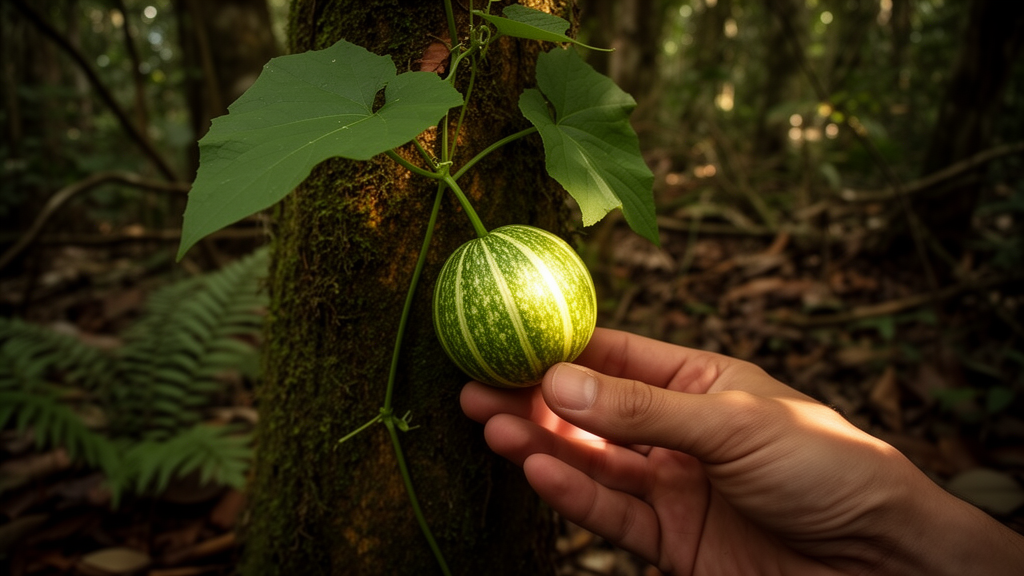
The new species is a climber reaching up to four meters long, rising from a tuberous rootstock that can measure up to 17 centimeters in diameter. Its annual herbaceous stems are nearly glabrous, with sparse hairs mainly restricted to the nodes, a subtle but taxonomically telling feature. The leaves are dark green and glossy, broadly ovate to reniform-cordate in outline and palmately divided into three to five lobes, with blades ranging from 6.6 to 18.7 centimeters long and 6.1 to 26.0 centimeters wide. Male flowers are borne in clusters of two to fourteen on short peduncles, with pale orange petals marked by darker centers, while female flowers are solitary or paired. The fruits are ovoid to ellipsoid, pale green with conspicuous white blotches, fleshy, and taper into a stout beak about 15 millimeters long. The seeds are oblong-elliptic, blackish brown with a pale raphe and a slightly fibrous testa.
What sets Eureiandra orientalis apart most clearly is its similarity to, and simultaneous divergence from, its presumed closest relative, Eureiandra fasciculata. The two species share annual herbaceous stems, palmately lobed leaves and female flowers with five staminodes, yet they differ consistently across a suite of vegetative and reproductive characters. E. orientalis has larger, darker, glossy leaves with hairs confined to the veins and margins, whereas E. fasciculata has smaller, paler leaves that feel rough or puberulous. The male inflorescences of the new species are shortly pedunculate, while those of E. fasciculata are solitary or in fewer-flowered clusters lacking a distinct peduncle. The petals are ovate rather than obovate, the fruits larger, at 6.5 to 11.5 centimeters long compared with 4.5 to 8.5 centimeters, and the seeds oblong-elliptic with indistinct margins and a fibrous testa rather than subglobose with a distinct margin and smooth surface.
Perhaps the most evocative difference lies in the species’ phenology, the timing of its life cycle events. In Eureiandra orientalis, the leaves are fully developed at flowering time, draping the vines in glossy green as the pale orange blossoms open. In Eureiandra fasciculata, by contrast, the stems are often leafless at anthesis, producing flowers on bare stems. The new species flowers from January to August, with peak activity coinciding mainly with the coastal long rains of March to June and adjacent months, and it may also respond to local rainfall at individual sites. Notably, its flowering does not correspond to the short rains of October to December. Fruiting begins toward the end of the long rains and continues through the dry season, a rhythm shaped by East Africa’s bimodal rainfall regime.
The species’ name, orientalis, refers to its eastern African distribution and honors the unpublished name used by Luke in 2005. It is currently known from the coastal lowlands of Kenya and Tanzania, with most records from Kilifi County in Kenya and the coastal forest areas of Dar es Salaam and Tanga in Tanzania. The plant occupies low elevations between sea level and 760 meters, growing commonly on rocky limestone or coral rag slopes, at the edges of coastal forests, and in the understory of semi-deciduous forest. The paratype collections trace a rich history of botanical exploration, from specimens gathered in the Usambara Mountains in the 1890s to recent field collections made in 2024 on limestone slopes near Kilifi, documenting the plant across more than a century of East African botany.
Conservation assessment offers a measure of reassurance, though not complacency. With 39 georeferenced occurrences across roughly 15 locations, an extent of occurrence of about 130,000 square kilometers and an area of occupancy of 148 square kilometers, the species has been evaluated as Least Concern under the IUCN Red List Categories and Criteria. Yet the authors caution that coastal forest at several localities is already being lost to agricultural clearance and to quarrying of coral rag and limestone for cement. These activities are ongoing and are likely to reduce some populations in the near term, meaning that remaining forest fragments require prompt monitoring and protection even though the species does not yet meet the thresholds for a threatened category.
The long interval between the taxon’s first recognition in 1967 and its formal description today highlights the incomplete documentation of plant diversity in East Africa, a pattern echoed by a series of previously overlooked gourd family species described from Kenya during the past decade, including members of the genera Peponium and Zehneria. The discovery also underscores the importance of the coastal forests of Kenya, Tanzania and northern Mozambique, a region widely recognized as a center of exceptional plant diversity and endemism that continues to reveal significant taxonomic novelties.
One question remains open: the phylogenetic position of Eureiandra orientalis within the genus has yet to be confirmed with molecular data. The authors note that morphology alone may not fully capture evolutionary history in understudied tropical lineages, and they call for future studies integrating expanded field sampling, herbarium revision and phylogenomic data to clarify species limits, relationships within Eureiandra and the biogeographic significance of this eastern African coastal lineage. For now, a plant that waited nearly sixty years for a name has finally claimed its place in the botanical record, a reminder of how much undiscovered diversity still clings to the fragments of East Africa’s coastal forests.
Subject of Research: Taxonomic description of a new gourd family species from East African coastal forests
Article Title: Eureiandra orientalis ( Cucurbitaceae ), a new species from Kenya and Tanzania
Article References: Wang, R.-Z., Ran, Z.-H., Schaefer, H., Luke, Q., Mollel, N. P., Kirika, P. M., Chapano, C., Yan, X., Wang, S.-W., Wei, N., & Wang, Q.-F. (2026). Eureiandra orientalis (Cucurbitaceae), a new species from Kenya and Tanzania. PhytoKeys, 280, 133-146. https://doi.org/10.3897/phytokeys.280.206680
Image Credits: AI Generated
DOI: 10.3897/phytokeys.280.206680
Keywords: Eureiandra orientalis, Cucurbitaceae, new species, Kenya, Tanzania, coastal forests, taxonomy, plant diversity, biodiversity hotspot, herbarium, East Africa, conservation
Cite Scienmag News
Margaret Porter. (October 16, 2026). New Gourd Species Hidden for Decades Finally Named from East African Coastal Forests. Scienmag. https://scienmag.com/new-gourd-species-hidden-for-decades-finally-named-from-east-african-coastal-forests/
Margaret Porter. "New Gourd Species Hidden for Decades Finally Named from East African Coastal Forests." Scienmag, 16 October 2026, https://scienmag.com/new-gourd-species-hidden-for-decades-finally-named-from-east-african-coastal-forests/. Accessed 16 October 2026.
Margaret Porter. "New Gourd Species Hidden for Decades Finally Named from East African Coastal Forests." Scienmag. October 16, 2026. https://scienmag.com/new-gourd-species-hidden-for-decades-finally-named-from-east-african-coastal-forests/


