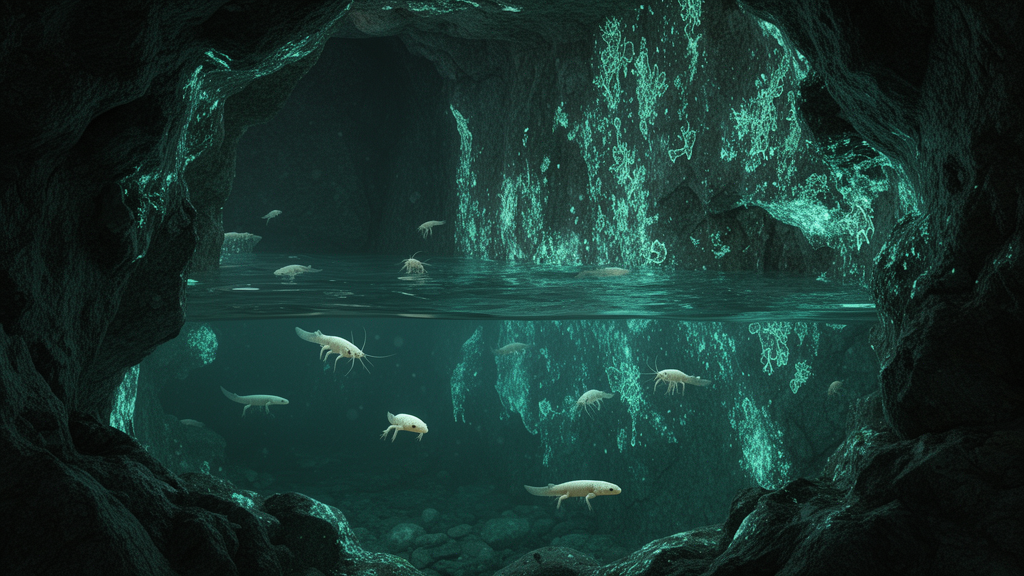
Far beneath the rolling hills and urban sprawl of Austin, Texas, one of North America’s most important karst aquifers hums with hidden life. The Barton Springs segment of the Edwards Aquifer supplies drinking water to more than a million people and shelters blind salamanders, eyeless shrimp, and other creatures found nowhere else on Earth. For decades, scientists assumed these subterranean communities depended mostly on organic matter washed down from the surface—leaves, soil, and other debris carried by rainwater seeping into caves and sinkholes. A new study, published in the journal Subterranean Biology, reveals a more complicated picture: chemosynthetic microbes living deep in the aquifer can manufacture their own food from inorganic chemicals, and in some wells this dark production accounts for nearly half of the organic matter available to the ecosystem.
The research, led by Hannah R. Rigoni of Texas State University together with colleagues from the University of Tennessee and other institutions, set out to answer a question that has puzzled cave biologists for years: how much of the energy flowing through groundwater food webs comes from the sunlit surface, and how much is generated underground by microbes that never see daylight? This question matters because karst aquifers are notoriously fickle. Rainfall can flush organic material into the system in sudden pulses, or it can bypass the aquifer entirely during droughts. If subterranean animals rely too heavily on surface subsidies, their survival hinges on what happens above ground—on land use, urbanization, and the vagaries of weather.
Chemolithoautotrophy—the process by which bacteria and archaea build organic molecules from carbon dioxide using energy harvested from inorganic chemical reactions—thrives wherever reduced compounds such as hydrogen sulfide, methane, iron, or ammonium meet oxygenated water. In karst systems, these compounds can originate from two sources: the slow decomposition of buried organic matter, and the chemical dissolution of minerals like pyrite and gypsum in the bedrock itself. Microbes exploiting these energy sources form the base of a food web that operates entirely in darkness, a phenomenon biologists have documented in sulfidic caves across the globe, from Movile Cave in Romania to the Frasassi Caves in Italy.
To determine whether such chemosynthetic production matters in the Edwards Aquifer, the team sampled groundwater from multiple wells across the Barton Springs segment, capturing not only the water chemistry but also the microbial communities and the fine particulate organic matter—FPOM—that drifts through the system as a potential food source for animals. They combined geochemical measurements with biomass-weighted metabolic profiling, a technique that estimates which metabolic pathways dominate in a microbial community based on the abundance and composition of the organisms present. The results showed clear patterns: wells with distinct geochemical gradients hosted distinct microbial assemblages, and in wells where sulfide was present, the signatures of chemolithoautotrophic metabolism were strongest.
The most striking evidence came from stable isotope analysis. Because chemolithoautotrophic microbes typically produce organic matter with unusually light (depleted) carbon isotope ratios—often below −35 per mil—researchers can trace their contributions through the food web by measuring the isotopic composition of particles and animals. Using Bayesian isotope mixing models applied to the carbon and nitrogen isotope ratios of fine particulate organic matter, the team calculated that chemolithoautotrophic production contributed as much as 44.8 percent of the organic matter in one groundwater well. In sulfidic wells, where heterotrophic microbial activity contributed the least to FPOM, the chemosynthetic signal was clearest.
But when the researchers turned to the animals themselves—the stygofauna, including amphipods, snails, and other invertebrates adapted to life underground—the picture shifted. Bulk carbon isotope ratios of metazoan assemblages were not strongly depleted, failing to show the extreme values that would indicate heavy reliance on chemosynthetic food sources. Bayesian mixing models of animal tissues pointed instead to diets dominated by allochthonous organic matter: the surface-derived material that rains and floods deliver into the aquifer. In other words, even where chemosynthetic microbes were demonstrably producing food, the animals appeared to be eating mostly imported groceries.
Why the disconnect? The authors point to the hydrologic character of the Barton Springs segment. Unlike deep, stagnant aquifers where water may reside for decades or centuries, this portion of the Edwards Aquifer is rapidly recharged. Rainfall over the recharge zone can move through the system in days to weeks, delivering fresh pulses of surface organic matter that overwhelm the slower, steadier production of chemosynthetic microbes. Short groundwater residence times mean that allochthonous food is constantly replenished, giving stygofauna little incentive—or evolutionary pressure—to depend on the in-house production of chemolithoautotrophs. The isotopic signal of chemosynthesis, present in the particulate matter, gets diluted in the diets of animals that feed opportunistically on whatever the latest recharge event delivers.
This finding carries significant implications for conservation. The Barton Springs segment is home to federally listed endangered species, including the Austin blind salamander and Barton Springs salamander, whose populations depend on the quality and quantity of groundwater flowing through the system. If the food web is primarily fueled by surface-derived organic matter, then changes in land use—paved surfaces that alter recharge patterns, agricultural runoff that changes water chemistry, or urban development that reduces the quality of infiltrating water—could ripple through the entire subterranean ecosystem. Conversely, the study shows that chemosynthetic production is not negligible; in certain geochemical settings, it constitutes a substantial fraction of available energy, potentially providing a buffer when surface subsidies falter during droughts.
The research also highlights how much remains unknown about energy flow in groundwater ecosystems worldwide. Karst aquifers underlie roughly 20 to 25 percent of the global land surface and supply drinking water to billions of people, yet the food webs they harbor are among the least studied on the planet. Most previous work on chemolithoautotrophy in subterranean systems has focused on caves with obvious sulfidic springs or sulfur springs, where the chemical energy sources are concentrated and visible. The Edwards Aquifer study demonstrates that even in a rapidly flushed, well-connected karst system—arguably a worst-case scenario for detecting chemosynthetic support—the process is measurable and locally significant.
For the scientists, the next step is to refine the picture with finer-scale sampling: measuring isotope ratios of individual animals and specific food sources, tracking seasonal changes in recharge, and identifying which microbial taxa are responsible for the chemosynthetic production. For now, the study stands as a reminder that the line between sunlit and sunless ecosystems is blurrier than it appears. Deep beneath Austin, microbes are quietly manufacturing food from stone and chemistry, and while the salamanders and shrimp above them may prefer the imported variety, the underground pantry is stocked with homegrown goods as well. Understanding the balance between these two energy pathways may prove essential for protecting one of Texas’s most treasured and vulnerable natural systems as the city above it continues to grow.
Subject of Research: Chemolithoautotrophic microbial production and its contribution to stygofaunal food webs in the Barton Springs segment of the Edwards Aquifer, Texas
Article Title: Chemolithoautotrophic contributions to stygofaunal food webs in the Barton Springs Segment of the Edwards Aquifer, Texas
Article References: Chemolithoautotrophic contributions to stygofaunal food webs in the Barton Springs Segment of the Edwards Aquifer, Texas. (n.d.). Original publication
Image Credits: AI Generated
DOI: Not provided
Keywords: Edwards Aquifer, chemolithoautotrophy, stygofauna, karst hydrogeology, stable isotopes, groundwater ecology, microbial communities, Barton Springs, subterranean biology, food webs, organic matter, Texas
Cite Scienmag News
Morgan Morrow. (October 16, 2026). Dark Life Beneath Austin: Deep Microbes Help Feed Cave Creatures in Texas Aquifer. Scienmag. https://scienmag.com/dark-life-beneath-austin-deep-microbes-help-feed-cave-creatures-in-texas-aquifer/
Morgan Morrow. "Dark Life Beneath Austin: Deep Microbes Help Feed Cave Creatures in Texas Aquifer." Scienmag, 16 October 2026, https://scienmag.com/dark-life-beneath-austin-deep-microbes-help-feed-cave-creatures-in-texas-aquifer/. Accessed 16 October 2026.
Morgan Morrow. "Dark Life Beneath Austin: Deep Microbes Help Feed Cave Creatures in Texas Aquifer." Scienmag. October 16, 2026. https://scienmag.com/dark-life-beneath-austin-deep-microbes-help-feed-cave-creatures-in-texas-aquifer/