


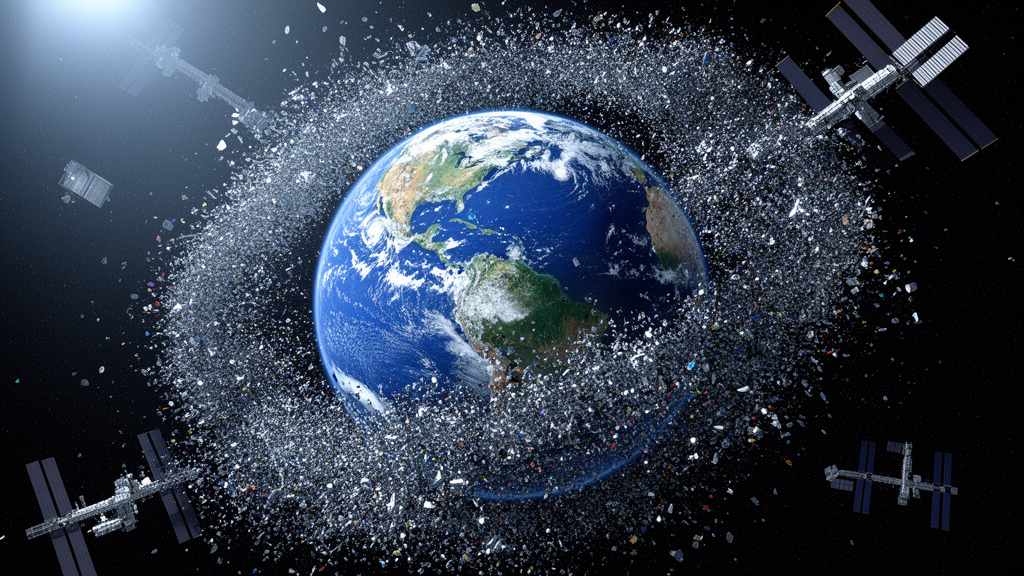
Half a million fragments, maybe more than a million, are hurtling around Earth at speeds that turn a paint fleck into a bullet and a bolt into a bomb. Nobody can see most of them. And according to a new review published in Frontiers in Space Technologies, the world’s leading space agencies cannot even agree on how many of these invisible killers exist — with their best computer models disagreeing by factors of two, three, or in some regimes by more than an order of magnitude. That disagreement is not an academic quibble. It directly shapes how much shielding a spacecraft carries, how operators assess collision risk, and how confidently humanity can plan for a future in low Earth orbit that some projections suggest could include 100,000 additional satellites within a decade.
The review, conducted by James H. Kirk and Cagri Kilic of Embry-Riddle Aeronautical University’s Space Robotics and Generative Estimation Laboratory, tackles a problem that has quietly festered beneath the glossy headlines about mega-constellations: debris smaller than 10 centimeters is simultaneously the most dangerous and least measurable population in orbit. Objects larger than 10 centimeters can be tracked by surveillance networks, which catalog tens of thousands of them. But estimates of the 1-to-10-centimeter population range from roughly 500,000 in NASA assessments to about 1.2 million in the European Space Agency’s Space Environment Report — a discrepancy of more than a factor of two before any modeling even begins. Below that range, the picture dissolves entirely into extrapolation.
Why does this size regime matter so much? Physics provides a brutal answer. A fragment just a few millimeters across, striking at the typical orbital closing velocity of around 10 kilometers per second, carries enough kinetic energy to destroy a functioning satellite. The 2009 Iridium 33–Cosmos 2251 collision, the 2007 Fengyun 1C anti-satellite test, and even the 1962 Starfish Prime nuclear detonation each seeded thousands of such fragments into orbit, and each event became a foundational case study for the debris models that agencies still rely on today. Because these fragments are too small to track individually, mission planners must lean entirely on statistical models — and those models, the review shows, rest on assumptions that diverge in ways most users never realize.
Kirk and Kilic classify the major modeling frameworks into two families. Evolutionary models, such as NASA’s EVOLVE 4.0 and its successor LEGEND, simulate how the debris population changes over decades by modeling fragmentation events, propagating fragments under atmospheric drag, solar radiation pressure, and gravitational perturbations, and estimating physical properties like each fragment’s area-to-mass ratio. Environmental models, such as ESA’s MASTER and NASA’s ORDEM, take a different approach: rather than tracking individual objects, they reconstruct the debris flux environment from a patchwork of in-situ measurements, radar observations, and known fragmentation events, producing statistical descriptions of what a spacecraft is likely to encounter at a given altitude, size threshold, and epoch.
The trouble begins with the fragmentation physics itself. Both evolutionary and environmental models lean heavily on the NASA Standard Breakup Model, a set of statistically derived power-law equations built from hypervelocity impact tests, radar measurements, and historical breakup events — including the 1986 Delta-180 deliberate collision. These equations describe how many fragments of a given size a collision or explosion produces. But the review emphasizes that the power-law relationships were fitted to data from events and experiments that largely predate the modern orbital environment, and when extrapolated into the sub-10-centimeter regime — where the fragment counts balloon as parent size decreases — the uncertainty grows extreme. Small errors in the assumed breakup parameters cascade into large discrepancies in predicted populations, particularly because the fragment area-to-mass distribution is steeply concentrated at low values, making orbital lifetime predictions highly sensitive to initial assumptions.
The validation data underpinning these models is, if anything, more dated than the physics. The primary in-situ datasets come from the Long Duration Exposure Facility, deployed by NASA in 1984 at roughly 476 kilometers altitude and retrieved nearly six years later, and the European Retrievable Carrier, or EURECA, launched in 1992 and recovered after about a year in orbit. LDEF’s impact pits revealed a startling finding: more than 30 percent of impacts on its trailing edge — where micrometeorites, not orbital debris, were expected to dominate — came from debris, implying a substantial population on highly elliptical orbits that models had not fully accounted for. EURECA’s post-flight survey documented 71 impact sites on its multi-layer insulation with hole diameters from 100 micrometers to 1 millimeter, providing crucial calibration for small-particle flux. But both missions sampled narrow altitude bands for limited durations, and the debris environment has grown exponentially since they flew.
Modern validation efforts are trying to close this gap, with mixed and revealing results. The ADLER-1 mission, operating at roughly 480 kilometers altitude for 512 days, recorded 117 impact events during a 400-day collection period. When ESA compared ADLER-1’s measurements against MASTER predictions, the agreement proved highly sensitive to impact orientation: at orientations below 20 degrees, MASTER predicted 23 impacts while ADLER-1 detected 62 — nearly triple the forecast. At orientations between 60 and 80 degrees, the relationship inverted, with MASTER predicting 26 impacts and ADLER-1 recording only 5. The International Space Station’s Space Debris Sensor, the first in-flight demonstration of the DRAGONS detection technology, now provides continuous monitoring in the 50-to-500-micrometer regime, but such instruments cover limited orbital regions and time intervals. Ground-based systems face their own constraints: the Haystack radar can detect debris down to about 5 millimeters but only up to roughly 1,000 kilometers altitude, while the MODEST telescope in Michigan, which characterizes the geosynchronous environment down to about 20 centimeters, must assume circular orbits for its detections because the short orbital arcs it observes make eccentricity determination unreliable.
When models are compared head-to-head, the disagreements become stark. A 2021 comparison of ESA’s MASTER-8 and NASA’s ORDEM 3.1 found MASTER-8 predicting roughly 2.3 times higher flux at 1 centimeter for an 800-kilometer sun-synchronous orbit, and about 3 times higher for a geosynchronous transfer orbit. Below about 2 millimeters, the relationship reverses dramatically: ORDEM 3.1 exceeds MASTER-8 by up to 2.5 orders of magnitude, depending on the orbit. An earlier comparison of ORDEM 3.0 and MASTER-2009 identified the same crossover behavior near 1 centimeter across four test orbits, and an independent reproduction with China’s SDEEM2019 model confirmed the pattern is systematic rather than an artifact of any single implementation. Crucially, both MASTER and ORDEM employ modified versions of the same underlying NASA Standard Breakup Model — meaning the disagreement stems not from breakup physics but from differences in how each model treats source populations, calibrates against datasets, and applies scaling methodologies.
The international picture adds further complexity. China’s SDEEM, developed at the Harbin Institute of Technology, agrees reasonably well with MASTER and ORDEM for debris larger than 10 centimeters but diverges sharply below that threshold, with ORDEM predicting roughly an order of magnitude more debris above 1 millimeter than either SDEEM or MASTER. The United Kingdom’s DAMAGE model focuses on higher Earth orbits down to 0.1 millimeters, while ESA’s DELTA tool, built on the NASA Standard Breakup Model and MASTER-2009 initial populations, is restricted to particles larger than 1 millimeter. Russia’s SDPA model treats the debris population as a continuous statistical medium rather than individually propagated objects, but its small-debris treatment is sparsely documented in accessible English-language literature — a gap the review flags as itself a problem for the international characterization effort. Meanwhile, an Inter-Agency Space Debris Coordination Committee comparison that ran six independent evolutionary models on a common initial population found consistent qualitative agreement for objects 10 centimeters and larger, with an average population increase of about 30 percent over 200 years — but no equivalent multi-model benchmark exists for the 1-to-10-centimeter regime at all.
The review’s authors argue that the path forward requires a fundamental shift in how the community collects and uses validation data. They call for a modern in-situ measurement mission capable of characterizing debris populations across multiple size regimes and orbital altitudes — from low Earth orbit through medium Earth orbit to geosynchronous orbit — rather than relying on legacy datasets that captured a snapshot of a vastly smaller debris environment decades ago. Space-based detection systems operating within or near the debris populations themselves, they argue, represent the most promising path to closing the observability gap that ground-based radars and telescopes cannot overcome. They also advocate for in-situ detection constellations that sample multiple altitude and inclination regimes simultaneously, coupled with close-proximity optical detection methods. Until such capabilities mature, every spacecraft designer, constellation operator, and insurance underwriter must grapple with an uncomfortable truth: the models that govern their risk assessments may disagree with one another by factors that dwarf the margins they engineer for — and the true population of mission-ending fragments smaller than 10 centimeters remains, for now, an estimate built on data collected before the era of mega-constellations even began.
Subject of Research: Modeling assumptions, uncertainty, and validation limits in sub-10 cm orbital debris population evolution
Article Title: A review of modeling assumptions, uncertainty, and validation limits in the evolution of sub-10 cm orbital debris populations
Article References: Kirk, J. H., & Kilic, C. (2026). A review of modeling assumptions, uncertainty, and validation limits in the evolution of sub-10 cm orbital debris populations. Frontiers in Space Technologies, 7, Article 1893179. https://doi.org/10.3389/frspt.2026.1893179
Image Credits: AI Generated
DOI: 10.3389/frspt.2026.1893179
Keywords: orbital debris, space debris models, sub-10 cm debris, MASTER, ORDEM, EVOLVE, LEGEND, NASA Standard Breakup Model, model validation, Kessler syndrome, mega-constellations, space situational awareness
Cite Scienmag News
Denise Maddox. (October 16, 2026). The Invisible Threat: Why Space Agencies Can’t Agree on How Much Deadly Small Debris Is Orbiting Earth. Scienmag. https://scienmag.com/the-invisible-threat-why-space-agencies-cant-agree-on-how-much-deadly-small-debris-is-orbiting-earth/
Denise Maddox. "The Invisible Threat: Why Space Agencies Can’t Agree on How Much Deadly Small Debris Is Orbiting Earth." Scienmag, 16 October 2026, https://scienmag.com/the-invisible-threat-why-space-agencies-cant-agree-on-how-much-deadly-small-debris-is-orbiting-earth/. Accessed 16 October 2026.
Denise Maddox. "The Invisible Threat: Why Space Agencies Can’t Agree on How Much Deadly Small Debris Is Orbiting Earth." Scienmag. October 16, 2026. https://scienmag.com/the-invisible-threat-why-space-agencies-cant-agree-on-how-much-deadly-small-debris-is-orbiting-earth/


