


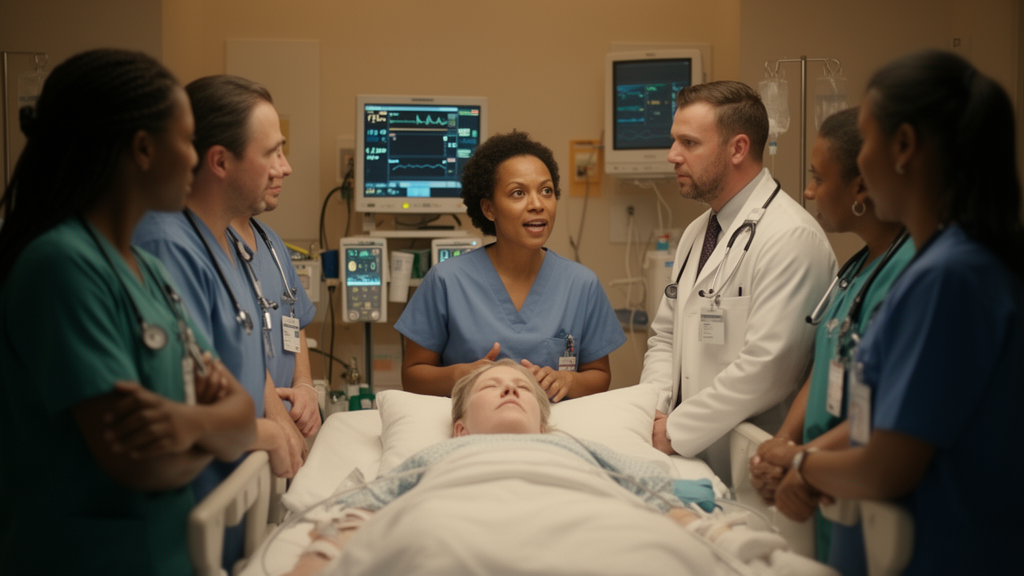
In the pressurized world of the intensive care unit, where a single miscommunication can cost a life, a team of researchers at Penn State Health Milton S. Hershey Medical Center has tackled a problem that has quietly plagued academic medicine for years: nobody ever teaches doctors-in-training and advanced practice providers how to work together. A new study published in the Journal of General Internal Medicine describes a rigorous, methodical effort to change that, translating the science of teamwork and psychological safety into a set of structured, assessable professional activities designed for the chaotic reality of critical care.
The context matters. Most academic medical centers depend on both trainees—residents and fellows—and advanced practice providers, the nurse practitioners and physician assistants who increasingly anchor frontline care. Blended teams of attending physicians, trainees, and APPs are now standard in many disciplines, and especially in critical care, where they bring documented educational and patient care benefits. Yet the literature reveals striking variability in how these groups actually interact: structures differ, roles blur, and biases often go unmanaged. There has been no evidence-based curriculum teaching trainees and APPs how to collaborate effectively, leaving one of medicine’s most consequential partnerships to run on improvisation.
The Penn State team, led by Ryan Munyon and Alia Chisty with collaborators spanning internal medicine, pulmonary and critical care medicine, nursing, and team science, saw an opening. In July 2025, hospital and educational leadership restructured their medical intensive care unit to place trainees and APPs on blended care teams, beginning with cohesive team huddles for patient sign-out. Rather than letting the new arrangement evolve by accident, the researchers set out to engineer it deliberately, building assessment tools around the daily morning huddle where night and day teams gather to transition care and discuss events and new admissions.
The intellectual backbone of the project comes from team science. Building on the evidence-based TeamSTEPPS program developed to optimize healthcare team performance, the researchers drew on a newer framework called Team FIRST, which identifies core teamwork competencies and incorporates contemporary concepts like psychological safety into its conceptual model. Psychological safety—the shared belief among team members that the interpersonal climate is safe for taking risks, raising concerns, and admitting errors without fear of punishment or humiliation—has emerged as one of the most consequential constructs in the team literature, and its effects are measurable at the bedside.
The evidence for that claim is striking. A meta-analysis of 136 independent samples found that psychological safety improves task performance, creativity, information sharing, learning, work engagement, and satisfaction. In clinical settings, nursing teams with higher psychological safety recorded significantly lower medication error rates in hospital administrative data. Neonatal intensive care units that empowered staff to speak up and stop mistakes reduced infant mortality rates by up to 18 percent. A systematic review in healthcare concluded that psychological safety is consistently associated with improved team communication, learning from failure, and a stronger patient safety culture.
But the intensive care unit is arguably the hardest place in medicine to build it. Large teams, steep hierarchies, status differentials, interprofessional diversity, professional identity boundaries, high-stakes decision-making, and extreme time pressure all conspire against the open communication psychological safety requires. The researchers note that developing and maintaining it demands deliberate cultivation through leadership behavior, team norms, and organizational design—which is precisely why they chose to encode it into formal assessment structures rather than hoping it would emerge organically.
The technical machinery of the project is entrustable professional activities, or EPAs—units of clinical work that supervisors can progressively entrust to learners with decreasing supervision. Crucially, EPAs are not checklists or measures of task completion; they capture a supervisor’s judgment about whether a learner is ready to perform a skill without someone stepping in. They have thrived in residency assessment because they mirror the entrustment decisions supervising physicians already make intuitively, and they can be mapped to training milestones to signal readiness for progression. Huddles, with their critical nature and narrow time window for entrustment decisions, have long been recognized as natural EPA territory.
The development process followed a prescribed sequential pipeline for EPA authoring and quality assessment. A diverse workgroup of education leaders, trainees, team science experts, and leadership from internal medicine, critical care, and the advanced practice provider groups met regularly to draft activities focused on huddle and sign-out structures. They identified two global EPAs to anchor the framework, then delineated the behaviors important for effective huddles and ranked them by importance in a mini-Delphi process. Cross-referencing those behaviors against existing sign-out EPAs, Team FIRST attributes, and components of psychologically safe environments yielded 21 candidate topic areas, from which a core writing team drafted 18 individual EPAs using a modified entrustment scale synthesized from the literature.
Quality control came next, and it had teeth. Every EPA was reviewed first by the entire study group and then individually using the EQual rubric, a validated instrument for evaluating EPA quality and structure, with individual evaluations collected through online survey software. The combined data identified five underperforming activities: one with limited specificity, three with poor overall validity, and one that scored poorly across all categories. Those were removed from the evaluation forms. One EPA rejected for vague language was rewritten and re-evaluated, then passed on a second round. The survivors were assembled into multi-directional, reciprocal feedback forms that assess residents, fellows, and APPs on their teamwork, communication, adherence to roles and responsibilities, and commitment to behaviors that promote psychological safety. Those forms are now in active use by MICU teams.
One of the project’s most interesting conceptual challenges was hierarchical. Traditional EPAs assume the assessor outranks the learner, but blended team huddles require entrustment decisions outside typical academic hierarchies—an APP or senior resident with deep procedural expertise may be well positioned to assess a learner’s competence regardless of formal rank. The writing group also debated where operational professional activities end and EPAs begin, ultimately deciding that any question involving trust should use EPA language for coherence, backed by a well-defined quality assessment tool. The team reports real-world friction too: APPs work rigid 12-hour shifts while trainees do not, so APPs sometimes signed out before the full team assembled, threatening the validity of role-based assessments. Looking ahead, the researchers plan to map the EPAs to ACGME milestones, expand to resuscitation debriefings, add psychological safety training, extend assessments to nurses and respiratory therapists, and compare team-level psychological safety with individual entrustment decisions. If it works, the humble morning huddle may become one of medicine’s most powerful teaching tools.
Subject of Research: Development of teamwork entrustable professional activities for interprofessional trainee and advanced practice provider teams in the intensive care unit
Article Title: Teamwork Entrustable Professional Activities in Interprofessional Teams Involving Trainees and Advanced Practice Providers in the Intensive Care Unit
Article References: Munyon, R., Madara, J., Simkins, S., Thoryk, J., Haag, A., Bucher, D., Dimmock, A., Janczewski, S., Haidet, P., & Chisty, A. (2026). Teamwork Entrustable Professional Activities in Interprofessional Teams Involving Trainees and Advanced Practice Providers in the Intensive Care Unit. Journal of General Internal Medicine. https://doi.org/10.1007/s11606-026-10799-4
Image Credits: AI Generated
DOI: 10.1007/s11606-026-10799-4
Keywords: psychological safety, entrustable professional activities, intensive care unit, interprofessional teamwork, medical education, advanced practice providers, Team FIRST, EQual rubric, patient handoff, team huddle, clinical assessment, team science
Cite Scienmag News
Ophelia Keating. (October 16, 2026). ICU Teams Get a Trust Rulebook as Researchers Turn Psychological Safety into Assessable Skills. Scienmag. https://scienmag.com/icu-teams-get-a-trust-rulebook-as-researchers-turn-psychological-safety-into-assessable-skills/
Ophelia Keating. "ICU Teams Get a Trust Rulebook as Researchers Turn Psychological Safety into Assessable Skills." Scienmag, 16 October 2026, https://scienmag.com/icu-teams-get-a-trust-rulebook-as-researchers-turn-psychological-safety-into-assessable-skills/. Accessed 16 October 2026.
Ophelia Keating. "ICU Teams Get a Trust Rulebook as Researchers Turn Psychological Safety into Assessable Skills." Scienmag. October 16, 2026. https://scienmag.com/icu-teams-get-a-trust-rulebook-as-researchers-turn-psychological-safety-into-assessable-skills/


