


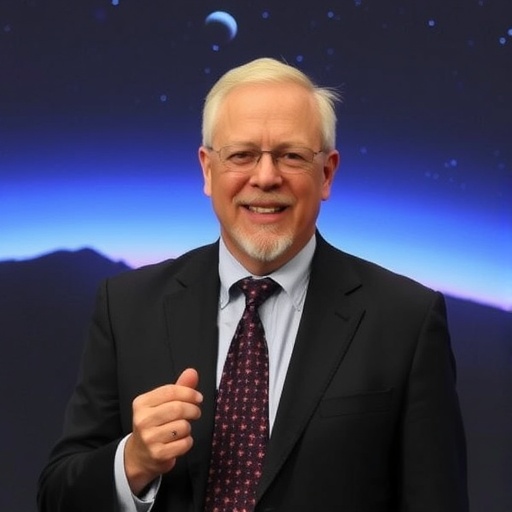
Dr. Matthew Tiscareno, a prominent figure in planetary science, has been honored with the 2026 Carl Sagan Center Director’s Award, recognizing his profound scientific leadership and exceptional contributions to the field. This prestigious accolade highlights not only his groundbreaking research on planetary rings and orbital dynamics but also his dedication to mentoring the next generation of scientists at the SETI Institute. Tiscareno’s work continues to shape our understanding of the intricate mechanisms governing the solar system’s outer planets and their ring systems.
The Carl Sagan Center Director’s Award is presented annually to scientists whose achievements push the boundaries of astrobiology and space exploration, aligning with the visionary legacy of Carl Sagan. Recipients are celebrated for their scientific excellence alongside a strong commitment to fostering education and outreach efforts, ensuring that both the scientific community and public remain engaged with the quest to understand life beyond Earth. This year’s awards ceremony will be held at the Computer History Museum in Mountain View, California, underscoring the pivotal role of technology in advancing planetary science.
Dr. Tiscareno’s career is distinguished by significant discoveries that have revolutionized planetary ring studies. As a Cassini Imaging Team associate, he contributed to the meticulous planning and execution of observational campaigns focused on Saturn’s rings. His identification of “propeller” moons—small bodies embedded within the dense ring particles—provided critical insights into the dynamic processes shaping ring morphology and evolution. Additionally, his observations of transient impact ejecta clouds have expanded knowledge of the interactions between ring particles and external forces, deepening our understanding of collisional physics in low-gravity environments.
A particularly transformative aspect of Tiscareno’s research is his involvement in confirming the presence of a global subsurface ocean on Saturn’s moon Enceladus. This discovery, pivotal for astrobiology, suggests a potentially habitable environment beneath the moon’s icy crust, reshaping hypotheses regarding where life might exist in our solar system. By combining remote sensing techniques with theoretical modeling, Tiscareno and his collaborators helped establish the geophysical framework supporting Enceladus as a prime candidate for extraterrestrial life exploration.
Beyond his scientific inquiries, Tiscareno exerts substantial influence through leadership roles within the astronomical community. His tenure as chair of an American Astronomical Society division and editorial contributions to definitive tomes on planetary rings underscore his commitment to advancing scholarly discourse and collaboration. These roles facilitate the dissemination of cutting-edge research and foster informed dialogue among scientists focused on unraveling the complexities of planetary systems and their evolutionary histories.
Central to his influence is Dr. Tiscareno’s stewardship of the SETI Institute’s Research Experience for Undergraduates (REU) program, where he mentors emerging scientists. His management of the Planetary Data System (PDS) Ring-Moon Systems Node ensures that high-fidelity data from planetary missions remains accessible worldwide, promoting open science and enabling ongoing research efforts. By nurturing young talent and championing data preservation, he contributes to the sustainability and growth of planetary science as a vibrant intellectual field.
The 2026 Carl Sagan Center Director’s Award also illuminates the achievements of up-and-coming scientists at the SETI Institute. Maria Calderon-Marrero, recognized with the SETI Forward Award, advances our understanding of extremophiles inhabiting Earth’s hydrothermal geysers. Her meticulous fieldwork and genomic analyses shed light on microbial strategies for survival under extreme physicochemical stresses, offering analogs for potential biosignatures in extraterrestrial hydrothermal systems and informing methodologies for life detection beyond Earth.
Similarly, Matti Weiss’s innovative research addresses critical challenges in the interpretation of SETI observations. By developing BEAMSETI, a sophisticated computational tool harnessing data from Gaia DR3 and the NASA/IPAC Extragalactic Database (NED), Weiss refines estimates of stellar populations within radio telescope fields of view. This refinement enhances the ability to distinguish potential extraterrestrial signals from astrophysical background noise, thereby improving the efficacy of SETI surveys and contributing to more accurate assessments of the prevalence of intelligent life.
The SETI Institute REU Award of Excellence awarded to Blayne Griffin highlights exceptional undergraduate contributions to the Breakthrough Listen “Exotica” catalog. This catalog expands the portfolio of astronomical targets studied for technosignatures and biosignatures beyond traditional Earth-like worlds, encompassing a diverse array of exotic cosmic phenomena. Under expert mentorship, Griffin’s work advances the strategic framework for identifying and prioritizing novel SETI targets, pushing the boundaries of the search for extraterrestrial intelligence.
Dr. Matthew Tiscareno’s recognition resonates deeply within the scientific community, symbolizing a blend of pioneering research and a commitment to cultivating future generations of planetary scientists. His work exemplifies the dynamic interplay between observational astronomy, theoretical physics, and data science, which collectively propel the quest to understand the origins and dynamics of our solar system’s complex environments. This award highlights how leadership within scientific institutions complements individual research excellence to shape impactful discovery.
SETI Institute Director of the Carl Sagan Center, Dr. Nathalie Cabrol, commended Dr. Tiscareno for his significant advancements in understanding planetary ring systems and ocean worlds, emphasizing his dual role in both scientific innovation and mentorship. Her remarks underscore the holistic criteria for the award, which values contributions that foster institutional strength and community engagement in planetary and astrobiological sciences.
The SETI Institute, established in 1984, remains at the forefront of multidisciplinary research, integrating physical and biological sciences with advanced computational techniques, including machine learning and signal detection technologies. Collaborating with NASA, the National Science Foundation, and industry partners, the Institute’s mission is to unravel the mysteries surrounding the emergence and distribution of life in the universe, while promoting public awareness and scientific literacy.
The upcoming Drake Awards event not only honors established researchers but also showcases the achievements of emerging scientists and leaders in the field. Alongside Dr. Tiscareno, this year’s honorees exemplify the vibrant intellectual ecosystem at the SETI Institute, where scientific rigor meets ambitious exploration. Collectively, these recognitions affirm the Institute’s commitment to pioneering planetary and astrobiological research that inspires both academia and the global community.
Keywords
Planetary rings, Saturn’s moons, subsurface ocean, Enceladus, planetary science mentorship, SETI Institute, Carl Sagan Center, astrobiology, extremophiles, Breakthrough Listen, stellar population modeling, research leadership
Cite Scienmag News
Grant Pearson. (May 13, 2026). SETI Institute Honors Dr. Matthew Tiscareno with 2026 Carl Sagan Center Director’s Award. Scienmag. https://scienmag.com/seti-institute-honors-dr-matthew-tiscareno-with-2026-carl-sagan-center-directors-award/
Grant Pearson. "SETI Institute Honors Dr. Matthew Tiscareno with 2026 Carl Sagan Center Director’s Award." Scienmag, 13 May 2026, https://scienmag.com/seti-institute-honors-dr-matthew-tiscareno-with-2026-carl-sagan-center-directors-award/. Accessed 4 September 2026.
Grant Pearson. "SETI Institute Honors Dr. Matthew Tiscareno with 2026 Carl Sagan Center Director’s Award." Scienmag. May 13, 2026. https://scienmag.com/seti-institute-honors-dr-matthew-tiscareno-with-2026-carl-sagan-center-directors-award/


