


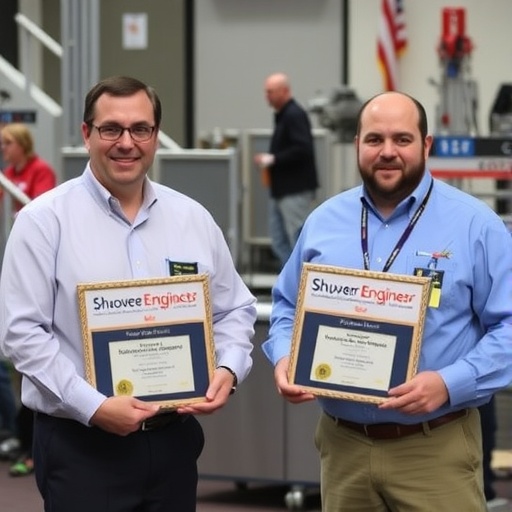
Two pioneering researchers at the Department of Energy’s Oak Ridge National Laboratory (ORNL) have been internationally recognized for their groundbreaking contributions to advanced manufacturing technologies. Nadim Hmeidat and Amber Hubbard have been awarded the prestigious 2026 Outstanding Young Manufacturing Engineer Award by the Society of Manufacturing Engineers (SME). This distinguished honor celebrates their innovative work in polymer and composite materials engineering, which is instrumental in driving the future of manufacturing competitiveness and technological advancement on a global scale.
Hmeidat and Hubbard were selected from a competitive international pool of candidates as part of an elite group of only 12 recipients globally. This accolade highlights not only their individual excellence but also the strategic role represented by ORNL’s Manufacturing Science Division in pioneering transformative manufacturing solutions. The recognition is a testament to how mission-driven scientific inquiry can invigorate U.S. manufacturing with novel, real-world applications and sustainable technologies.
Nadim Hmeidat possesses a multifaceted expertise in materials science and mechanical engineering. After completing his postdoctoral research at the Beckman Institute for Advanced Science and Technology, University of Illinois Urbana-Champaign, he joined ORNL with a focus on cutting-edge advanced manufacturing techniques. His work centers on polymer system manufacturing and the development of ceramic composites designed for extreme environments, enabling resilience in aerospace, defense, and energy sectors. Hmeidat’s research is notable for the creation of next-generation multifunctional materials, which combine structural strength with additional functionalities such as thermal resistance or electrical conductivity.
Boasting over 25 published scientific articles and numerous patent applications, Hmeidat’s contributions extend beyond academic scholarship to tangible technological innovations. His prior accolades include the 2024 Young Professionals Emerging Leadership Award from the Society for the Advancement of Material and Process Engineering (SAMPE), recognizing his promise as an early-career leader in materials engineering and manufacturing innovation. His work harnesses the interplay between material behavior under manufacturing processes and performance in demanding operational conditions, allowing for the informed design of advanced, durable material systems.
Amber Hubbard’s research trajectory combines chemical engineering and materials science with a focus on fiber-reinforced composite materials and polymer vitrimer systems. Vitrimers represent an emerging class of polymers characterized by their ability to be reshaped, repaired, and recycled without compromising mechanical integrity. Hubbard’s work in optimizing formulations and processing techniques of these polymers contributes directly to creating sustainable materials that support circular manufacturing economies—a critical consideration in reducing environmental impact.
Her research also emphasizes the utilization of domestically sourced raw materials, strategically positioning her work at the intersection of material innovation and national energy security. Before joining ORNL, Hubbard completed a highly selective postdoctoral fellowship at the Air Force Research Laboratory, where she advanced high-performance polymer systems tailored for extreme operating environments. Her research outputs, comprising 25 peer-reviewed publications, address the challenges of scalability, durability, and multifunctionality essential for future composites used in aerospace, automotive, and energy applications.
Both researchers embody a forward-looking approach to manufacturing science that integrates rigorous fundamental study with applied engineering solutions. Their work at ORNL, managed by UT-Battelle on behalf of the DOE Office of Science, exemplifies the nation’s commitment to sustaining excellence in physical sciences research—investing in innovations that strengthen U.S. manufacturing capabilities on an international stage.
The manufacturing challenges tackled by Hmeidat and Hubbard are highly complex, involving the precise control of polymer molecular architectures, composite interfacial chemistry, and microstructural evolution during processing. These parameters critically influence material properties such as toughness, thermal stability, and resistance to mechanical fatigue. Advancements in these areas enable the production of lightweight, robust components that are essential for energy-efficient transportation and resilient infrastructure.
The integration of vitrimer chemistry in composite manufacturing—explored extensively in Hubbard’s research—addresses longstanding barriers related to repairability and recyclability of high-performance materials. This breakthrough offers manufacturers a pathway to drastically reduce waste while maintaining mechanical performance, aligning with emerging regulations and consumer demands for greener industrial practices.
Meanwhile, Hmeidat’s work on ceramic composites for harsh environments pushes the boundaries of what materials can endure in extreme temperature, corrosive, and radiation-exposed conditions. Developing these materials involves advanced characterization techniques and computational modeling to understand and predict lifespan under operational stresses. Such insights lead to engineered solutions that extend service life and reduce maintenance costs across critical systems.
Together, the contributions of these two scientists represent a dynamic frontier in manufacturing research—where innovations in polymer science, composite engineering, and sustainable materials converge. Their success underscores the importance of interdisciplinary collaboration, combining chemistry, mechanics, and process engineering, fostering novel materials that not only meet stringent performance requirements but also integrate ecological and strategic priorities.
As the DOE and the Office of Science continue to support foundational and applied research endeavors, the achievements of Hmeidat and Hubbard stand as a beacon for the next generation of manufacturing engineers. Their work catalyzes advances that can transform industrial capabilities, support energy independence, and create a robust technological ecosystem capable of addressing the complex demands of the 21st century.
For more than a decade, ORNL’s Manufacturing Science Division has cultivated a culture of innovation and excellence, positioning itself at the forefront of manufacturing research. The recognition of Hmeidat and Hubbard affirms the division’s pivotal role in shaping the future landscape of engineering materials, driving advancements that resonate well beyond the laboratory.
The 2026 Outstanding Young Manufacturing Engineer Award not only celebrates individual achievement but also spotlights the broader impact of cutting-edge research in sustaining U.S. global leadership in manufacturing innovation. Hmeidat and Hubbard’s pioneering work paves the way for transformative applications across sectors, ensuring that advanced materials unlock new possibilities for performance, sustainability, and manufacturability in the decades ahead.
News Publication Date: 2026
Web References: https://www.energy.gov/science/office-science
Cite Scienmag News
Denise Maddox. (May 13, 2026). Hmeidat and Hubbard Named Outstanding Manufacturing Engineers. Scienmag. https://scienmag.com/hmeidat-and-hubbard-named-outstanding-manufacturing-engineers/
Denise Maddox. "Hmeidat and Hubbard Named Outstanding Manufacturing Engineers." Scienmag, 13 May 2026, https://scienmag.com/hmeidat-and-hubbard-named-outstanding-manufacturing-engineers/. Accessed 3 September 2026.
Denise Maddox. "Hmeidat and Hubbard Named Outstanding Manufacturing Engineers." Scienmag. May 13, 2026. https://scienmag.com/hmeidat-and-hubbard-named-outstanding-manufacturing-engineers/


