


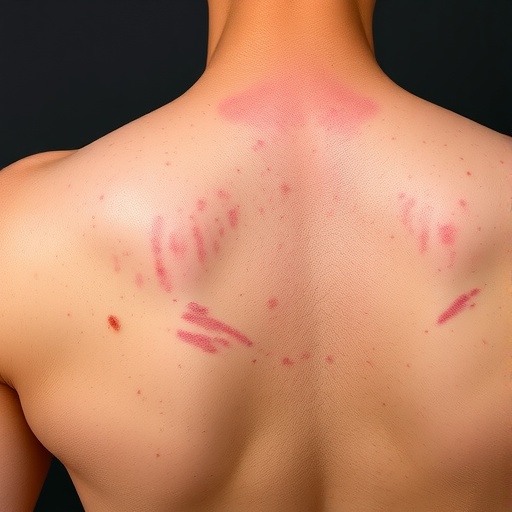
In a groundbreaking multicenter study that challenges conventional therapeutic strategies for chronic psoriasis, researchers from Radboud University Medical Center and Ghent University Hospital have demonstrated that significant dosage reductions in advanced biologic treatments do not compromise clinical efficacy. This international, pragmatic, randomized controlled trial, recently published in The Lancet Regional Health – Europe, proposes a paradigm shift in managing this burdensome skin disease, with profound implications for patient quality of life and healthcare economics.
Psoriasis, an autoimmune inflammatory disorder afflicting approximately half a million individuals in the Netherlands alone, manifests with complex immunopathology involving dysregulated cytokine networks. Over the past two decades, the development of biologics targeting specific interleukins—namely IL-17 and IL-23—has revolutionized disease control, offering patients dramatic symptom relief and improved functional capacity. Nevertheless, these biologics come with hefty price tags, often exceeding €17,000 per patient annually, necessitating exploration of optimized dosing regimens.
The study enrolled 244 patients across 19 Dutch and Belgian hospitals, following them over an 18-month period. By employing a non-inferiority design, the investigators assessed whether tapering the biologics to two-thirds or even half of the standard therapeutic doses could maintain remission or low disease activity without increasing adverse events. Importantly, dose reductions were implemented via gradually extending the intervals between injections, an innovative approach that offered practical advantages in clinical settings.
Findings revealed that 75% of patients responded favorably to the reduced dosing regimens, experiencing symptom control equivalent to those maintained on standard doses. This outcome not only underscores the potency and durability of IL-17 and IL-23 inhibitors but also supports the hypothesis that lower antigenic stimulus suffices to suppress the aberrant immune activation characteristic of psoriasis in many patients. By allowing the immune system to recalibrate under diminished pharmacological pressure, treatment sustainability was notably enhanced.
From a pharmacoeconomic standpoint, the implications are substantial. Reducing dosage effectively halves the frequency of injections for some individuals, translating into annual cost savings nearing €8,500 per patient. This reduction diminishes logistical burdens for both patients and healthcare systems and aligns with global imperatives for more sustainable and efficient medical resource utilization. Moreover, fewer injections potentially lower cumulative immunogenicity and treatment-related side effects, contributing to improved safety profiles.
Patient perspectives garnered during the study highlighted the psychological complexity inherent in tapering biologic therapies. Given psoriasis’s chronicity—with many suffering symptoms for decades before initiating biologics—patients often harbor understandable concerns regarding potential relapse. The study’s pragmatic design allowed participants to revert to standard dosing promptly if symptom control waned, ensuring personalized management and strengthening patient confidence during the dose reduction phase.
Lead dermatologist Elke de Jong emphasized that incorporating flexible dosage adjustments into clinical guidelines could transform routine practice. This adaptive strategy balances maximizing therapeutic benefit and minimizing overtreatment, fostering individualized care paradigms. Such guideline evolution is critical as novel biologics continue to enter the market, driving up costs and challenging healthcare sustainability globally.
The research specifically investigated a range of IL-17 inhibitors—including secukinumab, ixekizumab, bimekizumab, and brodalumab—and IL-23 inhibitors such as guselkumab, risankizumab, and tildrakizumab. These agents employ monoclonal antibody technology to selectively neutralize cytokines pivotal in psoriasis pathogenesis, thereby interrupting inflammatory cascades at a molecular level. The demonstrated feasibility of dosing attenuation with these biologics signifies a major advance in the nuanced application of targeted immunotherapies.
Physician-epidemiologist Juul van den Reek explained that extending injection intervals delivers dual benefits: reduction in iatrogenic trauma and the environmental footprint associated with production, packaging, and distribution of biologic medications. In an era accentuated by climate considerations, such efficiencies present vital contributions toward greener healthcare models without compromising patient outcomes.
This well-powered, rigorously conducted trial represents the first large-scale prospective evidence supporting dose tapering of biologics for psoriasis. Given the rising prevalence of autoimmune diseases and escalating pharmaceutical expenses worldwide, these findings furnish a robust framework for revising treatment algorithms both within the Netherlands and Belgium—and potentially beyond. Such clinical innovation positions the dermatology community at the forefront of precision medicine and value-based care delivery.
Future research avenues may focus on identifying biomarkers predictive of which patients can most safely and effectively sustain reduced biologic dosing, paving the way for even more tailored interventions. Furthermore, long-term observational studies are warranted to monitor sustained remission rates and assess immunological consequences of dose modulation.
In conclusion, this landmark study dispels the long-held notion that maximal drug dosing is invariably required to maintain psoriasis control. By scientifically validating the safety and efficacy of biologic dose reduction, the BeNeBio trial heralds a new chapter in dermatological therapeutics—one characterized by patient empowerment, economic prudence, and informed flexibility in chronic disease management.
News Publication Date: 1-Jun-2026
Web References:
10.1016/j.lanepe.2026.101721
Cite Scienmag News
Louis Brooks. (June 2, 2026). Newest Medicines Equally Effective at Half Dosage for Stable Psoriasis, Study Finds. Scienmag. https://scienmag.com/newest-medicines-equally-effective-at-half-dosage-for-stable-psoriasis-study-finds/
Louis Brooks. "Newest Medicines Equally Effective at Half Dosage for Stable Psoriasis, Study Finds." Scienmag, 2 June 2026, https://scienmag.com/newest-medicines-equally-effective-at-half-dosage-for-stable-psoriasis-study-finds/. Accessed 4 September 2026.
Louis Brooks. "Newest Medicines Equally Effective at Half Dosage for Stable Psoriasis, Study Finds." Scienmag. June 2, 2026. https://scienmag.com/newest-medicines-equally-effective-at-half-dosage-for-stable-psoriasis-study-finds/


