


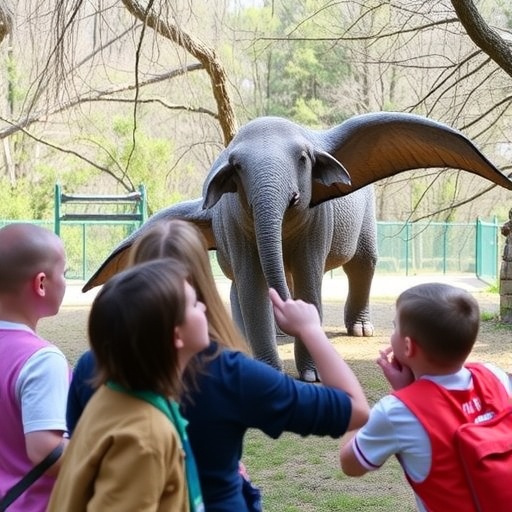
Zoos may do more than entertain visitors: a large international study suggests that well-designed education programs can produce a measurable, if initially short-term, increase in people’s sense of connection to nature. The findings, drawn from educational activities at 20 zoological institutions across Germany, Switzerland, the Netherlands and Portugal, indicate that the strongest changes occur among visitors who begin with only a moderate or limited feeling of belonging to the natural world. Direct encounters with animals, lessons focused on biodiversity and species conservation, and programs that extend over longer periods were associated with the most pronounced gains.
The study was conducted by biology education researchers at Goethe University Frankfurt and examined how visitors’ attitudes changed immediately before and after taking part in zoo-based learning activities. The programs included different formats, such as guided tours, workshops and multi-day educational experiences. Rather than measuring only whether participants enjoyed the visit, the researchers used questionnaires to assess their psychological connection to nature—a concept linked to the extent to which people see themselves as part of the natural world, value living systems and feel emotionally connected to other species.
This connection is increasingly regarded as an important factor in environmental behavior. People who feel more closely connected to nature are generally more likely to support conservation, recognize the importance of biodiversity and make choices that reduce environmental harm. However, the relationship is complex: feeling connected does not automatically lead to sustainable behavior, and educational programs cannot transform attitudes overnight. The new research nevertheless suggests that zoos may provide a practical setting for strengthening one of the psychological foundations on which conservation engagement can develop.
Participants completed surveys immediately before and after their educational program. The researchers compared their reported connection to nature with several variables, including age, gender, frequency of zoo visits, program duration, the presence or absence of direct animal contact, and whether the activity addressed nature protection or species conservation. This design allowed the team to examine not only whether scores changed overall, but also whether particular groups or program characteristics were linked to larger shifts.
Across the participating institutions, the average connection-to-nature scores increased after the educational experiences. The effect was not uniform, however. Visitors who began with low or moderate scores showed the greatest improvement, while those who already reported a very strong connection to nature exhibited smaller measurable changes. The researchers caution that this pattern should not be interpreted as evidence that programs are ineffective for nature-oriented visitors. Instead, it may reflect a statistical “ceiling effect”: when a person begins near the maximum possible score on a psychological scale, there is little numerical room for that score to rise further.
The strongest increases among less-connected participants appeared when educational activities involved direct encounters with animals, discussed biodiversity or conservation, or continued over an extended period. Direct contact may create a vivid and emotionally memorable experience, while conservation content can connect an individual animal to broader ecological systems and threats. Longer programs may provide repeated opportunities for attention, reflection and learning, allowing visitors to move beyond a brief emotional reaction toward a more developed understanding of interdependence in nature.
The analysis also revealed differences associated with visitor characteristics. Frequent zoo visitors experienced larger increases than people who attended only occasionally, possibly because repeated visits create more opportunities to build familiarity with animals, habitats and conservation messages. Children who initially reported low or moderate connection to nature showed particularly strong gains. Women also demonstrated slightly larger increases than men in the study sample. These differences do not establish that age or gender directly causes a particular response, but they suggest that visitors’ backgrounds and previous experiences may influence how they engage with educational content.
For zoo educators, the findings highlight the importance of designing programs around the participants who enter them. A single approach may not work equally well for a child encountering conservation ideas for the first time, an occasional visitor seeking a memorable experience, and a frequent zoo-goer who already has a strong interest in wildlife. Programs that combine emotional engagement with scientifically grounded explanations may be especially effective. Meeting an African elephant, for example, can generate wonder, but linking that encounter to habitat loss, social behavior, population decline and conservation strategies may help transform a moment of fascination into a broader understanding of ecological responsibility.
The researchers emphasize that their study measured immediate changes, not long-term transformation. A higher score directly after a program does not prove that the effect will remain weeks, months or years later, nor does it demonstrate that participants will necessarily change their daily behavior. Future research will need to follow visitors over longer periods and determine whether increased connection to nature leads to sustained conservation knowledge, stronger support for biodiversity protection or measurable changes in behavior. Even with these limitations, the findings suggest that zoos—institutions visited by people from widely different backgrounds—could serve as important public platforms for environmental education. Their greatest potential may lie not only in inspiring people who already care about wildlife, but also in reaching those who have not yet found a personal connection to the natural world.
News Publication Date: 4 August 2026
Web References: https://doi.org/10.1002/pan3.70396
References: Viktoria Feucht et al., “The impact of zoo education programs on connection to nature considering program type, participants’ demographics, and their initial connection,” People and Nature, DOI: 10.1002/pan3.70396.
Cite Scienmag News
Courtney Benton. (August 5, 2026). Zoo education deepens people’s connection with the natural world. Scienmag. https://scienmag.com/zoo-education-deepens-peoples-connection-with-the-natural-world/
Courtney Benton. "Zoo education deepens people’s connection with the natural world." Scienmag, 5 August 2026, https://scienmag.com/zoo-education-deepens-peoples-connection-with-the-natural-world/. Accessed 4 September 2026.
Courtney Benton. "Zoo education deepens people’s connection with the natural world." Scienmag. August 5, 2026. https://scienmag.com/zoo-education-deepens-peoples-connection-with-the-natural-world/


