


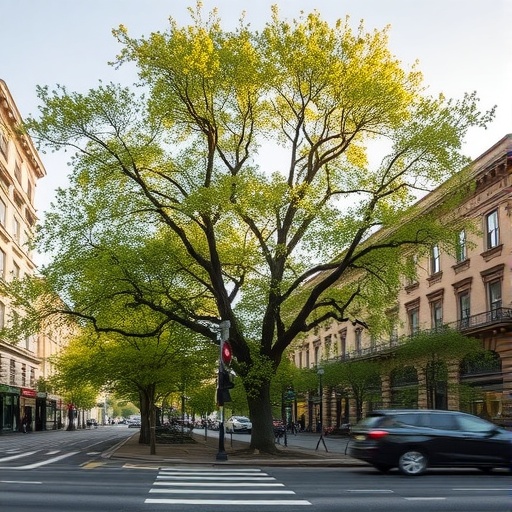
Brazilian scientists have turned a tree into a digital twin in an effort to answer a deceptively difficult question: how should a tree be pruned so that it is less likely to fall? At the University of São Paulo (USP), biologists and engineers have combined LiDAR laser scanning, mathematical modeling and wind simulations to create a new method for assessing tree stability. The approach produces a highly detailed three-dimensional model of a living tree, then uses computer calculations to identify branches that contribute most to mechanical weakness. The long-term ambition is to transform the technology into an app capable of helping urban authorities make pruning decisions before storms turn vulnerable trees into public hazards.
The project addresses an increasingly urgent problem in São Paulo, where violent weather regularly exposes weaknesses in the city’s vast urban forest. In December 2025, winds exceeding 90 kilometers per hour were associated with 1,327 reports of fallen trees across the São Paulo Metropolitan Area, some involving injuries. More than two million people lost power. According to Marcos Silveira Buckeridge of USP’s Institute of Biosciences, inappropriate pruning can make trees particularly susceptible to wind by disrupting their balance and leaving trunks, roots or branches exposed to forces they can no longer withstand. The danger is intensified by urban “wind tunnels,” or canyons formed by buildings, as well as heavy rain, temperature shifts, disease and poor maintenance.
The researchers began by scanning a rosewood tree, Tipuana tipu, on USP’s Butantã campus. The species is widely planted in cities and is therefore a useful model for studying trees exposed to urban conditions. A LiDAR scanner was positioned near the base of the tree and moved around it several times to capture the trunk and branches from different angles. The resulting point cloud contained approximately 30 million individual coordinates, creating a digital mold detailed enough to reproduce the tree’s architecture in a computer. Leaves were removed from the model so that the team could focus on the load-bearing structure of the trunk and branches.
Once the digital tree had been reconstructed, the team applied finite element method simulations, a widely used engineering technique for predicting how complex structures respond to forces. Virtual wind was directed at the model from multiple angles, allowing the researchers to calculate how stress moved through the tree. The simulations identified regions with high compliance, a measure related to mechanical flexibility or deformation under load. These areas are especially important because excessive movement can indicate that a branch or part of the trunk is contributing disproportionately to structural instability.
The pruning system uses a strategy known as topological optimization. In engineering, topological optimization removes material from areas that contribute least to a structure’s strength while preserving or reinforcing the regions that carry the greatest loads. Applied to a tree, the method evaluates the distribution of stress and recommends which branches or sections could be removed to produce a more balanced structure. The researchers aim to limit pruning to no more than 20 percent of the tree’s total mass. Rather than simply reducing the size of the canopy, the algorithm attempts to correct asymmetries caused by broken branches, disease or uneven growth.
The study also produced a counterintuitive finding: cutting a branch does not automatically make a tree safer. Removing material can create topological asymmetry and increase vulnerability if the cut changes how wind loads are distributed. The scanned tree was especially exposed because neighboring trees stood beside it but not directly in front of or behind it. The researchers found that the tree was stronger on the sides without neighboring trees, while clusters of intertwined trees appeared more resistant because their branches could help dissipate wind energy. The current models do not yet fully calculate the aerodynamic effects of leaves, but the team plans to include wind dissipation through foliage in future studies.
For now, the method remains a proof of concept rather than an automated replacement for professional arborists. A scan performed at the study’s level of detail takes about 40 minutes for a single tree, making citywide application difficult. São Paulo, however, is already pursuing projects to inventory roughly 650,000 street trees. A less detailed version of the technology could help estimate tree health and prioritize inspections, even if it cannot reproduce every branch with research-grade precision. The scientists emphasize that human judgment will remain essential, while the technology could provide a more objective basis for deciding where and how to prune.
Tree stability also depends on structures hidden below ground, and the team is developing complementary methods to account for roots. Approximately 30 percent of tree falls in São Paulo are thought to be related to root problems. Ground-penetrating radar, operated like a wheel rolled around the base of a tree, can reveal the location and arrangement of roots beneath sidewalks, parking lots and parks. The researchers are also studying how wood expands and contracts with temperature and water content. Dendrometers will measure these changes, which may influence a tree’s weight and flexibility. After prolonged rain, for example, a saturated tree becomes heavier, potentially increasing the forces acting on its roots and trunk.
LiDAR is being tested alongside other diagnostic technologies across the USP campus. On one avenue, researchers are using a compact scanner attached to a vehicle traveling at approximately 20 kilometers per hour to map trees with centimeter-level accuracy. The images may reveal holes, structural defects or changes in canopy form. In another experiment, scientists are examining sibipiruna trees infected with Ganoderma, a fungus associated with decay in trunks. Penetrometers measure wood resistance, while ultrasound devices detect internal cavities by recording the echoes produced when the trunk is tapped with a small hammer. Comparing these measurements with LiDAR scans could lead to a broader diagnostic protocol combining external architecture with internal health indicators.
The researchers are also investigating whether biochemical signals can reveal vulnerability across different tree species. Samples may be analyzed for sugars, alcohols, secondary metabolites and gene-expression patterns that could serve as universal markers of stress or structural decline. The immediate goal is to make urban pruning more scientifically informed, but the broader vision is a comprehensive risk-assessment system that integrates canopy structure, trunk integrity, root condition, water content, temperature response and biological health. If that system can be made fast and affordable, a laser scan could become an early-warning tool for cities worldwide, helping them identify dangerous trees before the next extreme windstorm does it for them.
News Publication Date: 8 May 2026
Web References: https://doi.org/10.1007/s00468-026-02744-z
References: “Improving tree stability with optimized pruning: a comprehensive cycle method,” Trees: Structure and Function, published 8 May 2026, DOI: 10.1007/s00468-026-02744-z.
Cite Scienmag News
Reid Dalton. (August 5, 2026). Laser Scanning Could Help Prevent Urban Trees From Falling. Scienmag. https://scienmag.com/laser-scanning-could-help-prevent-urban-trees-from-falling/
Reid Dalton. "Laser Scanning Could Help Prevent Urban Trees From Falling." Scienmag, 5 August 2026, https://scienmag.com/laser-scanning-could-help-prevent-urban-trees-from-falling/. Accessed 4 September 2026.
Reid Dalton. "Laser Scanning Could Help Prevent Urban Trees From Falling." Scienmag. August 5, 2026. https://scienmag.com/laser-scanning-could-help-prevent-urban-trees-from-falling/


