


In a remarkable confluence of perseverance and cutting-edge astronomy, Paul Smith, a University of Cincinnati astrophysics alumnus and current scholar in geosciences, recently experienced a milestone in exoplanetary science. After a distinguished two-decade tenure at Procter & Gamble followed by a prolific career in business leadership communication, Smith embarked on a transformative academic journey back to physics and planetary sciences. His latest endeavor, spearheading the data analysis for a groundbreaking observation from the James Webb Space Telescope (JWST), centers on a planet nearly a millennium away in light years, offering profound insights into the complex dynamics of exoplanetary atmospheres.
The exoplanet under scrutiny, TOI-2031Ab, orbits a star cataloged by NASA’s Transiting Exoplanet Survey Satellite (TESS) as an Object of Interest. Positioned an astounding 901 light years from Earth, the photons illuminating this distant star were emitted during the Middle Ages, underscoring the cosmic antiquity embodied in Smith’s research data. Through a highly competitive peer-review process, Smith’s team secured coveted telescope observation time, a testament to the scientific merit and innovative potential of their project amid a backdrop where only about 10% of proposals succeed.
Utilizing the JWST’s advanced near-infrared spectrographic instruments, Smith and his collaborators aimed to capture the subtle transit of TOI-2031Ab as it crossed its host star’s face. This transit method, indispensable in exoplanet science, allows astronomers to dissect the thin veil of an exoplanet’s atmosphere by analyzing stellar light filtered through it. Smith’s role as the lead data analyst was pivotal; he was the first to access and interpret this raw astronomical data, a process that revealed intricate details about the planet’s physical and chemical makeup.
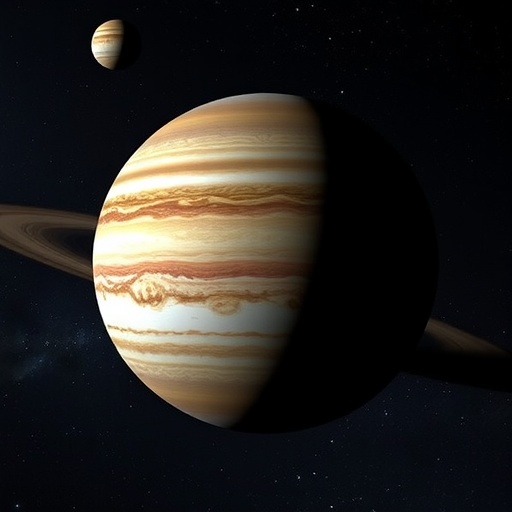
TOI-2031Ab presents an intriguing paradox. Though it is approximately 25% larger in circumference than Jupiter, the largest planet in our solar system, it possesses 20% less mass, hinting at a lower overall density. This gas giant’s proximity to its star is particularly striking, as its orbit lies closer than Mercury’s distance to the Sun and completes a full revolution in just six Earth days. These factors make TOI-2031Ab an exemplary subject for studying planetary formation theories and migration hypotheses within nascent solar systems.
The international collaborative nature of Smith’s research, involving co-authors and experts from 19 other institutions, underscores the global scientific community’s investment in unraveling the mysteries of exoplanetary atmospherics. Frequent consultations with Ohio State University’s astrophysics team and contacts at the Carnegie Science Institute enhance the depth and breadth of interpretive frameworks applied in the analysis. Their collective aim is to dissect not only the compositional characteristics of these gas giants but also their enigmatic orbital journeys.
The atmospheric composition of TOI-2031Ab, as revealed by transit spectroscopy, shares remarkable similarities with that of Jupiter. Predominantly composed of hydrogen and helium, this atmosphere also features detectable amounts of water vapor and carbon dioxide—compounds crucial to understanding planetary climate systems and chemical evolution on a cosmic scale. These measurements furnish essential clues about the planet’s formation conditions and potential atmospheric dynamics, which in turn inform broader astrophysical models of gas giant behavior.
Exoplanetary science has rapidly emerged as one of the most dynamic and fastest-evolving domains in astrophysics. Through studying worlds like TOI-2031Ab, scientists are beginning to contextualize our solar system within a broader galactic framework. As Cincinnati Observatory astronomer Wes Ryle notes, the investigation of planets beyond our sun not only enriches our comprehension of planetary migration and system architecture but also propels the search for habitable environments beyond Earth, a quest at the forefront of modern astrophysical exploration.
Technological advancements in space telescopes such as JWST have revolutionized observational capabilities. Its near-infrared sensors penetrate deep into stellar environments, unveiling spectral markers that ground-based telescopes cannot resolve. This leap in observational precision allows astronomers to decode the atmospheric signatures of exoplanets with unprecedented detail, thereby refining parameters like molecular abundances, temperature profiles, and potential weather patterns on distant worlds.
The discovery and subsequent study of TOI-2031Ab affirm the growing emphasis on gas giants orbiting perilously close to their stars—a phenomenon that challenges classical models of planetary system formation, which traditionally suggested that such massive planets should form in colder, outer regions of stellar disks. Understanding the mechanisms by which these planets migrate inwards—whether through disk interactions, gravitational perturbations, or other dynamical processes—remains a critical frontier being advanced by Smith’s research.
Smith’s journey from seasoned corporate executive to astrophysics data analyst epitomizes the interdisciplinary cross-pollination enriching scientific inquiry today. His dedication to interpreting complex exoplanet data and disseminating these insights at esteemed forums such as the American Astronomical Society meetings culminates in contributions that push the envelope of our cosmic knowledge, inspiring both the scientific community and the public alike.
The research into TOI-2031Ab sets a precedent not only for methodological rigor but also for the collaborative spirit driving contemporary astronomy. By leveraging international expertise and state-of-the-art instrumentation, the project exemplifies how modern astronomy transcends geographical and disciplinary boundaries, harnessing collective intelligence to decipher the cosmos’ intricate tapestry.
As astrophysicists continue to uncover the vast diversity of planetary systems, the role of exoplanetary atmospheres emerges as a linchpin in decoding planetary history, habitability, and the evolutionary pathways shaping solar systems. Studies like those led by Paul Smith illuminate this frontier, offering critical data that transform speculative models into empirical science, ultimately guiding humanity’s quest to understand our place in the universe.
News Publication Date: Not specified
Web References: Not specified
References: Not specified
Keywords
Exoplanets, TOI-2031Ab, James Webb Space Telescope, planetary atmospheres, gas giants, astrophysics, exoplanet migration, transit spectroscopy, TESS, planetary science, hydrogen, helium, water vapor, carbon dioxide, planetary formation
Cite Scienmag News
Grant Pearson. (May 8, 2026). Solitary Jupiter-like Planet Reveals New Insights About Gas Giants. Scienmag. https://scienmag.com/solitary-jupiter-like-planet-reveals-new-insights-about-gas-giants/
Grant Pearson. "Solitary Jupiter-like Planet Reveals New Insights About Gas Giants." Scienmag, 8 May 2026, https://scienmag.com/solitary-jupiter-like-planet-reveals-new-insights-about-gas-giants/. Accessed 4 September 2026.
Grant Pearson. "Solitary Jupiter-like Planet Reveals New Insights About Gas Giants." Scienmag. May 8, 2026. https://scienmag.com/solitary-jupiter-like-planet-reveals-new-insights-about-gas-giants/


