


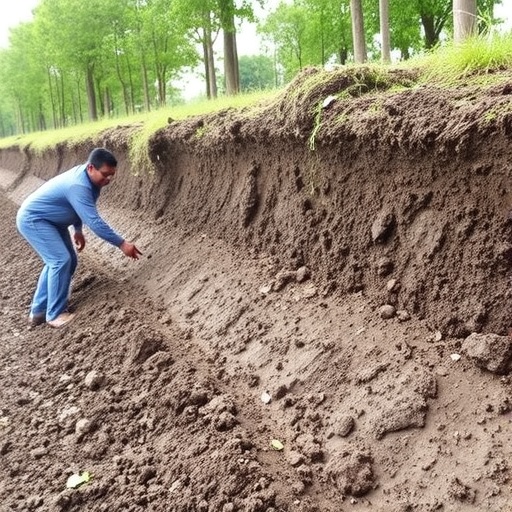
In a groundbreaking study set to transform our understanding of soil erosion, researchers Li, Hu, Zou, and colleagues have conducted an unprecedented on-site experiment examining the rainfall erosion process of soil slopes alongside its intricate hydraulic mechanisms. Published in Scientific Reports in 2026, this comprehensive investigation unravels the dynamics of how rainfall interacts with soil structures in natural settings, providing breakthrough insights that could influence future soil conservation strategies and landscape management worldwide.
Soil erosion caused by rainfall is a critical environmental challenge that affects agriculture, infrastructure, and ecosystem stability globally. Despite decades of laboratory studies and theoretical modeling, real-world observations under natural conditions have remained limited, primarily due to the complexity of environmental variability and technical constraints. This study overcomes these barriers by implementing a meticulous, long-term field experiment, capturing direct data on how rainfall initiates and propagates erosive processes on natural soil slopes.
Key to the research was the installation of an array of advanced monitoring instruments precisely positioned across representative slope sections. These sensors continuously measured rainfall intensity, soil moisture variations, surface runoff, and subsurface water fluxes. By coupling these empirical measurements with hydrodynamic modeling, the researchers delineated the roles of different hydraulic forces—including infiltration, percolation, and overland flow—in driving soil particle detachment and transport.
One of the most compelling findings from the experiment was the identification of threshold rainfall intensities, above which soil erosion rates dramatically increased. This nonlinear response highlights the critical tipping points within slope hydrodynamics, underscoring the vulnerability of certain soil types under intense precipitation events. Understanding these thresholds is vital for predicting and mitigating erosion risks, especially with the predicted increase in extreme weather patterns due to climate change.
Furthermore, the study revealed the crucial interplay between soil structure and moisture conditions in modulating erosion susceptibility. Highly permeable soils exhibited different erosion patterns compared to less permeable, compacted soils, emphasizing how micro-scale soil properties govern macro-scale erosion outcomes. This nuanced perspective challenges some conventional soil erosion models that often assume homogeneity within slope materials.
In addition, the researchers uncovered the significance of subsurface water movements in influencing surface erosion. Contrary to prior assumptions focusing mainly on surface runoff, the vertical flux of water within soil profiles was found to exacerbate slope instability by facilitating deeper soil saturation and weakening mechanical cohesion. These findings suggest that comprehensive erosion models must integrate both surface and subsurface hydraulic processes to accurately represent slope dynamics.
Importantly, the study’s on-site approach allowed the research team to observe the temporal evolution of erosion features, from initial soil particle mobilization to eventual gully formation. This temporal resolution is often missing from laboratory simulations due to scale limitations. By documenting the progressive changes under natural rainfall regimes, the research adds valuable temporal context to the spatial patterns of erosion.
The implications for land management and engineering are profound. Armed with these insights, practitioners can develop more precise erosion control measures—such as optimizing drainage systems, designing vegetation buffers, and enhancing soil stabilization techniques—tailored to site-specific hydraulic and soil properties. The ability to predict when and where erosion is most likely to intensify could reduce economic and ecological damages significantly.
Moreover, the findings carry global relevance since soil erosion is a pervasive problem in numerous regions vulnerable to deforestation, agricultural expansion, and urban development. Integrating this new knowledge into environmental policies could enhance the resilience of both natural landscapes and human infrastructures, particularly in mountainous and hilly terrains where slope erosion poses acute hazards.
The research also opens promising avenues for future studies to refine hydrological modeling frameworks. By incorporating real-time hydraulic data and sophisticated sensor networks similar to those deployed in this project, subsequent investigations can improve erosion forecasts and develop adaptive management strategies that respond dynamically to evolving environmental conditions.
This study stands as a pivotal advance in geosciences, bridging a critical gap between theoretical erosion mechanics and observed natural phenomena. The multi-disciplinary methodology, combining field experimentation, hydraulics, soil science, and environmental physics, sets a new standard for multidisciplinary investigations tackling complex Earth surface processes.
Furthermore, the research elegantly demonstrates the power of high-resolution, continuous monitoring in environmental science. As sensor technologies and data analytics advance, similar on-site experiments could unravel other intricate natural processes that have remained elusive due to previous technical limitations.
In sum, the work by Li and colleagues represents a milestone in our comprehension of rainfall-induced soil erosion on slopes. By elucidating the hydraulic mechanisms at play under natural conditions, this study provides indispensable knowledge critical for safeguarding landscapes against degradation and for promoting sustainable land use across the globe.
As extreme weather events become increasingly frequent in the Anthropocene, the urgency of understanding and managing soil erosion intensifies. This research equips scientists, environmental managers, and policymakers with a robust scientific foundation from which to devise effective interventions that can mitigate the detrimental impacts of erosion on ecosystems, agriculture, and infrastructure resilience.
With its groundbreaking experimental design and profound practical implications, this study is poised to become a reference point in erosion research, inspiring further exploration and innovation. It exemplifies how bridging experimental rigor with real-world complexity can drive transformative insights that extend beyond the laboratory into the very landscapes we depend upon.
Cite Scienmag News
Denise Maddox. (May 30, 2026). On-Site Study of Soil Slope Rainfall Erosion. Scienmag. https://scienmag.com/on-site-study-of-soil-slope-rainfall-erosion/
Denise Maddox. "On-Site Study of Soil Slope Rainfall Erosion." Scienmag, 30 May 2026, https://scienmag.com/on-site-study-of-soil-slope-rainfall-erosion/. Accessed 3 September 2026.
Denise Maddox. "On-Site Study of Soil Slope Rainfall Erosion." Scienmag. May 30, 2026. https://scienmag.com/on-site-study-of-soil-slope-rainfall-erosion/


