


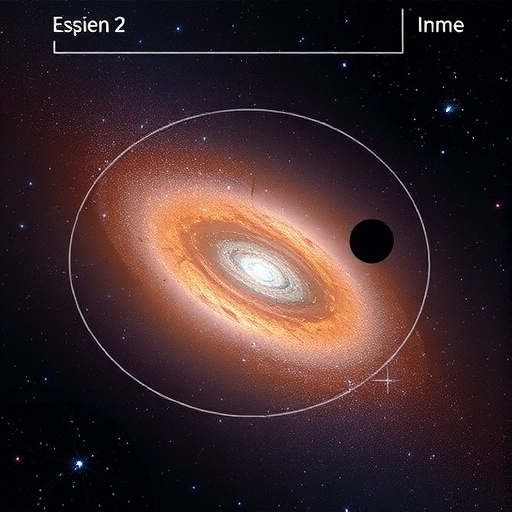
In a groundbreaking discovery that pushes the boundaries of our understanding of the early universe, astronomers using the James Webb Space Telescope (JWST) have identified LAP1-B, an ultra-faint, chemically primitive galaxy located at a redshift of 6.625. This astonishing find places LAP1-B at a cosmic age merely 800 million years following the Big Bang, offering an unprecedented glimpse into the nascent phases of galaxy formation during the epoch of reionization. Gravitational lensing magnifies this faint galaxy, enabling detailed spectroscopic analysis that reveals its remarkable chemical simplicity, positioning it as the most chemically pristine star-forming galaxy ever observed.
The significance of LAP1-B is rooted in its extremely low oxygen abundance, measured at just (4.2 ± 1.8) × 10⁻³ times the solar value. This makes LAP1-B unparalleled in its primordial character, shedding light on the state of the interstellar medium (ISM) in one of the universe’s earliest galaxies. The fact that this galaxy possesses such low metallicity invigorates long-standing theoretical models predicting the chemical conditions in young galaxies that had undergone virtually no prior stellar enrichment. These models anticipate environments dominated by gas composed primarily of hydrogen and helium from the Big Bang, with only trace amounts of heavier elements.
Spectroscopic observations from JWST unveil that LAP1-B hosts an extraordinarily hard ionizing radiation field, which defies explanation through conventional sources such as chemically enriched stellar populations or accreting black holes—both known contributors in typical star-forming galaxies. Instead, the ionization trends align closely with theoretical predictions for metal-deficient stellar populations, suggesting the presence of some of the universe’s first-generation stars. These Population III stars are theorized to have been massive, hot, and efficient producers of ionizing photons, profoundly influencing reionization and early chemical enrichment.
More fascinating still is LAP1-B’s elevated carbon-to-oxygen ratio within its ISM—a signature fingerprint that illuminates the underlying nucleosynthetic processes. This finding resonates with models of primordial star formation where nucleosynthetic yields diverge considerably from those observed in later, metal-enriched populations. The high carbon-to-oxygen ratio intimates that the galaxy’s early stellar inhabitants enriched their surroundings through unique supernova mechanisms expected for metal-free or ultra-metal-poor stars, providing direct empirical validation for decades of theoretical modeling about the yields of the first stars.
LAP1-B’s faintness extends to its stellar continuum, which remains undetectable even with JWST’s sensitivity. This absence imposes strict constraints on its stellar mass, capping it below 3,300 solar masses—a paltry number relative to most known galaxies, reflecting an embryonic stage of star formation. Yet, despite this modest stellar content, emission-line kinematics reveal LAP1-B’s dynamical mass outstrips this combined stellar and gas mass, indicating a dominant dark matter halo that governs its gravitational landscape. This finding is pivotal, highlighting the crucial role dark matter plays in the assembly and stability of the universe’s earliest galactic structures.
What elevates LAP1-B from a mere astronomical curiosity to a cornerstone in cosmic evolution studies is its characterization as a ‘fossil in the making.’ Ultra-faint dwarf galaxies observed in the local universe are believed to be the relics of early star-forming systems, survivors of billions of years of cosmic history. LAP1-B offers an observational window into the formative environment of these survivors, bridging theoretical predictions with tangible precedent. It allows researchers to chart the evolutionary trajectory from primordial gas clouds to chemically enriched, mature galactic systems.
This discovery exemplifies JWST’s transformative impact, revealing the earliest star-forming systems that have hitherto remained beyond reach. By leveraging gravitational lensing and state-of-the-art infrared instrumentation, this research uncovers galaxies that challenge existing paradigms about when and how chemical enrichment began across cosmic time. The ultra-low metallicity and unique radiation signatures reinforce the notion that primordial conditions were dominated by exotic stellar populations differing fundamentally from those seen in later epochs.
Moreover, LAP1-B’s study enriches our comprehension of how early nucleosynthesis redefined the cosmic chemical landscape. The precise carbon-to-oxygen ratio measurement empowers astrophysicists to constrain the yields of the first supernovae, the initial mass functions of primordial stars, and the overarching timeline of reionization. By capturing this detailed chemical fingerprint, the galaxy functions as a natural laboratory to test and refine simulations of the early universe’s chemical evolution.
Beyond its immediate scientific import, LAP1-B challenges observational astronomers to explore even fainter and more chemically primitive galaxies. As technologies evolve, particularly in gravitational lensing surveys combined with next-generation space observatories, it is likely that more proto-galaxies with similarly pristine qualities will be uncovered. Each new discovery will piece together the cosmic narrative, enriching our understanding of how complex elements accumulated to support the formation of planets, life, and eventually human civilization.
The absence of an active galactic nucleus in LAP1-B is another compelling facet of the study. This lack suggests that accretion onto black holes was not the dominant source of ionization or energetic feedback within the galaxy’s ISM at this epoch. Instead, it aligns with a scenario dominated by metal-poor stars providing the bulk of ionizing photons. Consequently, this finding nuances our conception of black hole growth timelines in early cosmic history, suggesting that black hole accretion became significant only after initial stellar feedback mechanisms.
In the broader cosmological context, LAP1-B serves as a crucial benchmark for theories of dark matter halo formation and early galaxy assembly. The disparity between its dynamical mass and its baryonic content confirms theoretical expectations, reinforcing that dark matter halos provided the gravitational wells essential for baryonic matter accumulation, star formation, and chemical development. These insights feed into hierarchical structure formation models, bridging small-scale physics with large-scale cosmic evolution.
Importantly, LAP1-B’s discovery underscores the symbiotic relationship between observational astronomy and theoretical astrophysics. The precise spectroscopic data provided by JWST allows for stringent tests of stellar population models, nucleosynthesis pathways, and ionization mechanisms. Conversely, theoretical foresight guided instrument targeting and data interpretation strategies, exemplifying the iterative scientific process. Such synergy is critical as we look forward to unraveling further mysteries of the early universe.
Ultimately, LAP1-B redefines the frontier of cosmic archaeology, symbolizing humanity’s quest to understand its deepest origins. As astronomers decode the signals from this faint, ancient galaxy, they unlock a narrative of transformation from a simple universe dominated by hydrogen and helium to one abundant with the chemical diversity necessary for complexity and life. This research not only expands the horizons of astrophysics but also inspires a profound reflection on our place within cosmic history.
Cite Scienmag News
Grant Pearson. (May 13, 2026). Ultra-Faint Primitive Galaxy Forms During Reionization. Scienmag. https://scienmag.com/ultra-faint-primitive-galaxy-forms-during-reionization/
Grant Pearson. "Ultra-Faint Primitive Galaxy Forms During Reionization." Scienmag, 13 May 2026, https://scienmag.com/ultra-faint-primitive-galaxy-forms-during-reionization/. Accessed 4 September 2026.
Grant Pearson. "Ultra-Faint Primitive Galaxy Forms During Reionization." Scienmag. May 13, 2026. https://scienmag.com/ultra-faint-primitive-galaxy-forms-during-reionization/


