


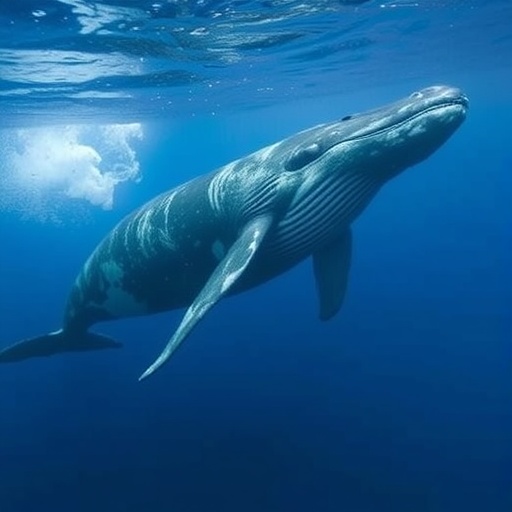
For male humpback whales, singing is not merely a spectacular display heard across tropical breeding grounds. It is an energetically demanding behavior performed underwater, where a whale must coordinate sound production with diving, breathing, buoyancy and movement. A new study of humpback whales off Maui has revealed that the architecture of these songs is closely linked to the animals’ dive cycles, suggesting that different sections of a song may be shaped by different biological pressures.
The research, led by Julia Zeh, a former Ph.D. student in Syracuse University’s College of Arts and Sciences and a member of Susan Parks’ Bioacoustics and Behavioral Ecology Lab, provides an unusually detailed view of what singing whales are doing as they vocalize. Humpback song has been studied for decades because of its complexity and cultural transmission, but scientists have traditionally analyzed it primarily as an acoustic phenomenon. By combining sound recordings with movement data, Zeh and her collaborators examined the physical context in which individual song elements are produced.
The team temporarily attached non-invasive suction-cup tags to 16 singing humpback whales between 2018 and 2024. The work took place in the waters off Maui, part of the Hawaiian breeding grounds where male humpbacks gather during winter. The tags, approximately the size of a tablet, recorded the whales’ underwater sounds and movements before detaching naturally. Researchers deployed the devices from small boats using long poles and, in more recent fieldwork, with the assistance of drones. Once recovered, the tags provided synchronized acoustic and behavioral records for analysis.
The recordings captured an extraordinary level of persistence. Some whales repeated their songs continuously for as long as 16 hours, offering researchers extended sequences in which to compare vocal structure with diving behavior. Humpback songs consist of repeated units arranged into phrases and larger sections known as themes. Although songs can change over time and differ among populations, individual males within a breeding population often share recognizable structures. The new analysis showed that recurring themes appeared consistently during particular portions of a whale’s dive rather than being distributed randomly throughout the performance.
This pattern means that a song can act as a kind of acoustic map of a whale’s behavior. Certain themes were associated with the descent, others with periods of changing depth, and still others with the deepest and most stable portions of a dive or the approach toward the surface. Earlier observations had suggested that some themes were more common near the surface, but the new study links the organization of an entire song to the organization of an entire dive cycle. The result is a connection between the temporal structure of vocal communication and the physical demands of life underwater.
The deepest, relatively stable sections of dives may be especially important for understanding how sexual selection shapes humpback song. Themes performed during these periods displayed different levels of variability from themes sung during other parts of the dive. Zeh and her colleagues propose that the most variable sections could be more strongly influenced by sexual selection, potentially allowing males to signal individual quality or distinguish themselves from competitors. In contrast, song elements associated with ascent, descent or changing depth may be more tightly constrained by physiology and environmental conditions.
Singing while diving is likely to impose competing demands on a whale’s body. Humpbacks must manage limited oxygen stores, control buoyancy and maintain movement while producing powerful, repeated sounds. Changes in depth also alter pressure, and the whale’s body must respond as it moves through the water column. The study does not show that every song theme has a single physiological function, but it indicates that the demands of a particular stage of a dive may influence when that theme is produced and how much it varies. This offers a framework for investigating how acoustic displays evolve under both social and physical constraints.
The findings could also transform how scientists monitor whales. Passive acoustic monitoring is already widely used to detect humpback presence, estimate seasonal activity and study population-level changes without approaching the animals. If specific song themes reliably correspond to particular depths or dive stages, recordings made from hydrophones could provide clues about a whale’s position in the water column even when the animal cannot be seen. Such information could improve estimates of normal diving and singing behavior, creating a baseline against which disturbances from vessel traffic, construction or underwater noise can be measured.
It remains uncertain whether the same relationship between song themes and diving occurs in humpback populations elsewhere. Humpback whales in different oceans share broad biological traits, including the use of learned songs during breeding, but their songs evolve independently and can differ substantially between hemispheres. Physiological limits on oxygen use and buoyancy may be widespread, while local environments, social conditions and cultural traditions could produce different acoustic patterns. Testing the idea will require comparable tag deployments on breeding grounds around the world, where researchers can determine which aspects of the song–dive relationship are universal and which are population-specific.
Published in Current Biology, the study represents the culmination of years of fieldwork and computational analysis carried out during Zeh’s doctoral research at Syracuse. Its significance extends beyond humpback whales: the approach demonstrates how biologging and bioacoustics can be combined to study complex communication in moving animals. By showing that a whale’s song is tied not only to what it sounds like but also to where the animal is in its dive, the research reframes one of nature’s most famous vocal performances as a dynamic interaction between behavior, physiology, environment and evolution.
Web References: https://vimeo.com/1214371898/d03d506015?share=copy&fl=cl&fe=ci%C2%A0 ; https://babel.syr.edu/
References: Current Biology; research led by Julia Zeh and collaborators at Syracuse University.
Cite Scienmag News
Violet Maxwell. (August 3, 2026). Whale Diving Alters the Structure of Its Song. Scienmag. https://scienmag.com/whale-diving-alters-the-structure-of-its-song/
Violet Maxwell. "Whale Diving Alters the Structure of Its Song." Scienmag, 3 August 2026, https://scienmag.com/whale-diving-alters-the-structure-of-its-song/. Accessed 3 September 2026.
Violet Maxwell. "Whale Diving Alters the Structure of Its Song." Scienmag. August 3, 2026. https://scienmag.com/whale-diving-alters-the-structure-of-its-song/


