


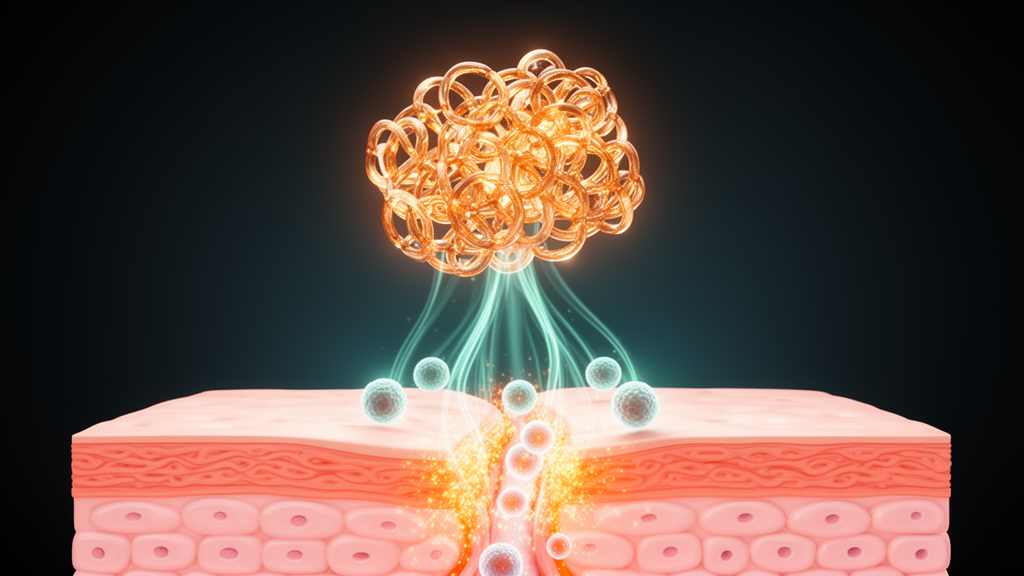
A compound extracted from the roots of a traditional Chinese medicinal herb may quiet the runaway immune signaling that drives psoriasis, according to a new study published in Frontiers in Pharmacology. Researchers at Ningxia Medical University combined computational network pharmacology with clinical specimen analysis and laboratory cell experiments to map how oxymatrine, the primary active alkaloid of Sophora species, appears to counter the chronic inflammatory skin disease. Their findings point to a central role for the EGFR-JAK/STAT signaling axis, a molecular cascade whose excessive activation fuels both the inflammation and the abnormal skin-cell proliferation that define the condition.
Psoriasis affects millions worldwide and is characterized by recurrent, scaly erythematous plaques covered with silvery scales, often accompanied by itching. The disease is immune-mediated and polygenetic, with environmental triggers such as infections, smoking, alcohol, metabolic and endocrine abnormalities, and psychological stress capable of inducing or worsening flare-ups. Abnormally infiltrated lymphocytes in lesions release cytokines that drive excessive keratinocyte proliferation and dermal microvascular changes through multiple signaling routes, including JAK/STAT, NF-κB and MAPK.
The JAK/STAT pathway acts, in the authors' words, like a central processing unit, receiving and integrating instructions from many upstream signals, and its overactivation is considered one of the core mechanisms of the disease. Current treatments carry meaningful limitations. Conventional systemic agents such as methotrexate, acitretin and cyclosporine are associated with significant adverse effects and high recurrence after discontinuation.
Biologic drugs work rapidly and effectively but are costly, require long-term administration, and carry risks of immune tolerance problems and dysregulation, and they are contraindicated in patients with a history of certain infections or malignancies. This unmet therapeutic need motivated the team to investigate oxymatrine, which has anti-inflammatory, anti-fibrotic and immunomodulatory activities and has been used clinically for conditions such as viral hepatitis and myocarditis, with no severe adverse reactions reported to date. Screening databases yielded 241 putative oxymatrine targets and 5,616 psoriasis-related genes, whose intersection produced 109 common targets.
Building a protein-protein interaction network from these, they identified core hubs including EGFR and AKT1, which had the highest degree values of 41, followed by CASP3, MMP9, BCL2, IFNG, CYCS, PTEN, PARP1 and CASP1. Gene Ontology and KEGG enrichment analyses showed significant enrichment in regulation of inflammatory response, cellular response to oxidative stress, regulation of apoptotic signaling, and multiple JAK/STAT-related pathways, alongside terms tied to antigen presentation, autophagy, tissue remodeling and histone deacetylase activity. The compound showed its lowest binding energy with EGFR at −8.3 kcal/mol, followed by JAK2 at −8.0 kcal/mol, both meeting the authors' threshold for extremely strong binding, with BCL2, JAK1, STAT3 and SOCS1 falling in the effective range between −7.0 and −8.0 kcal/mol.
The JAK1 complex reached equilibrium after 15 nanoseconds and stabilized at roughly 1.8 angstroms root-mean-square deviation, while the STAT3 complex stayed below 2.8 angstroms throughout, with compact protein structures and persistent hydrogen-bond contacts supporting stable binding. The clinical arm of the study enrolled 58 patients with severe plaque psoriasis between July 2019 and October 2024, all with baseline Psoriasis Area and Severity Index scores of at least 12 and disease duration of at least six months. After treatment, the group's mean PASI score fell significantly from 29.0 plus or minus 7.4 at baseline to 7.6 plus or minus 4.7, a difference the authors report as highly significant.
Hematoxylin and eosin staining of lesion biopsies showed marked improvement in the characteristic pathology, including reduced epidermal hyperkeratosis and acanthosis and diminished inflammatory cell infiltration. Molecular analysis of the lesion tissue reinforced the mechanistic picture. Immunohistochemistry, quantitative PCR and Western blotting all showed that after eight weeks of treatment, the levels of phosphorylated JAK1, phosphorylated JAK2 and phosphorylated STAT3, along with their upstream receptor EGFR, were significantly decreased, while SOCS1, a natural negative-feedback regulator of the pathway, was significantly increased.
At the same time, the balance of apoptosis-related molecules shifted: anti-apoptotic Bcl-2 declined, while pro-apoptotic Bax and CASP3 rose, with mRNA and protein changes moving toward levels seen in normal control skin samples obtained from the Department of Burns and Plastic Surgery. The researchers induced a psoriasis-like state using an M5 cytokine cocktail of IL-1α, IL-17, IL-22, TNF-α and oncostatin M, which significantly increased EGFR and JAK/STAT pathway activity and suppressed apoptotic execution. Oxymatrine intervention significantly reversed these abnormalities, reducing phosphorylation of the signaling proteins and restoring SOCS1, Bax and CASP3 expression toward normal levels, mirroring the methotrexate positive-control group.
Cytotoxicity testing established safe working concentrations, with cell viability remaining at or above 88 percent at oxymatrine concentrations up to 1.5 milligrams per milliliter, the ceiling used in subsequent experiments. Taken together, the authors propose that oxymatrine acts at three levels of the EGFR-JAK/STAT hierarchy: inhibiting receptor activation at the source, blocking kinase transduction in the middle of the cascade, and upregulating SOCS1 to re-establish negative feedback. They suggest that restoring SOCS1 function may help explain the lower recurrence rates observed in their earlier clinical work, in which oxymatrine showed efficacy comparable to acitretin with fewer side effects and additional metabolism-regulating benefits.
The pathway enrichment results also connected the drug's targets to apoptosis, necroptosis, rheumatoid arthritis and lipid and atherosclerosis pathways, networks that cross-regulate JAK/STAT signaling and correspond to the inflammatory and metabolic dimensions of psoriasis. The study has important limitations that temper the enthusiasm. The clinical component was a single-arm treatment cohort without a placebo or active comparator, so the PASI improvement cannot be definitively attributed to oxymatrine alone, and the molecular validation of lesion tissue relied on only three randomly selected patients, albeit ones whose baseline characteristics and treatment response did not differ significantly from the full cohort.
The in vitro findings, while consistent with the clinical trends, come from a single cell line, and the authors themselves note that future work will need animal models, multi-omics target screening and drug structure optimization. Even so, by linking computational prediction, patient tissue evidence and mechanistic cell data around a single signaling axis, the study offers a coherent rationale for oxymatrine as a multi-target candidate in psoriasis and a foundation for the controlled trials that would be needed before any change in clinical practice.
Subject of Research: Network pharmacology and experimental validation of oxymatrine's effects on the EGFR-JAK/STAT pathway in psoriasis
Article Title: Network pharmacology-based investigation of the therapeutic effects and molecular mechanisms of oxymatrine in psoriasis
Article References: Ding, Y., Cai, W., Chen, H., Wang, X., Ma, Y., Liu, C., & Shi, H. (2026). Network pharmacology-based investigation of the therapeutic effects and molecular mechanisms of oxymatrine in psoriasis. Frontiers in Pharmacology, 17, Article 1901415. https://doi.org/10.3389/fphar.2026.1901415
Image Credits: AI Generated
DOI: 10.3389/fphar.2026.1901415
Keywords: psoriasis, oxymatrine, network pharmacology, EGFR, JAK/STAT signaling, keratinocytes, apoptosis, SOCS1, molecular docking, molecular dynamics simulation, Sophora alkaloids, traditional Chinese medicine
Cite Scienmag News
Louis Brooks. (October 27, 2026). Traditional Herb Compound Oxymatrine Shows Promise Against Psoriasis by Taming a Key Immune Signaling Pathway. Scienmag. https://scienmag.com/traditional-herb-compound-oxymatrine-shows-promise-against-psoriasis-by-taming-a-key-immune-signaling-pathway/
Louis Brooks. "Traditional Herb Compound Oxymatrine Shows Promise Against Psoriasis by Taming a Key Immune Signaling Pathway." Scienmag, 27 October 2026, https://scienmag.com/traditional-herb-compound-oxymatrine-shows-promise-against-psoriasis-by-taming-a-key-immune-signaling-pathway/. Accessed 27 October 2026.
Louis Brooks. "Traditional Herb Compound Oxymatrine Shows Promise Against Psoriasis by Taming a Key Immune Signaling Pathway." Scienmag. October 27, 2026. https://scienmag.com/traditional-herb-compound-oxymatrine-shows-promise-against-psoriasis-by-taming-a-key-immune-signaling-pathway/


