


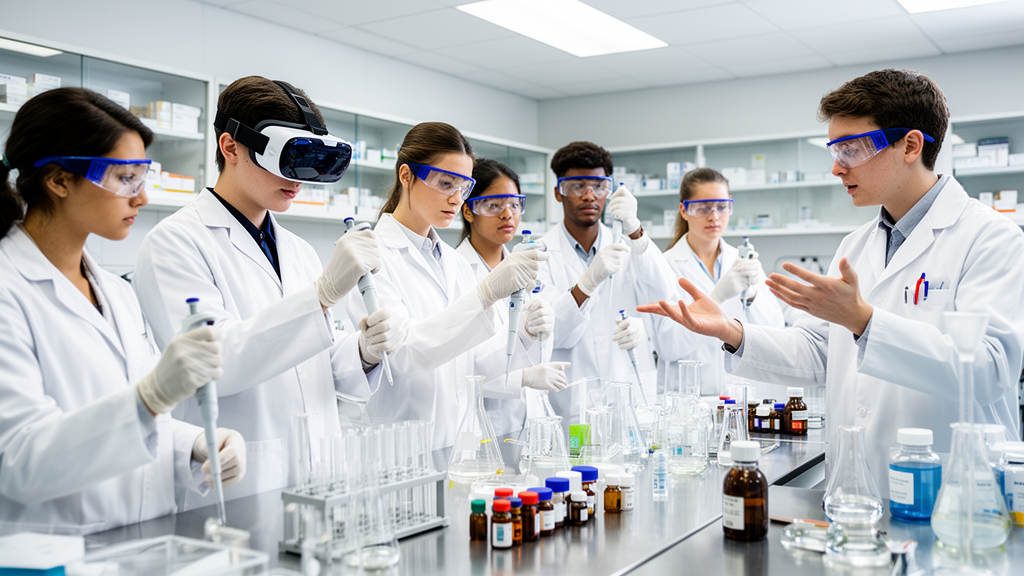
Undergraduate pharmacology students who explored a virtual replica of their laboratory before setting foot in the real one reported feeling markedly more prepared and confident, according to a new evaluation from Cardiff University published in Frontiers in Pharmacology. The study describes the development and classroom trial of an interactive, browser-based pre-laboratory resource, dubbed VR-Lab, built to accompany a second-year organ bath practical in a BSc Medical Pharmacology degree. Crucially, the authors report that the virtual intervention enhanced the student experience without shifting summative assessment scores, a distinction they argue matters when judging what educational technology is actually for.
Laboratory practicals sit at the heart of pharmacology training, spanning everything from bioassays and drug effects on isolated tissues to in-vivo models. They are designed to immerse students in good laboratory practice, mirroring how professional scientists run experiments. Yet the same classes are widely recognised as a source of significant anxiety.
Unfamiliarity with equipment, time pressure and the perceived link between practical performance and assessment can all erode confidence, and reduced confidence in turn undermines engagement with the very experiential learning the classes are meant to deliver. The impact of an unfamiliar, high-sensory-demand environment is also unlikely to fall evenly across a diverse cohort, potentially acting as a disproportionate barrier for some learners. Digital simulations have long been used in pharmacology education to soften these problems, but the Cardiff team identified a gap.
Existing freely available tools, such as the organ bath simulation OBSim, prioritise conceptual understanding at the expense of procedural context. Students may grasp the pharmacology of concentration-response curves yet still arrive at the bench uncertain about which pipette to pick up, in what order to add solutions, or how the physical workflow unfolds. That mismatch limits a simulation's ability to reduce uncertainty around equipment handling, experimental sequencing and practical logistics, precisely the factors that feed pre-laboratory anxiety.
The VR-Lab was designed to close that gap. It was built entirely with no-code authoring platforms: 360-degree photographs of the actual teaching laboratory were assembled in 3dVista, while interactive components were layered on using the e-learning package XERTE. Interactive hotspots were positioned over relevant pieces of equipment at each stage of the protocol, allowing students to progress sequentially through the experiment in the correct order.
In one sequence, students select the appropriate pipette, transfer drug solutions to a test tube and then add the drug to the organ bath, mirroring the workflow they will later perform in person. Instructional overlays and an interactive inventory system carried short demonstration videos created in Panopto, and a formative quiz embedded at a relevant stage let students practise the drug concentration calculations the experiment demands. The resource targeted a compulsory 20-credit module, Application of In-Vitro Pharmacology in Research, which runs for eight weeks in the spring semester and combines six tutorials with four practical classes.
Across those classes, students construct four non-cumulative concentration-response curves to the muscarinic acetylcholine receptor agonists acetylcholine and carbachol, three of them in the presence of mystery drugs whose identities are known to staff but withheld from students, before performing a Schild analysis to calculate the pA2 value of atropine in the final session. Assessment takes the form of a dissertation written in the style of a British Journal of Pharmacology paper, requiring students to use analytical skill and the wider literature to deduce the mystery drugs. Because the VR-Lab ran in a standard web browser, no immersive virtual reality hardware was needed, keeping the approach low-cost and scalable.
Delivery was deliberately low-pressure. The VR-Lab was released to all 34 students in the 2024/25 cohort via Blackboard Ultra ahead of their first practical, with access remaining open throughout the module. Completion was encouraged but not compulsory and carried no assessment weight.
Uptake was nonetheless high: 31 of the 34 students completed the resource before attending the first organ bath class, while the remaining three never accessed it at any point. Evaluation followed immediately after the first practical, using an anonymous voluntary survey on Microsoft Forms that combined five-point Likert-scale items on engagement, usability, preparedness, confidence and perceived educational value with a binary question on technical difficulties and three open-ended questions analysed thematically. The quantitative results were strikingly positive.
Respondents rated the VR-Lab as engaging with a mean score of 5, strongly agree, found it easy to navigate at a mean of 4.6, and agreed strongly that it reinforced prior learning. Every respondent strongly agreed that the resource was a useful addition to the module and a good example of technology-enhanced learning. Perceived preparedness was uniformly high, again averaging 5.
Confidence during the practical itself showed slightly more variation, with 70 percent of students strongly agreeing and 30 percent agreeing, the only domain where agreement fell short of unanimity. All respondents reported that the VR-Lab enhanced their preparedness for, and confidence during, the in-person session. Thematic analysis of the free-text responses surfaced four recurring themes.
The dominant one concerned enhanced preparedness, familiarity and confidence before and during the practical: students said the simulation helped them understand the experimental set-up and protocol before entering the physical laboratory, and that they made better use of in-person time because they spent less effort interpreting the protocol or waiting for staff assistance. The value of the embedded videos and stepwise guidance was also frequently praised, particularly the explanatory content clarifying why each step mattered. On the negative side, navigation and interface issues were common complaints, mostly tied to screen layout on smaller devices such as tablets and smartphones, with students suggesting clearer visual cues and the ability to revisit previous steps.
A small subset of respondents simply wanted similar VR-Labs extended to other practicals in the course. What the intervention did not do is change grades. Comparing anonymised summative assessment results with the previous year's cohort, which had no access to the VR-Lab, the 2024/25 mean was 60.2 percent against 62.3 percent, a difference the authors report as not statistically significant using an unpaired two-tailed Student's t-test.
Excluding a single non-submission in the newer cohort, the mean rose to 62.2 percent, again indistinguishable from the prior year. The authors argue this null result is consistent with the resource's design intent: the VR-Lab was built to support procedural preparedness and the experience of hands-on teaching, not to align with an assessment that tests higher-order skills such as data interpretation, critical evaluation and scientific writing, which would not be expected to respond to this kind of preparatory intervention. The team is careful about the limits of the evidence.
This was an evaluation of teaching practice within a single module at one institution, the survey drew only 10 voluntary respondents, and self-selection may have inflated the positivity of the feedback, since students who enjoyed the VR-Lab were plausibly more likely to complete the survey. The evaluation captured self-reported perceptions rather than direct measures of anxiety, cognitive load or in-class behaviour, and the cross-cohort comparison was exploratory, based on anonymised historical data that cannot isolate the VR-Lab as the sole variable. Future work, the authors suggest, should follow longitudinal implementation across multiple modules and cohorts and could track more objective indicators such as the number of staff interventions, procedural errors and set-up times.
Even so, the findings support the idea that low-cost, browser-based virtual pre-labs, best experienced on a larger display and refined for navigation and accessibility, can act as useful adjuncts to practical pharmacology teaching, reducing the barriers posed by unfamiliar settings while leaving hands-on experimentation, and the grades attached to it, untouched.
Subject of Research: A virtual pre-laboratory simulation for undergraduate pharmacology organ bath practicals and its effect on student confidence, preparedness and assessment outcomes
Article Title: Enhancing student confidence and preparedness in pharmacology: a virtual pre-laboratory approach
Article References: Voisey, A. C., Crawford, O. J., Hilbourne, A., Jordan, N. J., Hutcheson, I. R., & Lang, D. (2026). Enhancing student confidence and preparedness in pharmacology: a virtual pre-laboratory approach. Frontiers in Pharmacology, 17, Article 1897899. https://doi.org/10.3389/fphar.2026.1897899
Image Credits: AI Generated
DOI: 10.3389/fphar.2026.1897899
Keywords: pharmacology education, virtual laboratory, pre-laboratory simulation, student confidence, student preparedness, organ bath, technology-enhanced learning, simulation-based learning, Cardiff University, undergraduate teaching, student experience, 360-degree learning
Cite Scienmag News
Louis Brooks. (October 27, 2026). Research report: Enhancing student confidence and preparedness in pharmacology: a virtual pre-laboratory approach. Scienmag. https://scienmag.com/research-report-enhancing-student-confidence-and-preparedness-in-pharmacology-a-virtual-pre-laboratory-approach/
Louis Brooks. "Research report: Enhancing student confidence and preparedness in pharmacology: a virtual pre-laboratory approach." Scienmag, 27 October 2026, https://scienmag.com/research-report-enhancing-student-confidence-and-preparedness-in-pharmacology-a-virtual-pre-laboratory-approach/. Accessed 27 October 2026.
Louis Brooks. "Research report: Enhancing student confidence and preparedness in pharmacology: a virtual pre-laboratory approach." Scienmag. October 27, 2026. https://scienmag.com/research-report-enhancing-student-confidence-and-preparedness-in-pharmacology-a-virtual-pre-laboratory-approach/


