


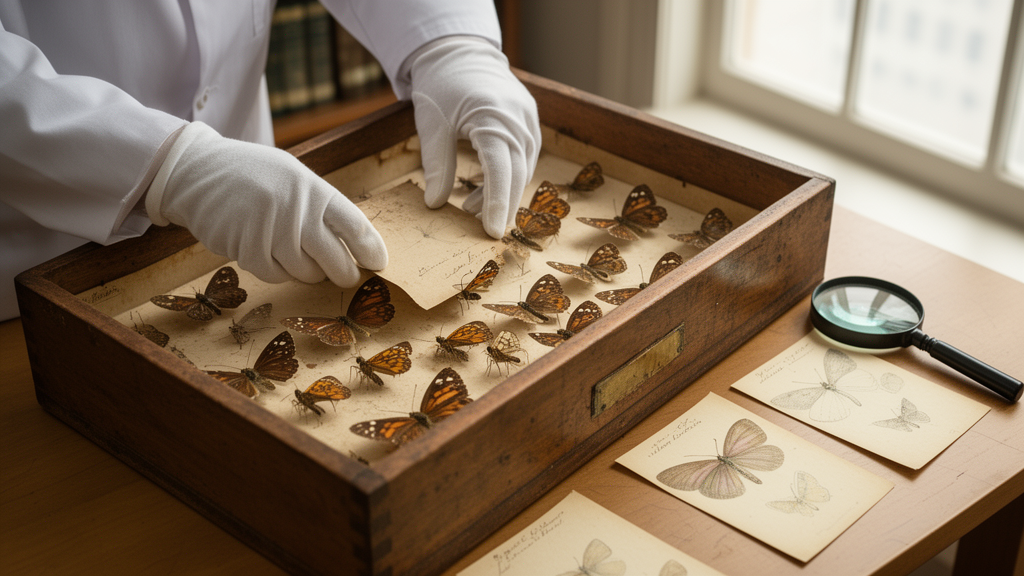
A careful re-examination of museum drawers in Berlin, London and Washington has untangled a series of long-standing puzzles surrounding skipper butterfly names proposed in the nineteenth century by the German entomologist Carl Plötz. The study, published in the journal Contributions to Zoology… actually appeared in Deutsche Entomologische Zeitschrift, documents how specimens curated for decades as primary types of several Hesperiidae species do not match the original descriptions, and it applies the rules of the International Code of Zoological Nomenclature to set the record straight through lectotype and neotype designations.
Plötz, who lived from 1814 to 1886, named a very large number of skipper species in a flurry of papers published between 1879 and 1886. Many of his descriptions were embedded in identification keys and were too brief to distinguish the species from their relatives. He also illustrated most of the skippers he treated, but the original set of drawings has never been located. Copies of some of these drawings were assembled by Frederick DuCane Godman in 1907 for species he could not confidently recognise, and this compilation is now stored in the library of the Natural History Museum in London. A second set of copies, cut into small cards, is pinned among the corresponding specimens in the collection of the Smithsonian Institution in Washington.
Because of the sketchy descriptions, the imperfect illustrations and the frequent loss or unrecognisability of type material, many of Plötz’s names remain poorly understood, and their application to species still largely follows the comprehensive revision by William Evans published in the 1930s through the 1950s. The researchers, working with specimens in the Museum für Naturkunde in Berlin, the Natural History Museum in London, the Zoologisches Institut und Museum Greifswald and the Zoologische Staatssammlung München, stumbled upon a number of discrepancies between the original descriptions, the illustrations and the specimens themselves, including their label data. Genomic sequencing of historical specimens, using protocols developed for century-old butterfly material, helped resolve several of the cases.
A central insight concerns the numbering system used in the Berlin collection. Plötz regularly cited a phrase meaning Museum Berlin number followed by a figure after each new species name. Although labels bearing these numbers are unique to a single specimen in the Berlin museum, the numbers themselves generally denote entire series of up to four specimens, of which only one, the so-called header specimen, actually carries the printed label. The authors therefore argue that a reference to a single Berlin number in Plötz’s descriptions should not be taken as a holotype designation, since Plötz sometimes described both sexes and made clear that some descriptions were based on more than one specimen, in line with a recommendation of the ICZN Code.
The most striking case involves Netrocoryne seneca, described in 1882 from Brazil. The specimen in Berlin bearing the number 4865 cited in the original description does not agree with Plötz’s description at all, which instead matches his unpublished drawing number 160 perfectly. Both the description and the drawing refer unambiguously to a distinctively patterned species known today as Ectomis labriaris, a synonymy first suggested over a century ago. The Berlin specimen is in fact Nascus broteas, a differently patterned species lacking even a trace of the hyaline hindwing spot described by Plötz. After an unsuccessful search for the lost syntypes, the authors designated a single known syntype of Ectomis labriaris as both the lectotype of that name and the neotype of Netrocoryne seneca, satisfying all seven requirements of ICZN Article 75.3 and preserving the synonymy that has been in use for nearly a hundred years.
A second case concerned Eudamus jalapus, described in 1881 from Xalapa, Mexico. Plötz cited number 4960, but the Berlin catalogue lists a specimen from Suriname under that number, while a specimen curated as a type carries number 4970, collected at Jalapa by Deppe. The description matches specimen 4970 except for the colour of the ventral hindwing, which Plötz described as violaceous-grey. Comparison with his drawing number 134 showed that the drawing agrees with the brownish colour of the specimen, and a survey of Plötz’s usage revealed that he applied the term veilgrau rather loosely, from greyish to brownish shades. The authors designated the female specimen 4970, which they also sequenced genetically, as the lectotype of Eudamus jalapus, attributing the discrepancy between the cited numbers to a simple writing error of 6 instead of 7.
A third case proved more troubling. Hesperia ulphila, described in 1883 from Mexico, was based on a description citing number 5426, but the specimen curated as its type in Berlin is smaller than described, lacks well-developed spots in two forewing cells, lacks a clear discal dash on the ventral hindwing and shows a different pattern of the discal band, all of which agree with Plötz’s drawing instead. The curated specimen is currently identifiable as Lon monticola. The catalogue lists seven specimens under the number, collected by three different collectors, and most of them could not be located. Because species in two distantly related genera, Lon and Paratrytone, each partly match the illustrations, the authors concluded that the true identity of Hesperia ulphila cannot be determined and proposed treating the name as a nomen dubium, a species possibly waiting to be rediscovered in southern Mexico or Central America.
The fourth case resolved a tangle around Apaustus interpunctata, described in 1884 from Bahia, Brazil, and named for the small pale dots between pale veins on the underside of the hindwing. The Berlin specimen bearing the cited number 5392 lacks these dots almost entirely and is instead Vehilius vetula. Genomic sequencing of all five specimens in the drawer revealed that two belong to Vehilius vetula and two to Eutocus vetulus, while a fifth, from Panama, is Callimormus juventus. The two Eutocus vetulus specimens fully agree with the original description and with specimens in London that Godman and, separately, the curator Francis Heron had compared against Plötz’s original drawing. The authors designated the better-marked Eutocus vetulus specimen as the lectotype of Apaustus interpunctata, confirming that name as a junior subjective synonym of Eutocus vetulus, and consequently reinstated Callimormus diaeses Schaus, 1902 as a valid species, since it is the only available name for the species that Evans had misidentified under the Plötz name.
The final case concerned Hesperia irma, described in 1882 from Colombia. The Berlin specimen bearing the cited number 5234 is larger than described, has a shorter antenna, shows a different ventral forewing pattern and, according to its label, came from Rio de Janeiro rather than Colombia; it is currently identifiable as Mnaseas sirene. Plötz’s own archive in Munich revealed that in an 1870 list he knew the specimen was from Rio but could not name it, and that in an 1876 manuscript version of his key the locality was changed from Rio to Colombia, suggesting he had incorporated Colombian material resembling Pamphila irma Möschler, 1879 into his concept. The authors concluded that the syntypes of Hesperia irma are lost and designated the holotype of Pamphila irma, a male from Colombia, as the neotype of Hesperia irma, making the two names objective synonyms and preserving current usage.
Notably, all five cases involved Berlin specimens bearing green labels likely written by Carl Heinrich Hopffer, the curator of the entomological collections until his death in 1876, and these labels sometimes served as header labels for series from two different localities. The reasons for the discrepancies between the specimens, their labels and the original descriptions remain unclear, but may involve switched labels or labels placed on similar-looking specimens. The authors urge researchers to question the type status of specimens curated as types in Berlin, particularly those bearing green labels, and to analyse each case individually, seeking a reasonable compromise between the stability of nomenclature and the intent of the original author.
Subject of Research: Nomenclatural resolution of discrepancies between Plötz's Hesperiidae descriptions and their presumed type specimens
Article Title: Resolving inconsistencies between Plötz’s descriptions and presumed type specimens of some Hesperiidae ( Lepidoptera )
Article References: Zhang, J., Cong, Q., Song, L., Shen, J., Léger, T., Lamas, G., Mielke, O. H. H., & Grishin, N. V. (2023). Resolving inconsistencies between Plötz’s descriptions and presumed type specimens of some Hesperiidae (Lepidoptera). Deutsche Entomologische Zeitschrift, 70(1), 159-174. https://doi.org/10.3897/dez.70.98280
Image Credits: AI Generated
DOI: 10.3897/dez.70.98280
Keywords: Hesperiidae, type specimens, Carl Plötz, nomenclature, lectotype, neotype, Museum für Naturkunde, Natural History Museum London, skipper butterflies, ICZN Code, Eutocus vetulus, Hesperia ulphila
Cite Scienmag News
Drew Townsend. (October 27, 2026). Century-old butterfly type specimens unraveled to fix skipper names from Plötz’s sketches. Scienmag. https://scienmag.com/century-old-butterfly-type-specimens-unraveled-to-fix-skipper-names-from-plotzs-sketches/
Drew Townsend. "Century-old butterfly type specimens unraveled to fix skipper names from Plötz’s sketches." Scienmag, 27 October 2026, https://scienmag.com/century-old-butterfly-type-specimens-unraveled-to-fix-skipper-names-from-plotzs-sketches/. Accessed 27 October 2026.
Drew Townsend. "Century-old butterfly type specimens unraveled to fix skipper names from Plötz’s sketches." Scienmag. October 27, 2026. https://scienmag.com/century-old-butterfly-type-specimens-unraveled-to-fix-skipper-names-from-plotzs-sketches/


