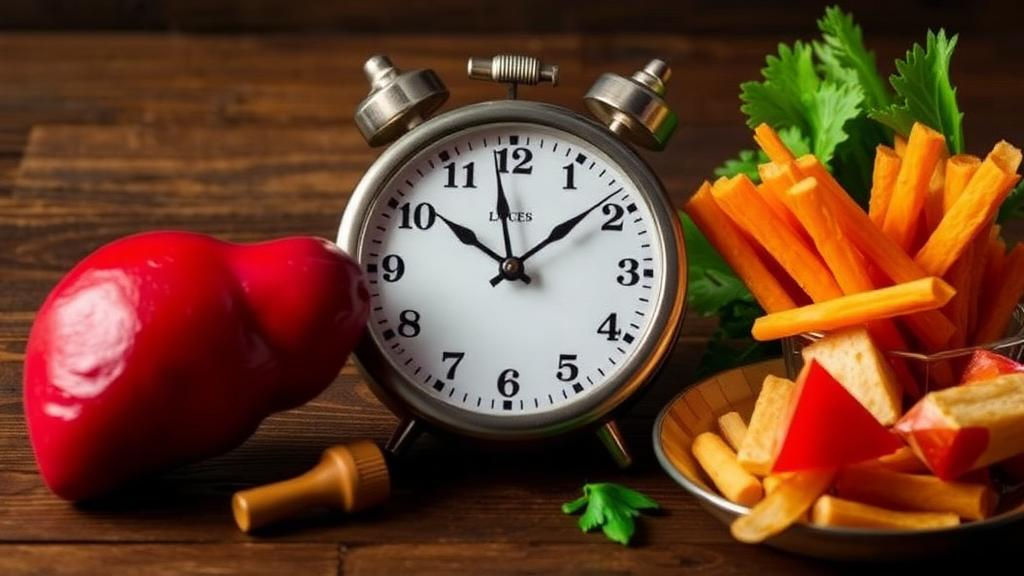
A late-night trip to the refrigerator may do more than disturb your sleep. New research led by scientists at Oregon Health & Science University suggests that eating after dinner, or even after going to bed, is associated with a substantially elevated risk of liver disease, adding a major organ to the growing list of body systems that appear to suffer when human behavior drifts out of sync with the internal biological clock.
The study, published in the journal Clinical Gastroenterology and Hepatology, documents a 20 to 30 percent increase in all forms of liver disease among people who reported late-night eating compared with those who did not. The association held for two distinct conditions: metabolic dysfunction-associated steatotic liver disease, commonly known as fatty liver disease, and cirrhosis, the advanced scarring of liver tissue that represents one of the most serious outcomes of chronic liver injury. The finding is notable because previous work had already tied late-night snacking to obesity and heart disease, but a clear signal connecting meal timing to liver pathology had remained elusive.
“A few studies have hinted at this idea but this is among the first long-term analyses to explicitly draw the connection to fatty liver disease,” said lead author Robert Wilechansky, M.D., a hepatologist at OHSU who specializes in liver transplantation. His motivation, he explained, came from a striking epidemiological fact: as much as 30 percent of the U.S. population is affected by fatty liver disease, a prevalence that has climbed alongside rising rates of obesity and metabolic syndrome. If a behavior as simple and modifiable as the timing of the evening meal contributed to that burden, the public health implications could be considerable.
To investigate the question, the researchers turned to three of the largest and longest-running nutritional epidemiology projects in existence: the Nurses’ Health Study, the Nurses’ Health Study II, and the Health Professionals Follow-up Study. From these nationwide datasets, the team extracted diet and lifestyle information self-reported by almost 200,000 participants. Rather than analyzing individual nutrients or total caloric intake, the investigators grouped participants according to their eating behaviors, with particular attention to whether food was consumed after dinner or after bedtime, and then searched for correlations between those behavioral patterns and reports of fatty liver disease or cirrhosis.
The statistical signal that emerged was consistent across the pooled cohorts. People who reported eating late at night showed a 20 to 30 percent higher rate of liver disease overall than those who confined their eating to earlier hours. The researchers emphasize that this is a correlation drawn from observational, survey-based data, which means it cannot by itself prove that late-night eating causes liver damage. Self-reported dietary habits are also broadly defined and subject to recall limitations. Even so, the size of the cohorts and the consistency of the association give the finding a weight that smaller, shorter studies could not achieve, and the authors describe it as a starting point for more definitive research.
“It’s important to remember, of the people who developed fatty liver disease, only a small fraction develop serious forms of the condition like liver cirrhosis,” Wilechansky said. “Even so, the big take-away here is that confining your calorie intake to several hours before bedtime might be beneficial.” That framing matters for how the results should be interpreted. Fatty liver disease exists on a spectrum, ranging from benign fat accumulation to inflammation, fibrosis, and ultimately cirrhosis or liver cancer. Most people with hepatic steatosis never progress to end-stage disease, but because the affected population is so large, even a modest shift in the fraction who progress would translate into a substantial number of additional cases of serious liver illness.
The biological rationale for why meal timing might matter to the liver rests on the science of circadian rhythms, the roughly 24-hour cycles that govern physiology in virtually every organ. The liver is not a passive filter that processes nutrients identically around the clock. Its enzymatic machinery, its glucose and lipid metabolism, and its detoxification pathways all fluctuate in anticipation of feeding and fasting cycles that evolved over millions of years. When food arrives during the biological night, a period when the internal clock is promoting sleep rather than digestion, the organ must process an energy load for which it is not physiologically prepared.
“We are seeing over and over again that the timing of behaviors, whether it’s sleep, eating, or exercise, really matters,” said co-author Andrew McHill, Ph.D., associate professor and sleep and circadian physiologist at OHSU. “For example, we have shown that eating during the night, when the internal biological clock is promoting sleep, reduces the ability of your body to metabolize foods as efficiently and can eventually lead to obesity, diabetes and now poor liver health.” McHill also pointed to previous research in animal models showing that the liver is among the organs most susceptible to misalignment between eating and sleep timing, a vulnerability that the new human data now appear to mirror.
The findings also resonate with what is known about shift workers, a population that Wilechansky highlighted as an important context for the research. Night shift workers experience chronic misalignment of the body’s natural day-night cycle, and epidemiological studies have consistently documented elevated rates of obesity, cardiovascular disease, and metabolic disorders among them. Their eating patterns are frequently displaced into the biological night, making them a natural experiment in circadian disruption. The new study suggests that the liver may be a previously underappreciated casualty of that disruption, and that the risks extend beyond shift workers to anyone who regularly eats in the hours when the body expects to be fasting and asleep.
Because the study is observational, the OHSU team is already moving toward a more rigorous test of the hypothesis. Wilechansky is part of a group at OHSU recruiting participants for a clinical study that will monitor eating behaviors directly, rather than relying on retrospective questionnaires, and will assess whether shifting meals earlier in the day improves clinical measures of underlying fatty liver disease. Such an intervention trial could establish whether meal timing is not merely a marker of other unhealthy habits but a causal lever that patients can pull to protect their livers. “We know the liver is very much in tune with the body’s circadian rhythms,” Wilechansky said. “So we’re interested in changing the timing of eating in a way that could make a difference in health without changing the composition of what people eat.” If that proposition holds up under controlled conditions, the prescription for liver health could become remarkably simple: not necessarily a new diet, but the same diet, eaten earlier. “Our findings add to the growing body of literature linking late-evening eating patterns to adverse metabolic and liver outcomes,” the authors write, a conclusion that, if confirmed, would place the humble midnight snack squarely on the list of modifiable risks to one of the body’s most indispensable organs.
Subject of Research: The association between late-night eating and the risk of fatty liver disease and cirrhosis
Article Title: Late-night eating may be bad for your liver, study suggests
Article References: Late-night eating may be bad for your liver, study suggests. (n.d.). Original publication
Image Credits: AI Generated
DOI: Not provided
Keywords: liver disease, fatty liver disease, MASLD, cirrhosis, circadian rhythm, late-night eating, meal timing, metabolism, OHSU, Nurses' Health Study, sleep, observational study
Cite Scienmag News
Ophelia Keating. (October 10, 2026). The Liver Keeps Its Own Clock: Late-Night Meals Linked to Fatty Liver Disease and Cirrhosis. Scienmag. https://scienmag.com/the-liver-keeps-its-own-clock-late-night-meals-linked-to-fatty-liver-disease-and-cirrhosis/
Ophelia Keating. "The Liver Keeps Its Own Clock: Late-Night Meals Linked to Fatty Liver Disease and Cirrhosis." Scienmag, 10 October 2026, https://scienmag.com/the-liver-keeps-its-own-clock-late-night-meals-linked-to-fatty-liver-disease-and-cirrhosis/. Accessed 10 October 2026.
Ophelia Keating. "The Liver Keeps Its Own Clock: Late-Night Meals Linked to Fatty Liver Disease and Cirrhosis." Scienmag. October 10, 2026. https://scienmag.com/the-liver-keeps-its-own-clock-late-night-meals-linked-to-fatty-liver-disease-and-cirrhosis/