Checking whether a dose of pain reliever has reached a safe level in the body usually means a needle, a vial, and a trip to a laboratory. A team of researchers now wants to replace that routine with something far more familiar: a lollipop. In a study published in ACS Sensors, scientists describe a candy-coated device called Lollylab that collects saliva and measures the concentration of acetaminophen, one of the most widely used medications in the world, directly on the device itself. In an initial test with six adults, a peach-flavored prototype reliably detected the drug in saliva in less than two minutes, and participants reported that it was more comfortable and easier to use than conventional collection swabs.
The device is the work of Sina Khazaee Nejad, Maral Mousavi, and colleagues, who set out to merge two functions that are normally separated in diagnostic testing: sample collection and analysis. Traditional saliva testing typically involves a swab or absorbent pad that soaks up fluid from the mouth, after which the sample must be packaged, transported, and processed on benchtop instruments elsewhere. That separation adds time, cost, and opportunities for error, and it can be particularly awkward when the patient is a child. By contrast, Lollylab is designed to do everything at once. The candy coating stimulates saliva production, the stem channels the fluid to an integrated sensor, and the sensor reports the result on the spot. As Nejad, the first author of the paper, explained, turning a familiar object like a lollipop into both a collection device and a sensor means the sample can be gathered and measured directly at the point of care.
The clinical motivation behind the project is rooted in the pharmacology of acetaminophen itself. The compound, known in some countries as paracetamol, is an ingredient in a vast array of over-the-counter products, including standalone pain relievers and combination cold and flu remedies. Because it is so easy to obtain and appears in so many formulations, unintentional overdose is a persistent safety concern. Taking more than the maximum recommended dose can cause serious side effects, most notably liver damage. The risk is especially acute for children, who can experience harm at lower levels of the medication than adults and who may be exposed accidentally when caregivers underestimate how much of the drug is already present in combination products. A quick, noninvasive way to check how much of the drug is circulating in a patient’s body could therefore be a meaningful safeguard.
Saliva turns out to be a surprisingly good window into that circulating level. Previous work has shown that acetaminophen concentrations in saliva closely reflect those in blood, which means the drug’s pharmacokinetics can be tracked without drawing blood. That correlation is what made the researchers consider saliva as a simple, noninvasive monitoring medium. The challenge was not so much detecting the drug in saliva as making the entire process pleasant enough that patients, and especially young ones, would cooperate willingly. Blood draws are invasive and frightening for many children, and even standard saliva swabs can trigger gagging or discomfort. The insight behind Lollylab is that the collection step could be reframed as a treat rather than a procedure.
The design lineage of the device traces back to an earlier invention called CandyCollect, a lollipop-like sampling system developed to replace throat swabs for diagnostic testing. Mousavi says that system inspired the team, but CandyCollect specimens still need to be analyzed elsewhere, so the researchers wanted to go a step further and create what they describe as a miniature laboratory-on-a-lollipop. Where CandyCollect demonstrated that a candy-based device could harvest useful biological samples at home, Lollylab embeds the analytical chemistry into the lollipop itself, closing the loop between collection and measurement.
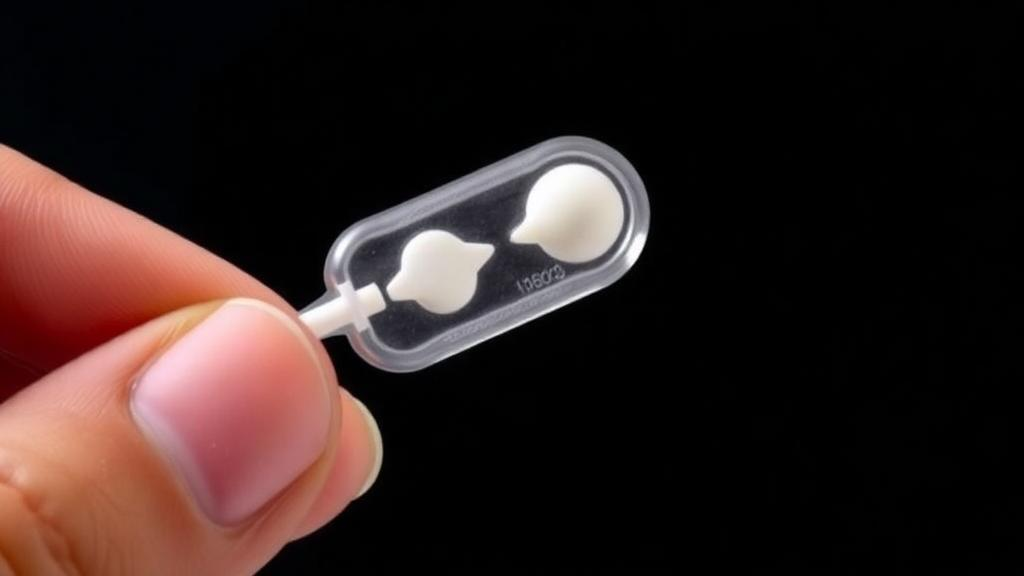
Mechanically, the device is elegantly simple. It is built from two plastic pieces, each with a round end and a thinner stem, that snap together. Holes at the top allow saliva to enter the interior of the candy head. The upper portion of the device is coated with a red, peach-flavored edible candy shell, which serves a dual purpose: it makes the object genuinely appealing to lick, and the act of licking stimulates the flow of saliva that the test requires. Importantly, the researchers confirmed that the candy coating did not interfere with the measurements, so the flavoring is a genuine functional element rather than a cosmetic afterthought.
Once saliva enters the device, it flows through the lollipop’s stem, which is lined with glass fiber paper, toward a sensor at the bottom. That sensor is made of graphene, a single-atom-thick form of carbon prized in electrochemical sensing for its high conductivity and large surface area. The graphene electrode measures acetaminophen levels as changes in electrical current, a readout strategy common in electroanalysis: the drug oxidizes at the electrode surface, and the magnitude of the resulting current is proportional to its concentration in the sample. Because the electronics can be miniaturized, the entire analytical pathway fits within the stem of a lollipop-sized object. In laboratory testing, the prototype successfully detected acetaminophen in both artificial saliva and real human saliva, demonstrating that the candy matrix and the complex chemistry of real oral fluid did not block the electrochemical signal.
The proof-of-concept study put the device into the hands of actual users. Six adults used Lollylab before taking a standard adult dose of acetaminophen, 650 milligrams, and then again an hour after taking it, a timeframe chosen to capture the period when the drug reaches measurable levels in the body. The device reliably measured the drug in the participants’ saliva in less than two minutes, confirming that the sampling-to-signal pipeline works on realistic post-dose saliva rather than only on spiked laboratory samples. Just as significant for the researchers, the participants said the device was easy to use and more comfortable than typical saliva swabs, an early signal that the candy-based format may overcome the compliance problems that plague conventional oral fluid collection.
For Nejad, the central message of the work is that diagnostic testing can be made much easier and more comfortable, especially for children. That framing positions Lollylab not merely as a faster acetaminophen meter but as a template for a different philosophy of diagnostics, one in which the sample collection experience is designed around the patient rather than the laboratory. A device that a child is happy to put in their mouth removes a major barrier to repeated testing, which matters for monitoring because a single measurement captures only one moment in the drug’s journey through the body. Repeated, low-friction measurements could give clinicians a fuller picture of how a patient is absorbing and clearing a medication.
The team’s roadmap extends well beyond acetaminophen. Next, the researchers plan to validate Lollylab’s acetaminophen measurements with more participants, including children, the population for whom the device’s comfort advantages matter most. They also intend to develop the platform to detect other substances in saliva, such as naturally occurring stress markers, and their longer-term goal, as Nejad describes it, is to create a multi-assay platform capable of measuring several biomarkers, which could then be evaluated alongside acetaminophen in larger clinical studies. The work was funded in part by a 3M Nontenured Faculty Award, Women in Science and Engineering at the University of Southern California, and the President’s Sustainability Research Award, and some of the authors have filed a provisional patent based on the device. If subsequent validation succeeds, the humble lollipop may become a serious instrument of point-of-care medicine, transforming a routine dose check from a clinical chore into something a patient might actually look forward to.
Subject of Research: A lollipop-shaped saliva collection and graphene electrochemical sensing device for point-of-care monitoring of acetaminophen levels
Article Title: Candy-coated Lollylab checks saliva for medication
Article References: Candy-coated Lollylab checks saliva for medication. (n.d.). Original publication
Image Credits: AI Generated
DOI: Not provided
Keywords: Lollylab, acetaminophen, saliva diagnostics, graphene sensor, point-of-care testing, pediatric safety, drug monitoring, electrochemical sensing, CandyCollect, ACS Sensors, noninvasive testing, biomarkers
Cite Scienmag News
Bethany Barker. (October 10, 2026). Lollipop-Shaped Sensor Reads Acetaminophen Levels From Saliva in Under Two Minutes. Scienmag. https://scienmag.com/lollipop-shaped-sensor-reads-acetaminophen-levels-from-saliva-in-under-two-minutes/
Bethany Barker. "Lollipop-Shaped Sensor Reads Acetaminophen Levels From Saliva in Under Two Minutes." Scienmag, 10 October 2026, https://scienmag.com/lollipop-shaped-sensor-reads-acetaminophen-levels-from-saliva-in-under-two-minutes/. Accessed 10 October 2026.
Bethany Barker. "Lollipop-Shaped Sensor Reads Acetaminophen Levels From Saliva in Under Two Minutes." Scienmag. October 10, 2026. https://scienmag.com/lollipop-shaped-sensor-reads-acetaminophen-levels-from-saliva-in-under-two-minutes/