


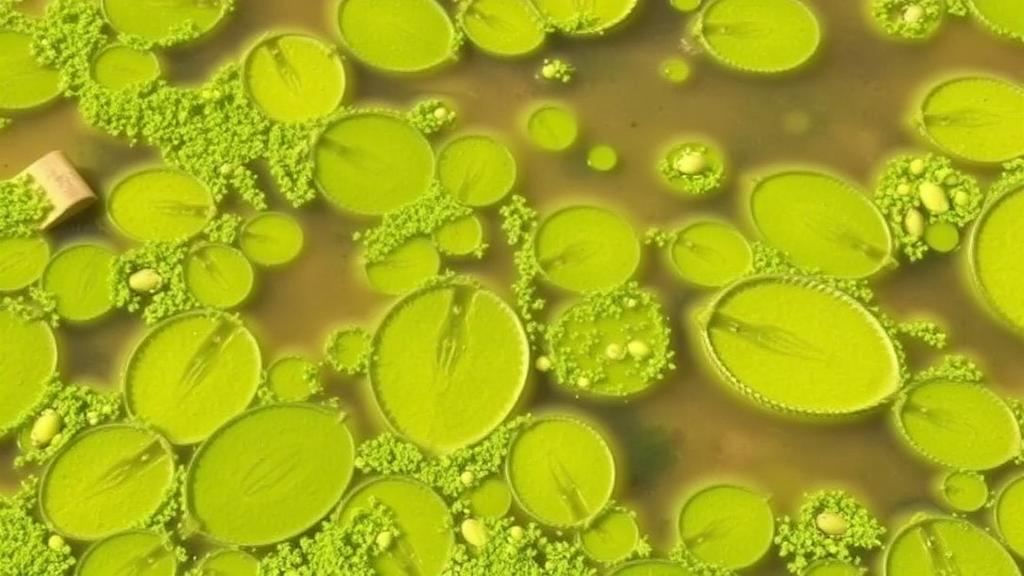
Lakes have long been celebrated as surprisingly powerful allies in the fight against climate change. Although they cover only a small fraction of Earth’s surface, their sediments trap and bury organic carbon at rates that far outpace most terrestrial ecosystems, effectively locking carbon away from the atmosphere for centuries or even millennia. But a new study published in Communications Earth & Environment suggests that one of the most common forms of human-driven water degradation — eutrophication, the over-enrichment of waters with nutrients such as nitrogen and phosphorus — may be quietly undermining this hidden carbon vault. The research, led by Youzi Gong of the Nanjing Institute of Geography and Limnology at the Chinese Academy of Sciences, reveals that algal blooms can strip away a key protective mechanism that keeps carbon buried in lakebeds, converting stable, long-lived carbon pools into vulnerable, easily decomposed material.
At the heart of the study is a chemical partnership that most people never see: the bond between organic carbon and reactive iron oxides. In soils and sediments, iron oxides act like microscopic bodyguards, binding organic molecules to their charged surfaces and shielding them from the microbes that would otherwise consume them and release carbon dioxide. This association, known as iron oxide-bound organic carbon or Fe–OC, is recognized as one of the most important pathways for long-term carbon preservation in both terrestrial and aquatic environments. When organic matter is locked onto iron minerals, it can resist decomposition far longer than free organic material drifting through the water column or sitting loosely in sediment pores.
The international team, drawing on a global synthesis of lake sediment data combined with field observations and laboratory incubation experiments, set out to quantify just how much carbon this iron shield protects in lakes worldwide — and whether the world’s increasingly bloom-prone lakes are losing that protection. Their answer is striking. Iron oxide-bound organic carbon, they found, accounts for roughly 16 percent of the total organic carbon stored in lake sediments. Scaled up across the world’s lakes, this represents a burial flux of approximately 14 megatonnes of carbon per year. To appreciate the scale of that figure, consider that lakes cover only about 1.25 percent of the area of the global ocean, yet their iron-bound carbon sink amounts to roughly 27 percent of the marine equivalent. Per unit area, lakes are extraordinarily efficient at preserving carbon through this iron-mediated pathway.
That efficiency, however, is not evenly distributed. When the researchers compared lakes that regularly experience algal blooms with lakes that remain free of them, a clear pattern emerged: bloom-prone lakes contained less iron-bound organic carbon, and that carbon made up a smaller share of their total sedimentary organic carbon pool. In other words, the very lakes that receive the greatest influx of organic material — the ones producing and receiving enormous quantities of algal biomass — appear to be the least capable of protecting that material for the long term. It is a counterintuitive result, because eutrophication superficially increases the amount of organic carbon entering sediments. More algae means more biomass sinking to the lakebed, and indeed, previous studies have documented substantial increases in organic carbon storage in lakes undergoing eutrophication. But quantity, the new findings show, is not the same as quality.
The study identifies two interlocking mechanisms that explain why blooms erode the iron shield. The first is chemical: blooms trigger dramatic fluctuations in oxygen levels and redox conditions in the water and surface sediments. Dense algal blooms consume oxygen as they decompose, driving sediments anoxic; when the water is reoxygenated, conditions swing back. Iron oxides are notoriously sensitive to this oscillation. Under reducing conditions, ferric iron is converted to ferrous iron and the oxide minerals dissolve, releasing the organic carbon they were holding. When conditions flip back, the minerals may reform — but the carbon that was released in the interim is exposed to microbial attack, and much of it is lost. Each redox cycle, in effect, shakes the iron bodyguard loose and gives microbes a window of opportunity to feast on the previously protected carbon.
The second mechanism concerns the character of the organic matter itself. Algal-derived organic matter differs fundamentally from the carbon that enters lakes from terrestrial sources such as leaf litter and soil. Terrestrial plant material is rich in aromatic compounds — complex, ring-shaped molecular structures that are chemically robust and bind strongly to iron oxides. Algal organic matter, by contrast, has low aromaticity: it is dominated by simpler, more labile compounds such as proteins and carbohydrates that microbes can digest readily and that adhere less tenaciously to mineral surfaces. As eutrophication shifts the dominant carbon input from land-derived to algae-derived material, the average quality of the carbon arriving at the sediment changes — and with it, the strength of the iron-carbon association.
Field observations and incubation experiments conducted by the team confirmed that these two forces — bloom-induced redox fluctuations and the influx of low-aromaticity algal organic matter — act jointly to accelerate the turnover of iron-bound organic carbon and reduce the loading of organic carbon on iron minerals. The consequences are dramatic: the study documents losses of iron-bound organic carbon of up to approximately 68 percent under these conditions. That is not a marginal adjustment to a carbon accounting ledger; it is a wholesale collapse of the protective mechanism in affected sediments. Carbon that would have been locked away for centuries is instead shifted into what the researchers call unprotected organic carbon pools — material that remains in the sediment but is far more susceptible to microbial degradation and eventual release as carbon dioxide or methane.
The broader implication is sobering for global carbon budgets. Eutrophication is one of the most widespread forms of water pollution on the planet, driven by agricultural runoff, sewage discharge, and urban development. As nutrient loading intensifies and climates warm — conditions that favor longer and more intense bloom seasons — more of the world’s lakes are crossing into the bloom-prone category. If each of those lakes experiences the kind of iron-carbon destabilization documented in this study, the cumulative effect could be a significant weakening of the inland-water carbon sink. Lakes that were counted as robust carbon burial sites may, in effect, be converting from carbon vaults into carbon processing plants, where incoming organic matter is rapidly recycled back to greenhouse gases rather than preserved.
The findings also carry a message for how scientists model the carbon cycle. Many global carbon budget assessments treat lake carbon burial as a relatively straightforward function of sediment accumulation rates and organic carbon content. This study demonstrates that the chemical form of that carbon matters enormously: a tonne of iron-bound carbon and a tonne of unprotected carbon are not equivalent from a climate perspective, even if they appear identical in a bulk carbon measurement. The authors argue that their results necessitate a reevaluation of the contributions of lakes to the global carbon budget, and that future assessments should account for the proportion of sedimentary carbon that is genuinely protected by mineral associations rather than merely present in the sediment.
There is, implicitly, a practical takeaway as well. Efforts to curb nutrient pollution — better wastewater treatment, precision agriculture, riparian buffer zones — are usually justified on the grounds of protecting drinking water, fisheries, and biodiversity. This study adds a climate argument to that list: keeping blooms out of lakes may be essential to keeping carbon in their sediments. As the researchers’ global figures make clear, lakes punch far above their weight in the iron-bound carbon cycle, burying more than a quarter as much of this protected carbon as the entire ocean on a fraction of the area. Whether that outsized contribution survives the accelerating spread of eutrophication may depend on how quickly the world acts to rein in the nutrients that feed the blooms — before the carbon those lakes have been quietly guarding slips out of its iron embrace and back into the atmosphere.
Subject of Research: The effect of lake eutrophication on iron oxide-bound organic carbon preservation in lake sediments
Article Title: Lake eutrophication increases unprotected organic carbon pools in sediments
Article References: Gong, Y., Li, C., Yang, Y., Jiang, X., Gu, Y., Song, J., Wang, Y., Chen, M., Cai, Y., Wang, X., Wang, X., & Ding, S. (2026). Lake eutrophication increases unprotected organic carbon pools in sediments. Communications Earth & Environment. https://doi.org/10.1038/s43247-026-04103-9
Image Credits: AI Generated
DOI: 10.1038/s43247-026-04103-9
Keywords: eutrophication, algal blooms, lake sediments, iron-bound organic carbon, carbon burial, biogeochemistry, carbon cycle, redox fluctuations, organic matter, global carbon budget, limnology, climate change
Cite Scienmag News
Violet Maxwell. (October 10, 2026). Algal Blooms Are Quietly Draining Carbon From Lake Sediments, Study Warns. Scienmag. https://scienmag.com/algal-blooms-are-quietly-draining-carbon-from-lake-sediments-study-warns/
Violet Maxwell. "Algal Blooms Are Quietly Draining Carbon From Lake Sediments, Study Warns." Scienmag, 10 October 2026, https://scienmag.com/algal-blooms-are-quietly-draining-carbon-from-lake-sediments-study-warns/. Accessed 10 October 2026.
Violet Maxwell. "Algal Blooms Are Quietly Draining Carbon From Lake Sediments, Study Warns." Scienmag. October 10, 2026. https://scienmag.com/algal-blooms-are-quietly-draining-carbon-from-lake-sediments-study-warns/


