

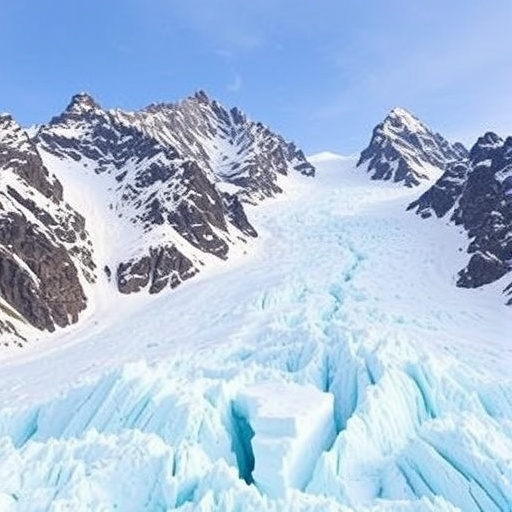
In the high alpine reaches of Wyoming’s Teton Range, a quiet underground army is holding the line against climate change while its exposed counterparts crumble at an unprecedented pace. A groundbreaking study published today in Science Advances reveals that rock glaciers—massive bodies of ice entombed beneath thick blankets of rock debris—are proving remarkably resilient to rising temperatures, even as traditional ice glaciers and perennial snowfields retreat at rates up to seven times faster than just a few decades ago. This divergence carries profound implications for mountain ecosystems, cold-water species already teetering on the edge of extinction, and the future of streamflow in the American West.
The research, spanning an extraordinary temporal sweep from 1967 to 2024, employed historical aerial photography, modern airborne lidar, and continuous stream temperature monitoring to track elevation changes across glaciers, rock glaciers, and perennial snowfields throughout the Teton Range. The results paint a stark picture of two ice worlds operating under entirely different rules. Between 2014 and 2022, exposed ice glaciers and snowfields thinned at a rate seven times greater than the baseline period of 1967 to 2014. During that same recent window, rock glaciers maintained near-perfect equilibrium, showing virtually no change in their ice mass. The insulation effect driving this stability is elegantly simple: the meter-thick debris mantle capping rock glaciers acts as a thermal shield, much like a down comforter thrown over an ice block on a scorching summer day, dramatically decelerating the transfer of atmospheric heat into the frozen core below.
This thermal protection carries cascading consequences for alpine hydrology and aquatic life. Streams originating from rock glaciers deliver reliably cold water throughout the summer melt season, creating thermal refugia for species pushed to their physiological limits by warming waters elsewhere. The stakes are acutely tangible in the Teton Range, where recent increases in meltwater temperatures have already triggered Endangered Species Act listings for bull trout and two species of stonefly. Rock glacier streams, by maintaining consistently lower temperatures, may represent a last stronghold for these organisms. The research team, which included scientists from the University of Wyoming, Utah State University, Missouri State University, Utrecht University, the Swiss Federal Institute of Technology, and Occidental College, monitored twelve streams continuously since 2015, documenting the thermal buffering capacity of rock glacier-fed systems.
The thinning acceleration observed in exposed ice glaciers aligns disturbingly well with rising summer temperatures rather than declines in winter snowfall. Lidar differencing between the two time periods isolated summer warming as the primary driver of mass loss, a finding that underscores the vulnerability of surface ice to direct atmospheric forcing. As exposed glaciers shrink and eventually vanish from individual basins, the proportional contribution of meltwater from rock glaciers is expected to rise significantly. This hydrologic regime shift carries implications beyond temperature alone, potentially altering the timing of peak streamflow, sediment delivery patterns, and nutrient dynamics that structure entire aquatic food webs from microbial communities up to apex fish predators.
Lusha Tronstad, lead invertebrate zoologist with the University of Wyoming’s Wyoming Natural Diversity Database and a co-author on the paper, has spent over a decade parsing these ecological connections. Her team’s long-term stream temperature datasets provided the biological context needed to translate geophysical ice change measurements into meaningful predictions for aquatic communities. The consistency of rock glacier stream temperatures across years of variable summer heat offers a stark contrast to the increasingly erratic thermal regimes observed downstream of surface ice sources, where summer flows now pulse warmer and more variably than at any time in the instrumental record.
The implications ripple far beyond the Tetons. Mountain ranges across temperate latitudes harbor rock glaciers in varying stages of activity, and their role as climate refugia for cold-adapted species may prove critical across the globe. The study’s lidar-based approach provides a methodological template for quantifying these dynamics in other ranges, from the European Alps to the Andes, where rock glacier meltwater sustains human communities and biodiversity hotspots alike. The research, funded by the National Science Foundation, signals a growing recognition that understanding mountain water futures requires looking beneath the surface. Ice hidden under talus and scree may outlast its photogenic glacial counterparts by centuries, fundamentally rewriting which streams run cold and which run warm as the alpine world transforms in the coming decades.
For national park managers and conservation biologists, these findings offer a sliver of actionable hope. Identifying and protecting watersheds fed predominantly by rock glaciers could maximize the return on limited conservation dollars, targeting preservation efforts toward stream reaches most likely to maintain cold-water conditions through mid-century and beyond. Grand Teton National Park physical scientists Simeon Caskey and Madeline Grubb contributed directly to the research, reflecting the park’s commitment to integrating cutting-edge cryosphere science into management planning. As the iconic surface glaciers of the Tetons continue their accelerated retreat, the quieter ice beneath the rocks may increasingly become the backbone of alpine aquatic resilience.
Subject of Research: Comparative stability of rock glaciers versus exposed ice glaciers and perennial snowfields under atmospheric warming, and implications for alpine stream thermal regimes and aquatic species persistence.
Article Title: Accelerating glacier recession contrasts rock glacier stability in a temperate mountain range
News Publication Date: 1-Jul-2026
Web References: https://www.science.org/journal/sciadv; http://dx.doi.org/10.1126/sciadv.aee5865
References: Khatiwada, A. et al. (2026) “Accelerating glacier recession contrasts rock glacier stability in a temperate mountain range,” Science Advances, DOI: 10.1126/sciadv.aee5865
Image Credits: Isabella Errigo
Keywords: Rock glaciers, glacier retreat, alpine hydrology, climate refugia, periglacial geomorphology, thermal buffering, stream ecology, cold-water species, lidar, Teton Range, Endangered Species Act, cryosphere, debris-covered ice, mountain ecosystems


