


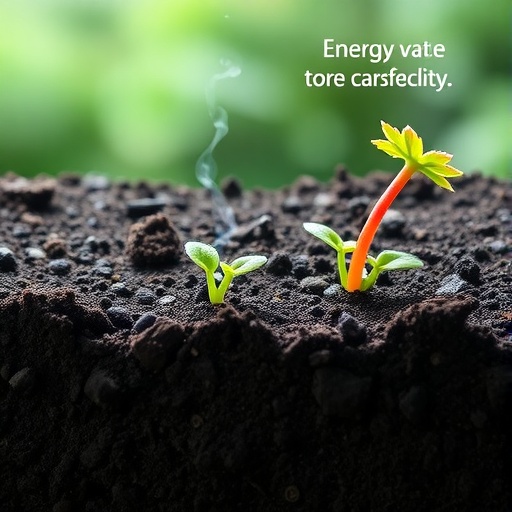
Beneath every step we take lies a universe of unimaginable abundance and profound silence. A single gram of soil can harbor billions of microbial cells, a genetic reservoir dwarfing the Amazon, and yet the vast majority of these organisms are not growing, not dividing, not even metabolizing at full tilt—they are in a state of dormancy, locked in a physiological stasis that has puzzled scientists for decades. For years, the question of why soil’s sleeping majority remains inert has been a stubborn riddle at the heart of terrestrial carbon cycling. Now, a sweeping new study published in Nature Geoscience cracks that riddle open with a thermodynamic crowbar, revealing that the answer is not a lack of food, but a lack of energy. The research, led by Chao Wang and colleagues, quantifies for the first time the global energy budget of soil microorganisms, demonstrating that the metabolic fuel obtainable from organic carbon in topsoil is so severely limited that it can support only a fraction of the microbial community in an active state, imposing a hard cap on the production of microbial necromass—the primary ingredient in the recipe for long-term soil carbon storage.
The emerging paradigm that energy limitation, rather than carbon limitation, is the dominant governor of microbial life in soil has been building momentum for years, but until now it lacked a rigorous quantitative footing at the planetary scale. The team assembled a formidable toolkit to tackle this problem: they applied scaling laws that link energy utilization to biomass growth and maintenance—principles rooted in the metabolic theory of ecology—and woven these into a mechanistic, microbial-process explicit model. They then fed this model with an immense collection of global datasets spanning soil properties, climate variables, and microbial traits, and harnessed the pattern-finding power of deep learning to map the hidden energy fluxes across Earth’s topsoil, from 0 to 30 centimeters. The headline number that emerged is as startling as it is precise: soil microorganisms can extract, on average, 37 ± 22 megajoules of energy per square meter per year by oxidizing the available organic carbon. That might sound like a significant amount of raw power, but in the currency of cellular maintenance and reproduction, it is a meager allowance.
To appreciate just how meager, one must understand what a budget of 37 megajoules per square meter per year can actually buy in the microbial economy. When the researchers translated this energy availability into the number of microbial cells that can be supported, they found that at best, only 8 ± 6 percent of the total microbial population can be in a growth state—that is, actively dividing and synthesizing new biomass. If every cell were to abandon growth and instead shift to a pure maintenance mode, where energy is spent solely on repairing leaky membranes, correcting misfolded proteins, and maintaining ion gradients just to stay alive, that same energy stream could sustain 61 ± 57 percent of the standing community. The staggering implication is that even under the most generous interpretation of metabolic frugality, at least two-fifths of the microorganisms in global topsoils are forced into dormancy by a simple lack of energy. This is not a quirk of a few biomes; the pattern proved remarkably consistent across diverse land uses, from tropical forests to temperate grasslands to agricultural fields, revealing a ubiquitous energy famine that constrains the very foundation of soil’s living engine.
The distinction between carbon and energy is subtle but critical, and it is here that the study delivers one of its most provocative insights. In soil science, carbon use efficiency—the fraction of carbon taken up by microbes that is converted into biomass rather than respired as carbon dioxide—is a holy grail parameter, widely used in Earth system models to predict soil carbon storage. The new work reveals that this metric tells only half the story. By parsing the coupled flows of carbon and energy, Wang and colleagues calculated a global mean microbial energy use efficiency of just 0.22 ± 0.02, a stark 17 percent lower than the corresponding carbon use efficiency of 0.27 ± 0.04. This thermodynamic discount reflects the fact that not all carbon substrates are created equal: a molecule of carbon can arrive at a cell’s doorstep in a richly reduced, energy-dense form or as a highly oxidized, energy-poor remnant. Microbes burn a considerable fraction of the harvested energy simply to process the carbon itself, wasting much of it as heat before a single new cell can be built, and this energetic overhead has been systematically overlooked in carbon-centric models.
Digging deeper into the thermodynamics, the study illuminates the hidden costs of cellular housekeeping. Maintenance energy is the non-negotiable metabolic bill that every cell must pay, regardless of whether it is growing or not, encompassing the thermodynamic work required to pump protons across membranes, to fight entropy, and to sustain the ordered state that is life. In the energy-starved soil environment, this maintenance demand dominates the energy ledger. The global analysis suggests that for many soil microbes, the energy income from their local patch of organic carbon barely covers, or even falls short of, the maintenance energy requirement. This creates a scenario where the only viable survival strategy is to power down into a dormant spore or a metabolically quiescent state, waiting—perhaps for centuries—for a pulse of fresh litter, a root exudate, or a rain event that temporarily lifts the energy drought. The ubiquity of this condition transforms our image of soil from a teeming, metabolically vibrant reactor into a landscape of scattered, energy-limited oases surrounded by a vast desert of starving, dormant cells.
The consequences of this energy bottleneck cascade upward to one of the most urgent issues in climate science: the fate of soil organic carbon. Soil holds roughly three times more carbon than the atmosphere, and the primary pathway by which carbon becomes stabilized in the mineral matrix is through the accumulation of microbial necromass—the dead bodies and cellular debris of microorganisms. Necromass production is directly tied to microbial growth and turnover, both of which are throttled by energy availability. If the energy obtainable from organic matter can sustain only a tiny fraction of the microbial community in a growth state, then the rate at which new necromass is formed is correspondingly capped. In essence, the study reveals a natural speed limit on the biological pump that sequesters carbon into soil, suggesting that the capacity of soils to accrue additional carbon in response to rising atmospheric CO₂ or improved land management is fundamentally constrained by this energetic ceiling.
The global mapping effort, powered by a deep neural network trained on thousands of soil profiles, paints a nuanced picture of this energy constraint across the planet. While the fundamental rule of energy limitation held everywhere, the intensity varied significantly with climate, vegetation, and soil texture. Soils under warm and moist conditions, which support rapid decomposition, often exhibited higher absolute energy fluxes but also higher maintenance demands, leaving the dormancy fraction stubbornly high. Cold and dry soils showed the lowest energy throughput, paradoxically driving even larger fractions of the community into dormancy. Agricultural soils, depleted of their organic matter by tillage and harvest, consistently fell on the most energy-poor end of the spectrum. These geographic patterns, now visible for the first time, provide a predictive framework for understanding which soils are operating closest to their theoretical energetic limits and are therefore most vulnerable to disturbances that could tip the balance from carbon sink to carbon source.
The implications for the next generation of Earth system models are profound. Currently, the vast majority of these models treat soil carbon dynamics as primarily substrate-limited, with microbial activity responding directly to the mass and quality of organic inputs. The new evidence argues forcefully that this picture is incomplete and misleading. An explicit accounting for the energy content of organic carbon, the thermodynamic efficiency of its conversion, and the maintenance energy demands of the microbial community is not a mere refinement—it is a structural necessity. Without it, models are likely to overpredict the capacity of soils to sequester carbon under elevated CO₂ or to underpredict the acceleration of carbon loss under warming, because they fail to capture the energetic handbrake on microbial growth and necromass formation. Integrating these thermodynamic principles could dramatically alter projections of the land carbon sink in a changing climate.
There is a deeper, almost philosophical lesson in these findings about the nature of life in one of Earth’s most biodiverse habitats. We are accustomed to thinking of ecosystems as limited by the scarcest nutrient—nitrogen, phosphorus, water. What the study proposes is that in the soil microbiome, the ultimate limiting resource is not a material at all, but free energy, the capacity to do work. This aligns soil ecology with the fundamental thermodynamic imperatives that govern all living systems, reminding us that every organism, from a soil bacterium to a blue whale, is a dissipative structure that must harvest energy to maintain its improbable order. The dormancy of the soil’s silent majority is therefore not a biological failure but a thermodynamic necessity, a strategy of deferred living in an environment where the flow of usable energy is chronically too weak to sustain a fully awake world.
The study’s methodological fusion is as noteworthy as its conclusions. By marrying the classical scaling laws of metabolic ecology—relationships that predict how organismal energy use scales with body size and temperature—with a mechanistic soil model, the team built a bridge between first-principles biology and large-scale Earth observation. The use of deep learning was not a black-box replacement for process understanding, but a tool to confront the model with the messy, heterogeneous reality of global soil data, estimating parameters and revealing emergent patterns that a purely theoretical approach would miss. This synthesis represents a new archetype for global ecology, one that respects the biophysical laws operating at the scale of a single cell while projecting their consequences across continents using the formidable pattern-recognition capabilities of modern artificial intelligence.
Looking ahead, the research opens a path toward a more realistic management of soil carbon as a climate solution. The energetic bottleneck suggests that simply adding more carbon to soil, through compost, cover crops, or biochar, may not translate linearly into greater carbon storage if the microbial engine lacks the energy to convert that carbon into stable necromass efficiently. Instead, strategies that increase the energy availability of the carbon already present—perhaps by alleviating other stressors like nutrient limitation or water deficit that increase maintenance costs—could yield disproportionate gains. Alternatively, fostering a microbial community with a higher intrinsic energy use efficiency, through selective management or even targeted microbiome engineering, might raise the fraction of microbes that can escape dormancy and contribute to soil organic matter building. These are speculative frontiers, but they are now anchored to a quantitative, global-scale understanding of the thermodynamic constraints that rule the soil’s hidden kingdom.
The study also sharpens a warning about the climate feedback loop that keeps carbon cycle scientists awake at night. As global temperatures rise, the maintenance energy demands of soil microorganisms will increase exponentially, following the Arrhenius-like kinetics of biochemistry. This means the same pool of organic carbon energy will sustain an even smaller active fraction of the microbial community, but those few active cells will burn through the carbon faster to meet their heightened maintenance needs, potentially releasing more CO₂. Simultaneously, the production of stabilizing necromass may decline further, as even less energy is available for growth. The research by Wang and colleagues provides the quantitative framework to predict these shifts, and the early signs are sobering: in the struggle for energy, a warmer world could turn many soils from a carbon refuge into a net source, accelerating the very warming that starves their microbial inhabitants.
In the end, the image that emerges from this work is one of a global soil system operating under a permanent energy drought, a constraint so fundamental that it shapes the very architecture of the microbial world below our feet. The silent, dormant billions are not a reservoir waiting to spring into action when conditions improve; they are a thermodynamic signature of an environment where the available free energy is barely sufficient to keep a minority of the population awake. This energy limitation, now quantified with unprecedented scope and rigor, imposes a hidden cap on the ability of soils to lock away carbon, a cap that no amount of carbon fertilization can lift without an infusion of usable energy. As humanity grapples with the twin crises of climate change and soil degradation, recognizing this energetic reality is not just a scientific advance—it is a prerequisite for any credible strategy to harness the soil’s power as a carbon sink.
Wang, C., Xue, L., Reich, P.B. et al. Limited energy for microorganisms constrains carbon accrual in soil.
Nat. Geosci. (2026). https://doi.org/10.1038/s41561-026-02035-9
Cite Scienmag News
Violet Maxwell. (July 6, 2026). Energy-starved microbes limit soil carbon storage. Scienmag. https://scienmag.com/energy-starved-microbes-limit-soil-carbon-storage/
Violet Maxwell. "Energy-starved microbes limit soil carbon storage." Scienmag, 6 July 2026, https://scienmag.com/energy-starved-microbes-limit-soil-carbon-storage/. Accessed 3 September 2026.
Violet Maxwell. "Energy-starved microbes limit soil carbon storage." Scienmag. July 6, 2026. https://scienmag.com/energy-starved-microbes-limit-soil-carbon-storage/


