


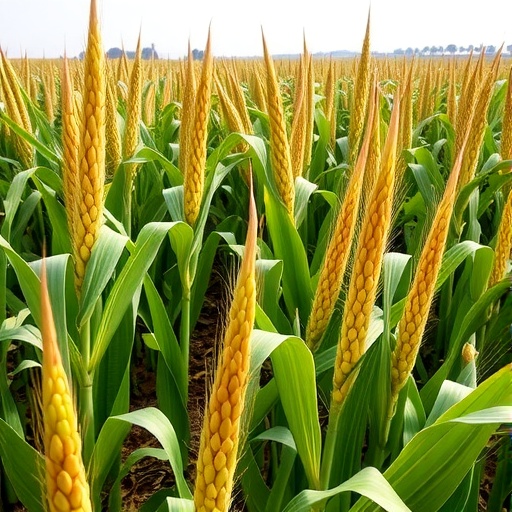
As the summer sun beats down upon the sprawling maize fields of China’s North China Plain, a hidden crisis unfolds at a microscopic scale within the tassels and silks of each plant. It is here, during the fleeting window of flowering, that the future grain yield is irrevocably determined, and it is precisely here that two relentless foes—extreme heat and insufficient water—conspire to inflict catastrophic damage. For decades, agronomists have studied these threats in isolation, quantifying how a heatwave at anthesis can desiccate pollen or how a drought can starve the developing embryo of moisture. Yet the real world does not attack crops with single stressors; it assaults them with a combination, a meteorological one-two punch that amplifies the destruction far beyond the sum of its parts. New research published in Communications Earth & Environment peels back the layers of this complex interaction, revealing that the joint probability of scorching temperatures and low soil moisture around the maize flowering stage is intensifying across China, but more importantly, it maps a lifeline: a set of precisely targeted adaptation measures that could neutralize the magnified threat and secure the nation’s food staple.
The study, led by Mingxia Huang and her team, plunges into the heart of what climate scientists term a compound event, a scenario where multiple climatic extremes coincide or occur in rapid succession, causing a synergistic impact that models of individual extremes fail to predict. In the context of maize, the flowering period represents a physiological bottleneck of supreme vulnerability. The process of pollen shedding, silk reception, and fertilization is exquisitely sensitive to environmental conditions; a mere few hours of temperatures exceeding 35 degrees Celsius can render pollen inviable, while even moderate water deficits during this window cause a dramatic failure of kernel set. When these two conditions manifest together, the soil’s parched surface amplifies the air’s temperature through reduced evaporative cooling, and the plant’s own transpiration—its natural air conditioning—shuts down as stomata close to conserve water, sending internal tissue temperatures soaring to lethal levels. The study’s groundbreaking contribution is its quantification of this amplified risk across the vast and climatically diverse maize-growing regions of China, using a sophisticated cascade of climate projections, crop models, and statistical techniques to forecast not merely hotter, drier conditions, but the specific frequency and severity of their dangerous co-occurrence at the exact moment when maize is most defenseless.
To construct their chilling projection, the researchers harnessed an ensemble of global climate models driven by the high-emission SSP5-8.5 scenario, downscaled and bias-corrected to represent the fine-scale weather patterns that govern local crop physiology. They then fed these future weather sequences into a well-validated mechanistic crop model, APSIM-Maize, which simulates the daily growth, development, and water balance of a maize plant from emergence to harvest. The team defined a compound water-heat stress index, or CWSI, which integrates the soil moisture deficit and maximum daily temperature around the flowering stage into a single, physiologically meaningful metric of peril. By running the model for decades into the future across a fine grid covering all major Chinese maize production zones, from the cool northeastern provinces of Heilongjiang to the subtropical highlands of Yunnan, they were able to map the shifting geography of risk with unprecedented granularity. The results are a clarion call: under unabated climate change, the frequency of compound stress events during flowering is projected to double or even triple in many key areas by the mid-to-late 21st century, with the amplification effect—the extra yield loss beyond what would be expected from heat and drought individually—accounting for a growing fraction of the total damage.
Digging deeper into the mechanics of the crisis, the research unveils the biochemical and biophysical cascade that makes compound stress so uniquely destructive. When a maize plant encounters drought, its immediate response is to close stomata, the tiny pores on leaves through which it takes in carbon dioxide and releases water vapor. This closure conserves water but cripples photosynthesis and, crucially, eliminates transpirational cooling, causing the leaf and reproductive tissue temperature to climb well above ambient air temperature. The heat, in turn, directly assaults the delicate proteins and membranes of the pollen grain, disrupting its mitochondrial function and its ability to produce the energy needed for tube growth. Simultaneously, the lack of water mobility within the plant halts the flow of sugars and nutrients to the developing ear, starving the nascent kernels. The study’s modeling framework effectively captures this vicious cycle, demonstrating that under a compound event, the rate of kernel abortion and the reduction in grain number per ear accelerate non-linearly, leading to harvest losses that are often 20 to 30 percent greater than those predicted by adding up the separate effects of a drought and a heatwave. This non-linearity is the fingerprint of a true compound event, and it signals that conventional risk assessments, which treat stressors independently, are dangerously underestimating the threat to China’s food security.
Against this stark backdrop, the core revelation of Huang and her colleagues shines with unexpected hope. They did not merely project doom; they subjected their virtual crops to a rigorous series of virtual adaptations, testing which interventions could effectively break the chain of cause and effect. They simulated three primary categories of adaptation: genetic, through the adoption of cultivars with shifted flowering phenology and enhanced heat and drought tolerance; management, through optimized irrigation schedules and altered sowing dates; and spatial, through a strategic relocation of maize production to emerging climatically suitable zones. Each strategy was evaluated not just for its average benefit, but for its specific ability to shave off the peaks of compound stress events. The modeling revealed that no single silver bullet exists; a blanket application of an adaptation, such as simply advancing the sowing date uniformly, proved counterproductive in some regions. Instead, the most powerful risk reductions came from a portfolio of geographically targeted measures, each precisely tuned to the local timing of the monsoon, the typical heatwave season, and the existing cultivar’s phenological pattern. This spatial precision, the team argues, is the key to unlocking resilience, transforming adaptation from a blunt instrument into a surgeon’s scalpel.
One of the most effective strategies to emerge from the simulations was the targeted shift in sowing dates, a measure that at first glance seems almost trivial but in practice requires a deep recalibration of generations of farming wisdom. In the North China Plain, for example, advancing the sowing of summer maize by one to two weeks allowed the crop to flower before the peak of the July and August heat, a seasonal window when the soil still retained residual moisture from spring rains and before the most intense drought periods set in. The model demonstrated that this simple temporal shift reduced the probability of a compound event overlapping with flowering by as much as 40 percent in some zones, by fundamentally desynchronizing the crop’s most vulnerable stage from the season’s most punishing conditions. However, the same prescription was useless or even harmful in the northeastern provinces, where an early sowing exposed seedlings to late spring frosts and failed to sufficiently advance flowering to miss the mid-summer stress because the crop’s development is slowed by the overall cooler growing season. The study underscores that the success of a phenological intervention hinges entirely on the local climate rhythm, a finding that demands a departure from nationally prescriptive agricultural extension policies towards a much more disaggregated, county-level decision-support architecture.
Complementing the temporal shift, the genetic enhancement of cultivars offered a powerful, yet nuanced, lever of control. The study modeled hypothetical maize hybrids with traits that are already on the breeding pipeline: a deeper and more efficient root system to mine subsoil moisture, an enhanced capacity for osmotic adjustment that allows cells to retain water under drought, and anthers and silks with a higher threshold temperature for protein denaturation. The most transformative trait, however, was an optimization of the flowering period’s length and its thermal time requirements. By breeding for a slightly shortened anthesis-silking interval—the critical gap between pollen shed and silk receptivity—the model plants were able to complete fertilization in a narrower window, reducing their exposure to a potential multi-day stress event. Crucially, when these improved genotypes were combined with the optimized sowing dates, the protective effect was not merely additive but synergistic, effectively locking the window of vulnerability somewhere the climate’s fingerprint was lighter. This result sends a clear message to breeding programs: rather than focusing exclusively on generic drought tolerance, an equal priority should be the precise choreography of crop development to waltz between the raindrops and around the heatwaves of a future climate.
The role of water management, unsurprisingly, proved to be a deciding factor between catastrophic failure and a near-normal harvest under compound stress. The researchers simulated several irrigation strategies, from full, non-limited application to deficit irrigation applied exclusively at the critical flowering stage. They found that even a single, precisely timed irrigation event, delivering just 30 to 40 millimeters of water at the onset of anthesis, could dramatically mitigate the compound effect. This small volume of water was not enough to fully erase the soil moisture deficit, but it was sufficient to re-hydrate the plant’s tissues, reopening stomata and reactivating transpirational cooling. The model’s biophysical equations revealed a sharp threshold: once the plant’s water potential recovered above a certain level, the lethal feedback loop of overheating was broken, and pollen viability remained largely intact even as air temperatures soared. Yet this strategy faces a harsh reckoning with the reality of groundwater depletion in the North China Plain, the very heartland of maize production. The paper thus integrates its findings with sustainability constraints, highlighting the stark choice between tapping non-renewable aquifers for a critical rescue irrigation and a more long-term strategy of shifting production to regions where water resources are more secure, a conundrum that places the research squarely in the messy intersection of science and policy.
A particularly innovative facet of the investigation was its explicit decoupling of the “amplified” effect of compound stress from the background trends of individual stressors. By running the crop model with a factorial experimental design—subjecting virtual crops to scenarios with heat alone, drought alone, and both combined—the authors could isolate the synergistic yield loss. They found that while climate change increases the raw frequency of both hot and dry days, the true thermodynamic engine of the amplification is the rise in land-atmosphere feedbacks. As soils dry, the Earth’s surface partitions more incoming solar radiation into sensible heat (warming the air) rather than latent heat (evaporating water), thereby intensifying and prolonging heatwaves. This land-atmosphere coupling is projected to strengthen in a warmer world, meaning that a dry spell will not be a co-existing but independent event alongside a hot spell, but a direct driver of a much hotter spell. Consequently, the amplified yield loss fraction mapped by the study is tightly correlated with regions where soil moisture is projected to decline most steeply, creating a hotspot map of amplified risk that traces a band across the southern part of the northeastern maize belt and deep into the North China Plain.
The granularity of the spatial analysis represents a leap forward in climate impact science. Instead of delivering a single, monolithic risk figure for “China’s maize,” the study dissects the nation into agro-ecological zones, each with its own evolving profile of stress timing and intensity. In the cool, humid northeast, the primary future threat is not a decrease in total seasonal rainfall, but a shift in its distribution, with spring droughts becoming more common just as heatwaves intensify in July, creating a novel compound event that the current maize cultivars have never experienced historically. In the arid northwest, where maize relies almost entirely on irrigation, the stress is predominantly controlled by the availability of meltwater from dwindling glaciers and the competing demands of other sectors. The study’s adaptation mapping therefore reveals a distinct prescription for each zone: for the northeast, the priority is developing chilling-tolerant cultivars that can be sown earlier to dodge the heat; for the North China Plain, it is a suite of measures including regulated deficit irrigation, water-saving ground cover, and a slow migration of the crop calendar; for the southwestern uplands, the focus shifts to stabilizing soils and breeding against the sporadic, intense droughts. This geographical differentiation is the foundation upon which a truly resilient national strategy must be built, moving away from one-size-fits-all agricultural directives.
Beyond the on-farm adaptations, the research provides a stark valuation of the cost of inaction, framing the projected yield losses in terms that resonate from the trading floor to the dinner table. By integrating the APSIM output with spatial production statistics, the team estimated that without targeted adaptation, the intensification of compound water-heat stress could reduce China’s total maize production by a double-digit percentage by the 2050s under a high-emission pathway. Such a shortfall would send shockwaves through global grain markets, given China’s position as the world’s second-largest maize producer and a major importer, inflating feed costs for the nation’s massive livestock industry and threatening the government’s grain self-sufficiency targets. The economic modeling embedded in the study suggests that every dollar invested in the targeted adaptation program—through breeding research, irrigation modernization, and extension services—would return several fold in avoided import costs and price stability. It transforms climate adaptation from an abstract environmental goal into a concrete instrument of national economic security, a framing designed to galvanize action from finance ministries and planning agencies that have historically viewed climate science as a distant, sectoral concern.
The technical modeling framework itself warrants attention, as it embodies a methodological innovation that could be replicated for other crops and regions. The researchers constructed a joint probability distribution of heat and drought conditions during the critical flowering window using a copula-based approach, which elegantly captures the dependence structure between the two variables without assuming they are independent. This statistical innovation allows for a more realistic representation of compound event frequency, avoiding the underestimation that plagues simpler models that treat extremes in isolation. They then coupled this with a crop model parameterized to reflect the specific response of Chinese maize cultivars to combined stress, validated against a network of manipulative field experiments where researchers had deliberately imposed heat and drought treatments during silking. The result is a modeling chain that is both physically grounded and computationally efficient enough to be run over large ensembles of years and climate models, providing a robust uncertainty estimate. For the first time, the error bars on future yield projections explicitly include the uncertainty arising from the representation of compound stress interactions—a critical step in honest climate risk communication.
Inevitably, the study confronts several layers of uncertainty that temper its dramatic findings with scientific humility. The climate models themselves, while state-of-the-art, struggle to reproduce the exact frequency and spatial pattern of the land-atmosphere feedback loops that drive compound heat-drought amplification, a known deficiency in global circulation models that leads to an under-dispersed representation of extreme temperature persistence. The crop model, APSIM, simplifies the intricate biochemistry of pollen thermotolerance and the dynamic root signaling that occurs under combined stress, potentially missing some acclimation mechanisms or threshold behaviors. The adaptation modeling further assumes a frictionless, rational adoption of new technologies, sidestepping the socioeconomic realities of farmer risk aversion, capital constraints, and the labyrinthine structure of China’s seed industry. To their credit, the authors transparently discuss these limitations, performing sensitivity analyses that show the qualitative message—the rising compound risk and the value of targeted adaptation—remains robust even when key parameters are varied within plausible ranges. This careful uncertainty quantification is not a weakness but a strength, allowing the study to serve as a benchmark against which future improvements in climate and crop science can be measured.
The policy implications that cascade from the research are as multifaceted as the stress itself. At a national level, the study calls for an overhaul of China’s agricultural early warning systems, which currently monitor heat and drought separately, to incorporate compound indices like the CWSI developed in the paper. Such a system could issue specific, localized alerts to farmers through the ubiquitous WeChat platform, advising them when to deploy a rescue irrigation or when the pollination window is about to close under adverse conditions, effectively providing a real-time decision cockpit for millions of maize growers. At an institutional level, the findings demand that agricultural research funding prioritize the development of maize ideotypes—model-based plant designs—that are specifically tailored to thrive not just in a warmer, drier world, but in a world where the very hot and very dry occur together more often. This means funding for high-throughput phenotyping facilities that can screen for compound stress tolerance, and for the gene-editing tools that can stack multiple protective traits into elite germplasm. For the international community, the study serves as a powerful template for assessing compound climate impacts on other staple crops such as wheat and rice, where the flowering period also governs yield, and whose geographical belts stretch across parts of South Asia and sub-Saharan Africa that are even more vulnerable to the whims of a destabilized monsoon.
At a deeper, philosophical level, the paper reframes the narrative of climate change and food security from one of passive victimhood to one of active, intelligent navigation. It rejects both the paralyzing despair of “doomism” and the complacent assumption that a gradual rise in average temperatures can be managed through gradual adjustments. Instead, it illuminates the specific, often abrupt thresholds—like the non-linear kernel abortion under compound stress—and shows that by identifying these thresholds, humanity can design interventions that operate precisely at the point of maximum leverage. The story of maize flowering becomes a metaphor for the larger human predicament: we are an exquisitely timed species, our agriculture, our cities, and our economies all choreographed to a climatic rhythm that is now being remixed. The art of survival lies not in resisting all change, but in learning the new rhythm faster than it disrupts our vital processes. Huang and her team have, in effect, composed a sheet of music—a map of the new rhythm’s stresses and a set of performance instructions for the crop—that could keep China’s maize fields singing through the storms of the coming century.
Zooming out to the global canvas, the implications of this research arrive at a moment of heightened anxiety over the resilience of the world’s breadbaskets. A synchronized failure of maize harvests in China, the United States, and Brazil due to interconnected atmospheric patterns is a scenario that keeps food security analysts awake at night, and compound events lie at the heart of such teleconnections. The North China Plain’s summer climate is increasingly linked via Rossby wave trains to heat and drought patterns in the US Midwest and the Black Sea region, meaning that a single, protracted circumglobal pattern of sinking air can simultaneously impose compound stress on multiple major growing zones. The adaptation strategies mapped in this study, while geopolitically fragmented, collectively represent a blueprint for a globally coordinated resilience effort. If China can demonstrate that modeling-driven, precision-targeted adaptation can decouple crop yields from a warming atmosphere, it will provide a proof-of-concept that could be adapted to the soybean fields of Iowa or the maize terraces of Kenya, transforming a piece of academic research into a pillar of planetary food stability.
The human dimension of the science is perhaps its most compelling undercurrent. Behind the statistical copulas and the APSIM modules lies the reality of hundreds of millions of smallholder farmers whose grandfathers and grandmothers calibrated their sowing to a lunar calendar and to the feel of the soil after a spring rain. The study’s advocacy of shifting sowing dates or switching to an unfamiliar hybrid is, in essence, a call for a massive, rapid cultural and knowledge transition in the countryside. The extension challenge is enormous: it requires not just broadcasting a message but building trust, demonstrating the counterintuitive benefits of planting earlier when a late frost might bite, and ensuring that seed supply chains can deliver the right variety to the right village at the right time. The paper does not shy away from this, acknowledging that the technical potential for adaptation is a necessary but insufficient condition; the social, economic, and institutional scaffolding must be erected just as deliberately. This honest integration of the human element elevates the work from a pure modeling exercise into a roadmap for a genuinely resilient agricultural civilization, where the science serves not to dictate from an ivory tower, but to illuminate a path that farmers can walk with confidence, guided by a shared understanding of the new atmospheric alchemy unfolding above their fields.
Huang, M., Wang, J., Wang, B. et al. Targeted adaptation options can effectively reduce amplified compound water-heat stress around maize flowering in China.
Commun Earth Environ (2026). https://doi.org/10.1038/s43247-026-03785-5
Cite Scienmag News
Alan Morgan. (July 6, 2026). Targeted adaptations reduce flowering heat-drought in China’s maize. Scienmag. https://scienmag.com/targeted-adaptations-reduce-flowering-heat-drought-in-chinas-maize/
Alan Morgan. "Targeted adaptations reduce flowering heat-drought in China’s maize." Scienmag, 6 July 2026, https://scienmag.com/targeted-adaptations-reduce-flowering-heat-drought-in-chinas-maize/. Accessed 4 September 2026.
Alan Morgan. "Targeted adaptations reduce flowering heat-drought in China’s maize." Scienmag. July 6, 2026. https://scienmag.com/targeted-adaptations-reduce-flowering-heat-drought-in-chinas-maize/


