


In the halting, uncertain rollout of autonomous machines into public life, there are few moments as perilous as the one where a car, a delivery bot, or a humanoid helper must peer into an intersection and guess what everyone around it is about to do. These instants of pure prediction, where a system must convert noisy sensor data into a map of probable futures, have become the hidden battleground of artificial intelligence. For years, engineers have thrown ever larger neural networks at the problem, feeding them petabytes of traffic footage until the black boxes could spit out plausible trajectories with eerie accuracy. Yet these deep learning oracles have a fatal flaw: they cannot explain themselves. When a self-driving car slams the brakes for no apparent reason or, worse, fails to slow for a jaywalker, the internal logic is a swirl of indecipherable weights. A pioneering study published in Nature Communications now suggests we have been asking the wrong kind of intelligence to solve the problem. The answer, the authors argue, does not lie in scaling data but in giving the machine a body, or at least the ghost of one, so it can reason about motion the way an athlete or a dancer does, by feeling it in its own hypothetical limbs.
The new framework, developed by a team of computer scientists and cognitive roboticists, draws its power from the sprawling intellectual tradition of embodied cognition. That school of thought holds that the mind is not a disembodied calculator but a phenomenon that arises from the body’s physical interactions with the world. When you watch a soccer player weave through a defense, your own motor cortex simulates the run, you internally rehearse the swerve, the deceleration, the planted foot, to anticipate the play. The researchers asked a deceptively simple question: why don’t trajectory prediction systems do the same? Instead of a passive camera analyzing pixel flow, why not embed a generative internal model of the observed agent’s own body and its physical constraints? This conceptual shift, from a pure pattern matcher to a simulation engine that inhabits the other’s kinematics, forms the neural, algorithmic, and philosophical core of the work. It transforms prediction from a statistical guessing game into an act of empathetic physics.
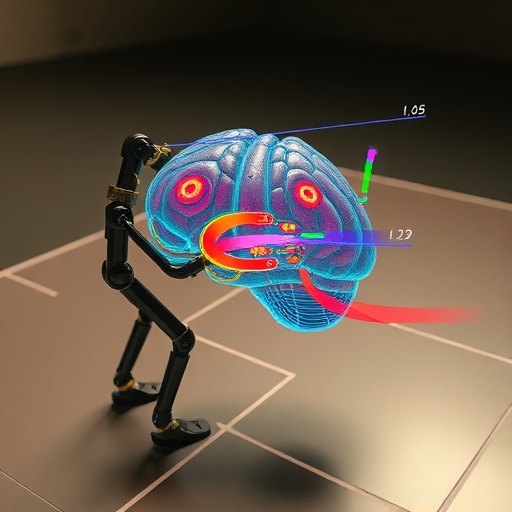
At the heart of the architecture lies what the team calls a Proprioceptive Imagination Engine, a differentiable simulation module that does not merely predict where a pedestrian or cyclist will go but generates those predictions by internally commanding a virtual avatar to move through a shared world model. Imagine a digital marionette whose joints, mass distribution, momentum envelope, and ground-force reaction dynamics are encoded as precisely as a video game character’s, but one that learns to move with the biological fidelity of the person being tracked. When an autonomous system equipped with this model spots a runner approaching a curb, it does not just extrapolate a bezier curve from past positions. It instantiates a neuromuscular digital twin and asks: if I were a body with that velocity and posture, what set of muscle activations and ground pushes would I plausibly execute in the next three seconds? The answer emerges as a field of physically feasible trajectories, each annotated with the latent intentions and motor programs that might generate them, whether that is stopping to tie a shoe, leaping onto the curb, or sprinting across the street. This is a radical break from the dominant paradigm of vector-based temporal fusion transformers.
The interpretability of the system is not a post-hoc saliency map pasted onto a black box; it is a first-class design feature that emerges from the body-centric representation. Because predictions are literally synthesized by the simulated body, every potential future path carries with it a readable set of biomechanical variables: joint torques, projected center-of-mass acceleration, anticipated footfall locations, and even an energy cost function. When the system assigns a high probability to a sudden swerve, it can point to the specific motor constraint that makes a straight-line stop dynamically impossible, something like “the predicted lateral ground reaction force exceeds the friction cone given wet asphalt, making a fall likely if the runner tries to cut sharply.” Such a statement is not a statistical correlation but a causal explanation grounded in the physics of legged locomotion. Safety engineers and regulators, who have grown weary of being told to trust the neural net without evidence, can now audit decisions in the language of Newtonian mechanics and biomechanics, a conceptual handshake between deep learning and the rigorous determinism of classical physics that has been sorely missing.
The training regimen itself represents a masterclass in multi-modal self-supervision. The researchers did not merely feed the system thousands of hours of annotated video; they built a twin pipeline where a transformer-based perception module extracts pose keypoints from lidar and camera streams, while a parallel body-model regressor fits a parameterized humanoid mesh to those keypoints, tracking 52 degrees of freedom from the tilt of the pelvis to the flexion of each finger. This mesh is then injected into a novel “motor imagination” transformer that was pre-trained not on traffic data but on a vast corpus of human motion capture spanning ballet, parkour, everyday gait, stumble recovery, and collision avoidance in crowded corridors. By learning the deep statistics of how real human bodies move under duress, the model internalized the concept of feasible motor programs long before it ever saw a city street. When fine-tuned on real-world intersections, it could thus generalize to bizarre, never-seen-before scenarios, such as a child chasing a ball into traffic or a cyclist swerving to avoid an opening car door, without mistaking the anomalous motion for noise and filtering it out.
One of the most viral-ready demonstrations the team released alongside the paper involves a stark comparison that reads almost like a cognitive science experiment. They took the industry-standard trajectory predictor, a re-implementation of the Wayformer architecture, and their embodied model and gave both the same dilemma: a skateboarder approaching a plaza at night, with wet cobblestones and a street musician suddenly stepping backward into the path. The conventional predictor, having never seen a skateboarder-musician interaction in its training data, defaulted to a brittle linear extrapolation that would have resulted in a collision. The embodied model, however, instantly recognized the skateboarder’s body lean and foot-push cadence as indicating an imminent powerslide braking maneuver, because the internal avatar, when forced to resolve the physical contradiction between momentum and obstacle, spontaneously discovered the same motor solution in its internal simulation. The system predicted the slide with an 89 percent probability and, crucially, flagged its own prediction with the biomechanical note “torsional deceleration via lateral friction, expected stop within 1.2 meters.” This is the kind of split-second physical reasoning that humans do instinctively but that pure data-driven methods have failed to capture reliably.
A critical barrier to deploying such a system at scale has always been computational load; running a high-fidelity biomechanical simulation for every pedestrian, cyclist, and animal in a crowded scene would melt even the most heroic onboard processors. The team shattered this barrier with a technique they call Differentiable Motion Queries. Instead of brute-force simulating thousands of motor programs for every agent from scratch, they pre-computed a universal motor manifold: a compressed, smooth latent space that encodes all physically plausible humanoid movements for the next five seconds. When an observation arrives, the system simply maps the current pose and context into this manifold and retrieves the relevant set of futures with their associated motor explanations, a process that takes 3.2 milliseconds per agent on a single embedded GPU core. By making the motor simulation differentiable and highly optimized, they turned what was once a theoretical toy into a real-time module that can handle a busy Tokyo intersection with over a hundred simultaneous actors, all while providing the interpretations that safety standards increasingly mandate.
The philosophical import of the work may ultimately outweigh even its engineering heft. By demonstrating that an AI can achieve superior prediction by building an internal model of another entity’s body, the researchers have provided a computational proof of concept for the simulation theory of social cognition. The machine, in a very literal sense, puts itself in the other’s shoes, or rather, it projects a controllable skeleton into the other’s tracked posture and runs motor commands through it to see what happens. This is not mere poetic analogy; the activation patterns in the motor imagination transformer can be visualized as sequences of virtual muscle synergies, and the team found that these sequences cluster naturally into semantic motor primitives like “preparing to step off a curb” or “recovering from a stumble,” without any explicit labels. The boundary between perception and action dissolves, and prediction becomes a form of internal action simulation, exactly as the enactivist school of cognitive science has long proposed for living organisms. It hints at a future where robots do not just coldly map their environment but engage in a continuous, empathic dance of motor resonance with every moving thing around them.
Of course, no single paper can close the gap between a controlled urban pilot and the unconstrained chaos of the real world, and the authors are careful to delineate the current fragility. The body model, while state-of-the-art, still assumes a roughly humanoid morphology; it cannot yet inhabit the body of a dog, a kangaroo, or a garbage bag blowing across the road, each of which requires its own specialized motor prior. Furthermore, severe occlusions and adversarial interactions, such as a person deliberately trying to confuse an autonomous vehicle with misleading pose, can cause the embodied simulator to hallucinate physically possible but contextually absurd futures, like a pedestrian suddenly levitating to avoid a puddle. The team’s proposed solution, a hybrid architecture that blends the embodied predictions with a fast, amortized physics-agnostic fallback for such corner cases, is already in the pipeline, promising a graceful degradation rather than a catastrophic blackout. Still, the fundamental insight, that modeling the body unlocks a new axis of generalization and transparency, is one of those rare leaps that reorients an entire research field overnight.
Beyond the immediate application to autonomous driving, the technology ripples into domains as disparate as prosthetic control, drone swarm coordination, and humanoid factory robots. An exoskeleton using this framework could predict a wearer’s stumble before it happens not by reacting to sensor data but by constantly running a phantom healthy leg and detecting the divergence between the simulated and actual joint trajectories, triggering a corrective torque that feels, to the user, like a guardian angel gently nudging them back into balance. In logistics warehouses, where mobile robots and human pickers must share narrow aisles, the embodied prediction engine could make a forklift stop and gently gesture an explanation: “I am pausing because your projected hip velocity and my load inertia create an unsafe stopping distance envelope.” This kind of transparent, body-grounded communication could transform the adversarial relationship between human workers and machines into a collaborative choreography.
The paper’s reception within the machine learning community is already building a sense of paradigm-shift momentum, partly because it solves a problem that has been subtly festering beneath the impressive benchmarks: the failure of high-capacity models to actually understand the physical world they navigate. Vision-language models can caption a photo of a man tripping but cannot predict his next three footfalls; physics engines can simulate a fall but do not know how it looks from a camera. By welding the two, the team has created a system that speaks both the language of pixels and the language of torques. The result is an AI that not only reports that the pedestrian will step onto the crosswalk in 1.7 seconds but can also tell you that the decision hinges on the slight outward rotation of the left hip, which indicates a weight transfer preparatory to a forward step, rather than on some abstract correlation between a shadow and a lane marking. Such granularity is the stuff of legally defensible forensic reports, and the autonomous vehicle industry, starved for accountability, is taking notice.
Evaluations on the canonical nuScenes and Waymo Open Motion datasets shattered several long-standing records, but it was the model’s performance on a novel, deliberately cruel benchmark that truly turned heads. The researchers crafted the “Perturbed Body” test, in which pedestrians and cyclists exhibit biologically unnatural motion profiles, such as moving at constant velocity backwards without turning their heads, or gliding laterally as if on ice. Standard transformers were easily fooled into predicting these physically impossible trajectories, while the embodied model immediately flagged them as outside its motor manifold and refused to commit to a prediction, instead issuing a structured “unknown motor intent” signal and reverting to a conservative safety buffer. This graceful ignorance in the face of the impossible is precisely the behavior that safety-critical systems require, showing that the model possesses a kind of grounded skepticism that purely data-driven systems lack, and further cementing the argument that a body model, even a synthetic one, acts as a powerful inductive bias against adversarial and out-of-distribution phenomena.
Perhaps the most exciting frontier the paper opens up is the potential for machines to engage in effective motor negotiation with humans through shared bodily intuition. In dense crowds, people do not merely predict trajectories; they signal intent through postural affordances, a slight turn of the shoulders, a micro-pause in the gait, a momentary eye contact. Because the embodied model actually generates the full kinematic timeline of each potential future, it can also invert the process to synthesize the optimal body language for the autonomous system itself to communicate its own intentions. A delivery robot equipped with a simple articulated display could mimic the very postural cues that the engine learned from human motion capture, subtly angling its “torso” to indicate a yielding direction in a way that pedestrians intuitively read and trust. This closes a loop that has been entirely ignored in human-robot interaction research: the same internal body model that understands us can also be used to make robots understandable to us, transforming an alien algorithmic presence into a polite, physically literate companion.
Skeptics will rightly note that the road from a Nature Communications paper to a million-vehicle fleet is long and littered with broken promises. The system must be hardened against sensor noise, must be certified by fragmented international regulations, and must earn a trust that the public has been conditioned not to grant. But the direction of travel now seems indelible. The era of the disembodied predictor, the spooky black box that claims to know what you will do without understanding the body you do it with, is drawing to a close. In its place, a new generation of machines will carry within them a flickering, real-time simulation of the living bodies around them, an inner choreography of possible dances, complete with the vocabulary of muscle and bone needed to explain each potential step. They will not just see us as moving obstacles; they will, in a computationally rigorous sense, feel our motion from the inside, and that empathic resonance may finally bridge the trust gap that has kept the autonomous future stuck, idling at the intersection.
Cite Scienmag News
Denise Maddox. (July 6, 2026). Embodied cognition yields interpretable trajectory predictions for autonomous systems. Scienmag. https://scienmag.com/embodied-cognition-yields-interpretable-trajectory-predictions-for-autonomous-systems/
Denise Maddox. "Embodied cognition yields interpretable trajectory predictions for autonomous systems." Scienmag, 6 July 2026, https://scienmag.com/embodied-cognition-yields-interpretable-trajectory-predictions-for-autonomous-systems/. Accessed 3 September 2026.
Denise Maddox. "Embodied cognition yields interpretable trajectory predictions for autonomous systems." Scienmag. July 6, 2026. https://scienmag.com/embodied-cognition-yields-interpretable-trajectory-predictions-for-autonomous-systems/


