


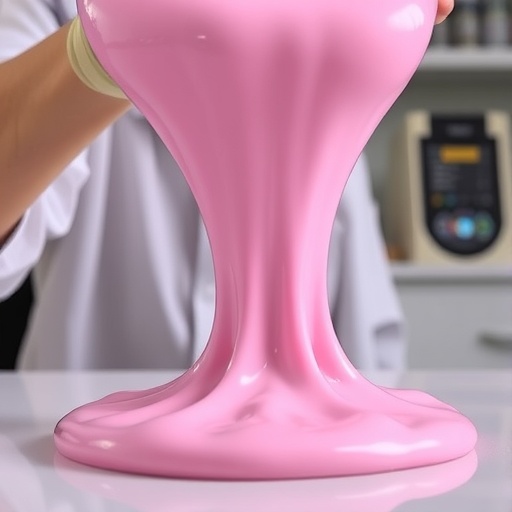
For centuries, the concept of viscosity has been a cornerstone of physical science, quantifying how easily a fluid deforms under stress. We experience it daily: water pours swiftly with a viscosity of roughly one millipascal-second, honey oozes lazily at about ten pascal-seconds, and cold tar seems almost solid. Yet hidden in these everyday comparisons is a profound question that physicists and geoscientists have largely sidestepped: is there a natural ceiling to viscosity, a value beyond which a material simply ceases to flow on any timescale that matters? A new study published in Physics of Fluids on June 29, 2026, takes a daring step toward answering that question by turning the Earth itself into a giant rheometer. Through a fusion of satellite geodesy, laboratory rock-squeezing experiments, and massive supercomputer simulations, the research proposes that the upper bound of geophysically meaningful viscosity is a staggering 10³⁰±² pascal-seconds, a threshold that redefines the very boundary between a deformable fluid and an effectively rigid solid.
The investigation, led by Professor Masaki Yoshida from the Department of Physical Sciences at Ritsumeikan University in Japan, begins with a deceptively simple premise: if viscosity is the measure of a material’s resistance to flow, then the highest meaningful viscosity must be one at which flow is just barely detectable over the longest available observational timescales. For a human observer, those timescales might be seconds, days, or years. But Earth’s interior offers a far grander clock, with geological processes that stretch across millions and even billions of years. The stable cores of continents, known as cratons, have remained essentially undeformed for more than two billion years. Post-glacial rebound, where the ground slowly rises after the removal of massive ice sheets, reveals effective viscosities in the underlying mantle of around 10²¹ to 10²⁴ Pa·s. By contrast, the stiff lithospheric plates that raft across the planet’s surface can be ten to a hundred times more viscous. These measurements, gathered from GPS networks and satellite radar interferometry, provide the first independent pillar of evidence: some portions of the Earth exhibit effective viscosities that already push toward 10²⁴ Pa·s and likely far higher.
To determine whether still greater viscosities are physically plausible, Professor Yoshida turned to the second pillar: laboratory-derived flow laws for the major rock-forming minerals that constitute the entire silicate Earth. Researchers have spent decades squeezing millimeter-sized cylinders of olivine, clinopyroxene, diopside, anorthite, and quartz inside high-pressure, high-temperature apparatuses that mimic conditions from the crust to the deep upper mantle. These experiments measure how the minerals creep and flow under differential stress, yielding constitutive equations that link strain rate to stress, temperature, pressure, and grain size. Extrapolating these laws to the relatively low stresses and low temperatures of the stiffest lithosphere—where the heat flow is minimal and the confining pressure immense—gives predicted effective viscosities that can soar beyond the measurement range of any conceivable laboratory experiment. The mineral-physics calculations point to values as high as 10²⁸ to 10³² Pa·s for the strongest, coldest minerals, converging on the same rarefied regime suggested by the geodetic data but now grounded in the fundamental atomic-scale physics of crystal lattice deformation.
The third line of evidence comes from numerical simulations of mantle convection and plate subduction that incorporate visco-elasto-brittle rheology, a set of equations that allows the same material to behave as a viscous fluid at high temperature, an elastic solid under short-duration loads, and a brittle substance that fractures when stresses exceed a threshold. These models solve the coupled partial differential equations of momentum, mass, and energy conservation on grids spanning hundreds of millions of cells, tracking how stiff oceanic plates bend, descend into the mantle, and eventually soften. By gradually increasing the maximum permitted viscosity in the simulations and observing when plate-like behavior breaks down, the team found that a ceiling between 10²⁸ and 10³² Pa·s produced the most Earth-like surface dynamics. If the viscosity cap was set too high, the lithosphere became so rigid that subduction could not initiate; set too low, and the plates would sag and drip away. That narrow window of geodynamic consistency aligns remarkably well with the inferences from geodesy and mineral physics, forming a three-way intersection that is extraordinarily unlikely to be mere coincidence.
The number that emerges from this convergence—10³⁰±² Pa·s—is almost impossible to grasp intuitively. One pascal-second is already a respectable viscosity; the mantle under the volcanic arcs churns at about 10¹⁹ Pa·s, meaning it flows a million billion times more slowly than liquid water. A material with a viscosity of 10³⁰ Pa·s is a further hundred billion times more resistant to flow than the already viscous mid-mantle. To put that in perspective, if you were to take a one-centimeter cube of such a substance and apply a shear stress equal to the crushing pressure at the base of the continental crust—roughly one gigapascal—the cube would deform at a strain rate so minuscule that it would take more than a trillion times the current age of the universe to accumulate a displacement of just one nanometer. Over the entire 4.6-billion-year history of our planet, the total accumulated viscous strain would amount to less than the width of an atom, effectively zero. This is not just a slow flow; it is a complete cessation of flow for all practical, and indeed all cosmologically relevant, purposes.
Professor Yoshida’s study emphasizes that this bound is not an abstract mathematical curiosity but a direct consequence of the physical definition of viscosity as a property measured over finite time. Every viscoelastic material possesses a characteristic timescale known as the Maxwell relaxation time, defined as the ratio of its viscosity to its elastic shear modulus. For typical rocks with a shear modulus of around 30 GPa, a viscosity of 10³⁰ Pa·s yields a Maxwell time of roughly 10¹¹ billion years, more than twenty times the age of the universe. When the observational or tectonic timescale is vastly shorter than the Maxwell time, the material stores elastic strain like a spring and fractures if stressed beyond its yield point, rather than flowing. In this regime, treating the material as an ideal solid with an infinite viscosity not only simplifies the mathematics but accurately captures the physics. The key insight is that “effectively rigid” does not require infinite viscosity; it merely requires a viscosity high enough that the Maxwell relaxation time astronomically exceeds the window of interest.
One of the most provocative implications of this work is that it reframes the classic solid–fluid dichotomy as a timescale-dependent continuum. At room temperature, window glass has a viscosity on the order of 10¹⁸ to 10²¹ Pa·s, which is high enough that old medieval windows are indeed measurably thicker at the bottom—but only if one waits a millennium. Extrapolate that logic to geological timescales, and mantle periodotite, often depicted as a slow-moving fluid, transforms into an effectively rigid solid when it is cold and thick enough. The study therefore provides a quantitative criterion for when a geodynamicist can legitimately approximate a lithospheric block as a rigid plate and when they must treat it as a power-law fluid. It also suggests that the search for a theoretical infinite viscosity is misguided; nature does not need infinities. It simply needs a number large enough to make the next increment irrelevant, and 10³⁰±² Pa·s appears to be that number for the Earth system.
The ramifications extend well beyond the geosciences. The general framework of a practical upper bound for viscosity could influence how physicists think about the glass transition, a notoriously tricky phenomenon where a supercooled liquid becomes so viscous that its structural relaxation time diverges toward laboratory timescales. If a similar concept applies, then the “ideal glass” state might be understood not as one of truly infinite relaxation time but as a condition where the relaxation time crosses a threshold beyond which the material is effectively frozen on human timescales. Engineers working with high-performance polymers, metallic glasses, or even dense colloidal suspensions may find the geophysical perspective useful when modeling creep and delayed fracture. By borrowing the Earth’s natural experiment, material scientists gain a data point at viscosity extremes that no laboratory instrument can reach. The study thus bridges the chasm between slow geodynamics and fast laboratory rheology, providing a Rosetta stone for translating viscous behavior across more than thirty orders of magnitude in timescale.
Digging deeper into the methodology, the synthesis of independent approaches is the study’s true backbone. The geodetic constraints came from global databases of crustal motion, including measurements of glacial isostatic adjustment in Fennoscandia and North America, which constrain mantle viscosity down to about 200 km depth. Seismic tomography provided temperature estimates that feed into the flow-law extrapolations. For the mineral physics leg, Professor Yoshida compiled flow-law parameters from dozens of published experiments, rigorously propagating uncertainties in activation energy, stress exponent, and water fugacity. The simulations, run on Japan’s flagship supercomputers, used a finite-difference code with Lagrangian tracers to track deformation history and incorporated a pseudo-plastic yielding mechanism to allow for brittle faulting. By systematically varying the numerical viscosity cap from 10²⁶ to 10³⁶ Pa·s, the team could identify the threshold where the model lithosphere’s effective flexural rigidity and subduction angle matched observations. Only the range 10²⁸–10³² Pa·s satisfied all three data streams simultaneously, an impressive triangulation.
An especially elegant aspect of the study is how it handles the concept of “effective rigidity” without invoking infinite numbers. In many textbook treatments, rigid bodies are assigned an infinite Young’s modulus or an infinite viscosity, a convenient fiction that breaks down when one asks how the body can transmit forces or bend under its own weight over geological time. By demonstrating that a viscosity of 10³⁰ Pa·s produces strains so small that no instrument on Earth could ever detect them, Yoshida effectively replaces the fiction of infinity with a finite, physically derived ceiling that has true predictive power. For instance, the study calculates that for a 100-km-thick lithospheric plate, the bending strain accumulated over one billion years under its own weight is on the order of 10⁻¹⁶, which is utterly negligible. This approach may influence how textbooks and numerical models treat the boundary conditions between fluid and solid domains, offering a rigorous cutoff grounded in observable physics rather than mathematical convenience.
The broader cultural resonance of such a finding should not be underestimated. In an era where the public is increasingly fascinated by Earth’s interior, from the future of plate tectonics to the habitability of exoplanets, the idea that there is a definitive “stiffness ceiling” for rock is inherently viral. It touches on deep, almost philosophical questions: What does it mean for a material to be solid? Can something be called a fluid if it has not flowed since before the Solar System formed? The study invites readers to reconsider the ground beneath their feet not as a static stage but as an incredibly slow-motion drama in which every grain of the lithosphere participates, even if only a handful of atoms have shifted relative positions in the entire span of life’s existence on Earth. By quantifying that slowness with a concrete number, the research anchors the sublime vastness of geological time to a tangible physical property.
Looking ahead, the proposed upper bound will likely spark a wave of follow-up studies. Planetary geophysicists might ask whether colder, one-plate planets like Mars or the Moon exhibit even higher effective viscosities in their stagnant lids, and whether the concept of a maximum viscosity helps explain the preservation of ancient impact basins. Exoplanet modelers could incorporate the viscosity ceiling into simulations of mantle convection on super-Earths, where extreme pressures might push the cold-surface viscosity even closer to the bound. On the experimental side, advances in high-pressure diamond-anvil cell techniques combined with synchrotron X-ray diffraction may eventually push the measurable strain-rate window low enough to directly test the flow laws at conditions approaching those of the stiff lithosphere, bringing the laboratory and field estimates into closer alignment. Professor Yoshida’s work thus sets a new benchmark and a clear target for a generation of cross-disciplinary research.
In the end, the story of the ultimate viscosity is also a story about the ingenuity of scientific inference. No one can measure a 10³⁰ Pa·s material directly; the required experiment would run for longer than the universe has existed. Yet by weaving together the slow whispers of GPS antennas, the microscopic creep of crushed crystals, and the digital dance of billions of simulated particles, science has triangulated a number that might otherwise have remained forever beyond reach. It is a testament to the power of consilience—the agreement of independent lines of evidence—that such an elusive property can be pinned down with confidence. The Earth, vast and ancient, has quietly conducted the experiment for us, and we are just now learning how to read its results. The next time you stand on ancient bedrock, you will do so with the knowledge that you are touching a material whose viscosity is so colossal that the last time it rearranged itself by even an atom’s width, trilobites may still have been crawling in the seas. And yet, given another few billion years, it would, in theory, still yield to the gentle insistence of gravity, proving that even the most rigid mountains are merely fluids on an unimaginably extended clock.
Cite Scienmag News
Violet Maxwell. (July 6, 2026). The Ultimate Goo: Scientist Calculates a Practical Maximum for How Thick Liquids Can Get. Scienmag. https://scienmag.com/the-ultimate-goo-scientist-calculates-a-practical-maximum-for-how-thick-liquids-can-get/
Violet Maxwell. "The Ultimate Goo: Scientist Calculates a Practical Maximum for How Thick Liquids Can Get." Scienmag, 6 July 2026, https://scienmag.com/the-ultimate-goo-scientist-calculates-a-practical-maximum-for-how-thick-liquids-can-get/. Accessed 4 September 2026.
Violet Maxwell. "The Ultimate Goo: Scientist Calculates a Practical Maximum for How Thick Liquids Can Get." Scienmag. July 6, 2026. https://scienmag.com/the-ultimate-goo-scientist-calculates-a-practical-maximum-for-how-thick-liquids-can-get/


